Things To Do with a Hundred Chart #30

100chartpuzzle

Here’s one more entry for my 20+ Things to Do with a Hundred Chart post, thanks to David Radcliffe in the comments on Monday’s post:

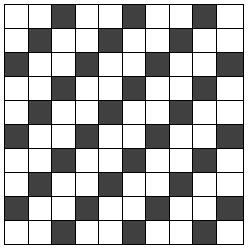
(30) Can you mark ten squares Sudoku-style, so that no two squares share the same row or column? Add up the numbers to get your score. Then try to find a different set of ten Sudoku-style squares. What do you notice? What do you wonder?
[Suggested by David Radcliffe.]

Share Your Ideas

Can you think of anything else we might do with a hundred chart? Add your ideas in the Comments section below, and I’ll add the best ones to our master list.

Things To Do with a Hundred Chart #29

100chart puzzle

Here’s a new entry for my 20+ Things to Do with a Hundred Chart post:

(29) Blank 100 Grid Number Investigations: Challenge your students to deduce the secret behind each pattern of shaded squares. Then have them make up pattern puzzles of their own.
[Created by Stuart Kay. Free registration required to download pdf printable.]

Share Your Ideas

Can you think of anything else we might do with a hundred chart? Add your ideas in the Comments section below, and I’ll add the best ones to our master list.

Maze Game: Land or Water?

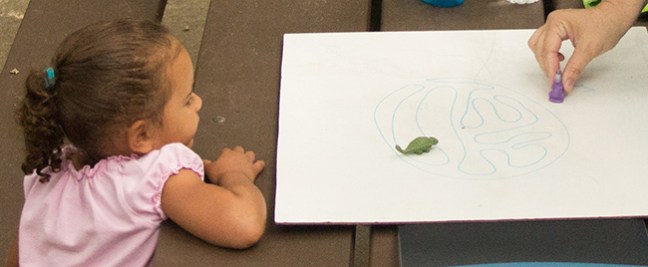
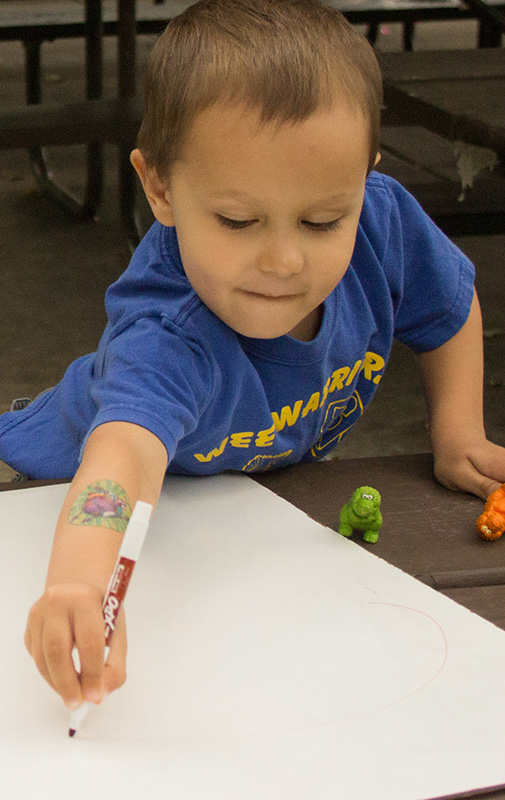
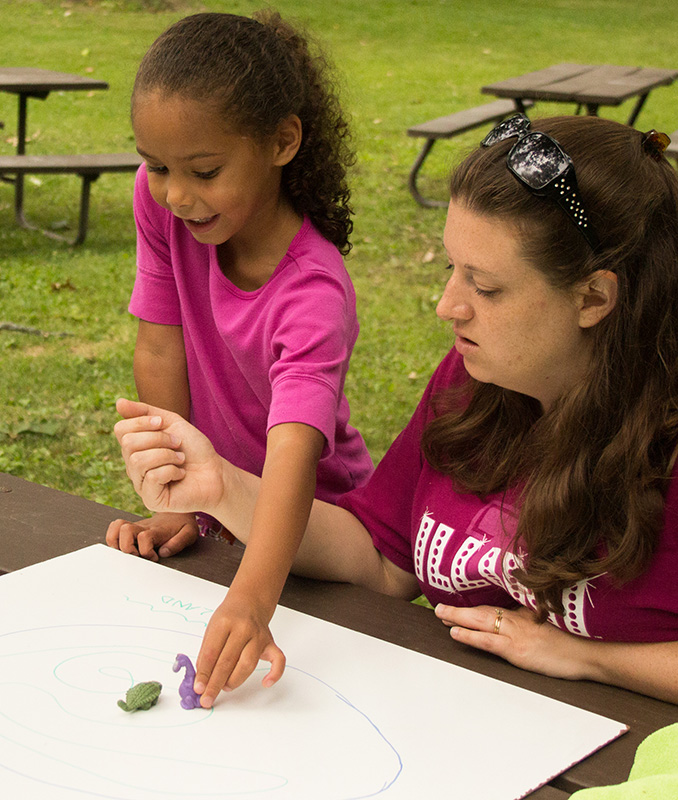
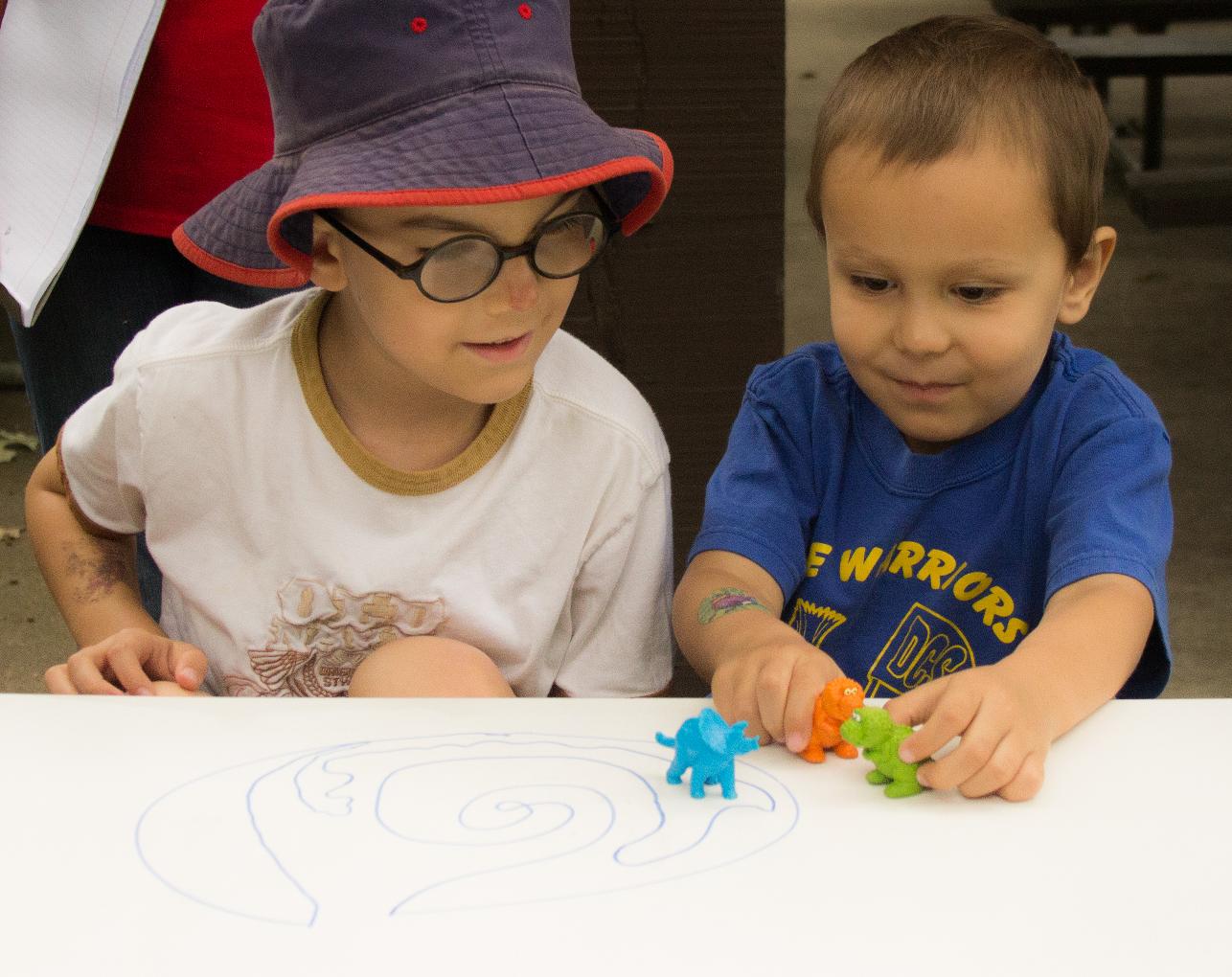
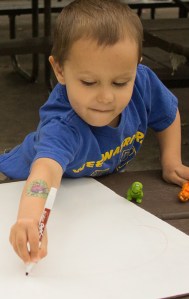
This was a fun activity from Moebius Noodles for our PK-1st grade Homeschool Math in the Park group. The children take turns making a maze and setting a dinosaur inside. Then the other dinosaurs (parents or siblings) try to guess whether their friend is on the land or in the water.
Draw the maze

Player #1

(1) First, draw a big circle on the white board. This is your lake.

(2) With a finger or a bit of cloth, erase a small section of the circle to create the opening for your maze.

(3) Starting at one edge of the opening, draw a random squiggle inside the circle. Make your squiggle end at the other edge of the opening.
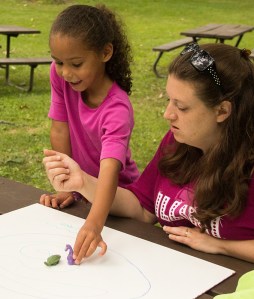
Looks like Land

(4) Set your dinosaur anywhere inside the maze.

Player #2

(1) Now it’s your turn to guess. Is the dinosaur standing on the land? Is it swimming in the water?

(2) How will you figure out if you guessed right?

(3) Check by jumping across the lines of the maze. Each jump takes you across a boundary: Splash! (Into the water.) Thump! (Back on the land.) Splash! Thump! … Until you reach the dinosaur inside.

(4) Or go to the maze entrance and walk your dinosaur along the path. Can you find your way?
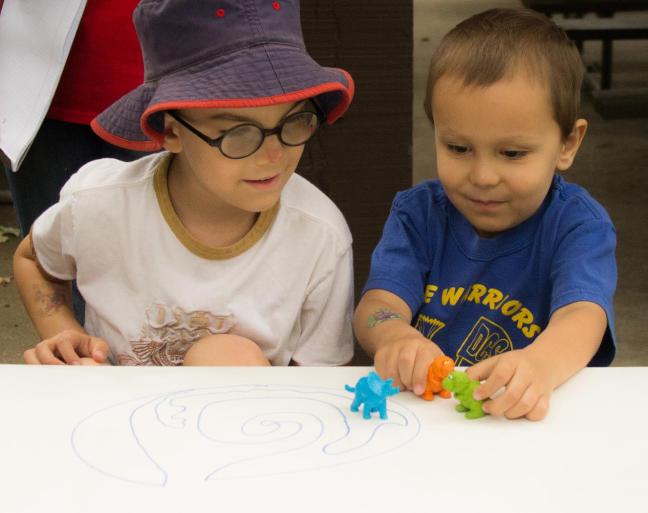
land or water

 
* * *

This blog is reader-supported.

If you’d like to help fund the blog on an on-going basis, then please join me on Patreon for mathy inspiration, tips, and an ever-growing archive of printable activities.

If you liked this post, and want to show your one-time appreciation, the place to do that is PayPal: paypal.me/DeniseGaskinsMath. If you go that route, please include your email address in the notes section, so I can say thank you.

Which I am going to say right now. Thank you!

“Maze Game: Land or Water?” copyright © 2013 by Denise Gaskins. All photos copyright © Denise Gaskins.
Parents, Teachers: Learn about Teaching Decimals

Many children are confused by decimals. They are convinced 0.48 > 0.6 because 48 is obviously ever so much bigger than 6. Their intuition tells them 0.2 × 0.3 = 0.6 has the clear ring of truth. And they confidently assert that, if you want to multiply a decimal number by 10, all you have to do is add a zero at the end.

What can we do to help our kids understand decimals?

Christopher Danielson (author of Talking Math with Your Kids) will be hosting the Triangleman Decimal Institute, a free, in-depth, online chat for “everyone involved in children’s learning of decimals.” The Institute starts tomorrow, September 30 (sorry for the short notice!), but you can join in the discussion at any time:

Past discussions stay open, so feel free to jump into the course whenever you can. Here is the schedule of “classes”:

Click here to see the TDI topic list →

Talking Math with Your Kids

Danielson-Talking Math

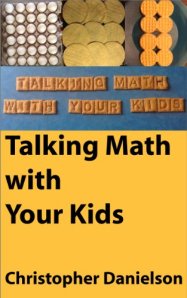
Christopher Danielson, one of my favorite math bloggers, has a new book out that is perfect for parents of preschool and elementary-age children:

It’s a short book with plenty of great stories, advice, and conversation-starters. While Danielson writes directly to parents, the book will also interest grandparents, aunts & uncles, teachers, and anyone else who wants to help children notice and think about math in daily life.

“You don’t need special skills to do this. If you can read with your kids, then you can talk math with them. You can support and encourage their developing mathematical minds.
 
“You don’t need to love math. You don’t need to have been particularly successful in school mathematics. You just need to notice when your children are being curious about math, and you need some ideas for turning that curiosity into a conversation.
 
“In nearly all circumstances, our conversations grow organically out of our everyday activity. We have not scheduled “talking math time” in our household. Instead, we talk about these things when it seems natural to do so, when the things we are doing (reading books, making lunch, riding in the car, etc) bump up against important mathematical ideas.
 
“The dialogues in this book are intended to open your eyes to these opportunities in your own family’s life.”

— Christopher Danielson
Talking Math with Your Kids

 
* * *

This blog is reader-supported.

If you’d like to help fund the blog on an on-going basis, then please join me on Patreon for mathy inspiration, tips, and an ever-growing archive of printable activities.

If you liked this post, and want to show your one-time appreciation, the place to do that is PayPal: paypal.me/DeniseGaskinsMath. If you go that route, please include your email address in the notes section, so I can say thank you.

Which I am going to say right now. Thank you!

“Talking Math with Your Kids” copyright © 2013 by Denise Gaskins.

Quotable: Learning the Math Facts

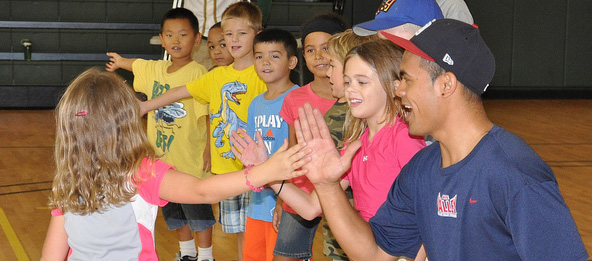
Feature photo above by USAG- Humphreys via Flickr (CC BY 2.0).

During off-times, at a long stoplight or in grocery store line, when the kids are restless and ready to argue for the sake of argument, I invite them to play the numbers game.

“Can you tell me how to get to twelve?”

My five year old begins, “You could take two fives and add a two.”

“Take sixty and divide it into five parts,” my nearly-seven year old says.

“You could do two tens and then take away a five and a three,” my younger son adds.

Eventually we run out of options and they begin naming numbers. It’s a simple game that builds up computational fluency, flexible thinking and number sense. I never say, “Can you tell me the transitive properties of numbers?” However, they are understanding that they can play with numbers.

photo by Mike Baird via flickr

I didn’t learn the rules of baseball by filling out a packet on baseball facts. Nobody held out a flash card where, in isolation, I recited someone else’s definition of the Infield Fly Rule. I didn’t memorize the rules of balls, strikes, and how to get someone out through a catechism of recitation.

Instead, I played baseball.

John Spencer
Memorizing Math Facts

Conversational Math

The best way for children to build mathematical fluency is through conversation. For more ideas on discussion-based math, check out these posts:

Learning the Math Facts

For more help with learning and practicing the basic arithmetic facts, try these tips and math games:

 
* * *

This blog is reader-supported.

If you’d like to help fund the blog on an on-going basis, then please join me on Patreon for mathy inspiration, tips, and an ever-growing archive of printable activities.

If you liked this post, and want to show your one-time appreciation, the place to do that is PayPal: paypal.me/DeniseGaskinsMath. If you go that route, please include your email address in the notes section, so I can say thank you.

Which I am going to say right now. Thank you!

“Quotable: Learning the Math Facts” copyright © 2013 by Denise Gaskins. Image at the top of the post copyright © USAG- Humphreys via Flickr (CC BY 2.0).

Quotable: The Adventure of Learning Math

Math mascot Moby Snoodles

As for mathematics itself, it’s one of the most adventurous endeavors a young child can experience. Mathematics is exotic, even bizarre. It is surprising and unpredictable. And it can be more exciting, scary and dangerous than sailing the high seas!

But most parents and educators don’t present math this way. They just want the children to develop their mathematical skills rather than going for something more nebulous, like the mathematical state of mind.

Children marvel as snowflakes magically become fractals, inviting explorations of infinity, symmetry and recursion. Cookies offer gameplay in combinatorics and calculus. Paint chips come in beautiful gradients, and floor tiles form tessellations. Bedtime routines turn into children’s first algorithms. Cooking, then mashing potatoes (and not the other way around!) humorously introduces commutative property. Noticing and exploring math becomes a lot more interesting, even addictive.

Unlike simplistic math that quickly becomes boring, these deep experiences remain fresh, because they grow together with children’s and parents’ understanding of mathematics.

— Maria Droujkova and Yelena McManaman
Adventurous Math For the Playground Set (Scientific American online)

PUFM 1.5 Multiplication, Part 2

Poster by Maria Droujkova of NaturalMath.com. In this Homeschooling Math with Profound Understanding (PUFM) Series, we are studying Elementary Mathematics for Teachers and applying its lessons to home education.

Multiplication is taught and explained using three models. Again, it is important for understanding that students see all three models early and often, and learn to use them when solving word problems.

— Thomas H. Parker & Scott J. Baldridge
Elementary Mathematics for Teachers

I hope you are playing the Tell Me a (Math) Story game often, making up word problems for your children and encouraging them to make up some for you. As you play, don’t fall into a rut: Keep the multiplication models from our lesson in mind and use them all. For even greater variety, use the Multiplication Models at NaturalMath.com to create your word problems.

Continue reading PUFM 1.5 Multiplication, Part 2