While I was working on the next post in my PUFM Series, I stumbled on an old favorite video. Since I couldn’t think of an excuse to use it in a post about multiplication, I decided to share it today. Enjoy!
Trouble with Times Tables
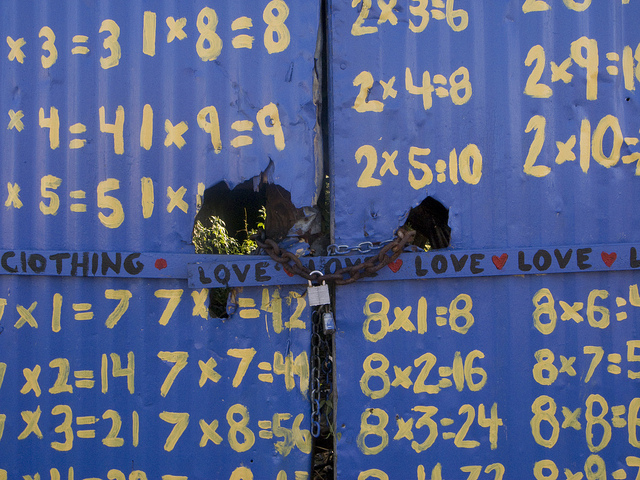
[feature photo above by dsb nola via flickr.]
Food for thought:
Imagine that you wanted your children to learn the names of all their cousins, aunts and uncles. But you never actually let them meet or play with them. You just showed them pictures of them, and told them to memorize their names.
Each day you’d have them recite the names, over and over again. You’d say, “OK, this is a picture of your great-aunt Beatrice. Her husband was your great-uncle Earnie. They had three children, your uncles Harpo, Zeppo, and Gummo. Harpo married your aunt Leonie … yadda, yadda, yadda.
— Brian Foley
Times Tables – The Worst Way to Teach Multiplication
On the other hand, if you want your children to develop relationships with the numbers, to learn the math facts naturally, then be sure to tell lots of math stories. And when you are ready to focus on multiplication, be sure to study the patterns and relationships within the times tables.
Build Mathematical Skills by Delaying Arithmetic, Part 3

To my fellow homeschoolers,
How can our children learn mathematics if we delay teaching formal arithmetic rules? Ask your librarian to help you find some of the wonderful living books about math. Math picture books are great for elementary students. Check your library for the Time-Life “I Love Math” books or the “Young Math Book” series. You’ll be amazed at the advanced topics your children can understand!
Benezet’s students explored their world through measurement, estimation, and mental math. Check out my PUFM Series for mental math thinking strategies that build your child’s understanding of number patterns and relationships.
Grade IV
Still there is no formal instruction in arithmetic.
By means of foot rules and yard sticks, the children are taught the meaning of inch, foot, and yard. They are given much practise in estimating the lengths of various objects in inches, feet, or yards. Each member of the class, for example, is asked to set down on paper his estimate of the height of a certain child, or the width of a window, or the length of the room, and then these estimates are checked by actual measurement.
The children are taught to read the thermometer and are given the significance of 32 degrees, 98.6 degrees, and 212 degrees.
They are introduced to the terms “square inch,” “square foot,” and “square yard” as units of surface measure.
With toy money [or real coins, if available] they are given some practise in making change, in denominations of 5’s only.
All of this work is done mentally. Any problem in making change which cannot be solved without putting figures on paper or on the blackboard is too difficult and is deferred until the children are older.
Toward the end of the year the children will have done a great deal of work in estimating areas, distances, etc., and in checking their estimates by subsequent measuring. The terms “half mile,” “quarter mile,” and “mile” are taught and the children are given an idea of how far these different distances are by actual comparisons or distances measured by automobile speedometer.
The table of time, involving seconds, minutes, and days, is taught before the end of the year. Relation of pounds and ounces is also taught.
— L. P. Benezet
The Teaching of Arithmetic II: The Story of an experiment
Continue reading Build Mathematical Skills by Delaying Arithmetic, Part 3
Cool Fibonacci Conversion Trick
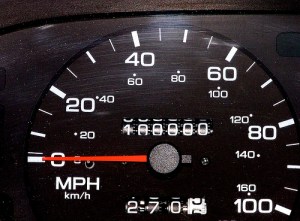
Maria explains how to use the Fibonacci Numbers to convert distance measurements between miles and kilometers:
P.S.: Congratulations to Maria for her Math Mammoth program being featured in the latest edition of Cathy Duffy’s 100 Top Picks for Homeschool Curriculum! And Home School Buyer’s Co-op has a sale on Cathy Duffy’s book through the end of July.
Build Mathematical Skills by Delaying Arithmetic, Part 2
To my fellow homeschoolers,
Most young children are not developmentally ready to master abstract, pencil-and-paper rules for manipulating numbers. But they are eager to learn about and explore the world of ideas. Numbers, patterns, and shapes are part of life all around us. As parent-teachers, we have many ways to feed our children’s voracious mental appetites without resorting to workbooks.
To delay formal arithmetic does not mean that we avoid mathematical topics — only that we delay math fact drill and the memorization of procedures. Notice the wide variety of mathematics Benezet’s children explored through books and through their own life experiences:
Grade I
There is no formal instruction in arithmetic. In connection with the use of readers, and as the need for it arises, the children are taught to recognize and read numbers up to 100. This instruction is not concentrated into any particular period or time but comes in incidentally in connection with assignments of the reading lesson or with reference to certain pages of the text.
Meanwhile, the children are given a basic idea of comparison and estimate thru [sic] the understanding of such contrasting words as: more, less; many. few; higher, lower; taller, shorter; earlier, later; narrower, wider; smaller, larger; etc.
As soon as it is practicable the children are taught to keep count of the date upon the calendar. Holidays and birthdays, both of members of the class and their friends and relatives, are noted.
— L. P. Benezet
The Teaching of Arithmetic II: The Story of an experiment
Continue reading Build Mathematical Skills by Delaying Arithmetic, Part 2
Build Mathematical Skills by Delaying Arithmetic, Part 1
To my fellow homeschoolers,
It’s counter-intuitive, but true: Our children will do better in math if we delay teaching them formal arithmetic skills. In the early years, we need to focus on conversation and reasoning — talking to them about numbers, bugs, patterns, cooking, shapes, dinosaurs, logic, science, gardening, knights, princesses, and whatever else they are interested in.
In the fall of 1929 I made up my mind to try the experiment of abandoning all formal instruction in arithmetic below the seventh grade and concentrating on teaching the children to read, to reason, and to recite — my new Three R’s. And by reciting I did not mean giving back, verbatim, the words of the teacher or of the textbook. I meant speaking the English language.
— L. P. Benezet
The Teaching of Arithmetic I: The Story of an experiment
Continue reading Build Mathematical Skills by Delaying Arithmetic, Part 1
How Crazy Can You Make It?
And here is yet more fun from Education Unboxed. This type of page was always one of my my favorites in Miquon Math.
Update:
Handmade “How Crazy…?” worksheets are wonderful, but if you want something a tad more polished, I created a printable. The first page has a sample number, and the second is blank so that you can fill in any target:
Add an extra degree of freedom: students can fill in the blanks with equivalent and non-equivalent expressions. Draw lines anchoring the ones that are equivalent to the target number, but leave the non-answers floating in space.
Or don’t draw lines. Let the kids create a worksheet for you to solve. After they finish their expressions, can you figure out which ones connect to the target number?

Olympic Logic
I love logic puzzles! Nrich Maths offers four fun Olympics Logic puzzles. And be sure to check out the rest of their Nrich Olympics Math as well.

Medals Count
Given the following clues, can you work out the number of gold, silver and bronze medals that France, Italy and Japan got in this international sports competition?
- Japan has 1 more gold medal, but 3 fewer silver medals, than Italy.
- France has the most bronze medals (18), but fewest gold medals (7).
- Each country has at least 6 medals of each type.
- Italy has 27 medals in total.
- Italy has 2 more bronze medals than gold medals.
- The three countries have 38 bronze medals in total.
- France has twice as many silver medals as Italy has gold medals.
Princess in the Dungeon Game
Yet more fun from Rosie at Education Unboxed. I found these while looking for videos to use in my PUFM Subtraction post. Rosie says:
This is seriously embarrassing and I debated whether to put this video online or not because this is NOT my normal personality, but my girls made up this game and will play it for over an hour and ask for it repeatedly… so I figured someone out there might be able to use it with their kids, too.
If you know me, please don’t ever ask me to do this in public. I will refuse.
Princess in the Dungeon, Part 1 – Fractions with Cuisenaire Rods
PUFM 1.4 Subtraction
Photo by Martin Thomas via flickr. In this Homeschooling Math with Profound Understanding (PUFM) Series, we are studying Elementary Mathematics for Teachers and applying its lessons to home education.
When adding, we combine two addends to get a sum. For subtraction we are given the sum and one addend and must find the “missing addend”.
— Thomas H. Parker & Scott J. Baldridge
Elementary Mathematics for Teachers
Notice that subtraction is not defined independently of addition. It must be taught along with addition, as an inverse (or mirror-image) operation. The basic question of subtraction is, “What would I have to add to this number, to get that number?”
Inverse operations are a very fundamental idea in mathematics. The inverse of any math operation is whatever will get you back to where you started. In order to fully understand a math operation, you must understand its inverse.
 Denise Gaskins' Let's Play Math