Mindset for Learning Math

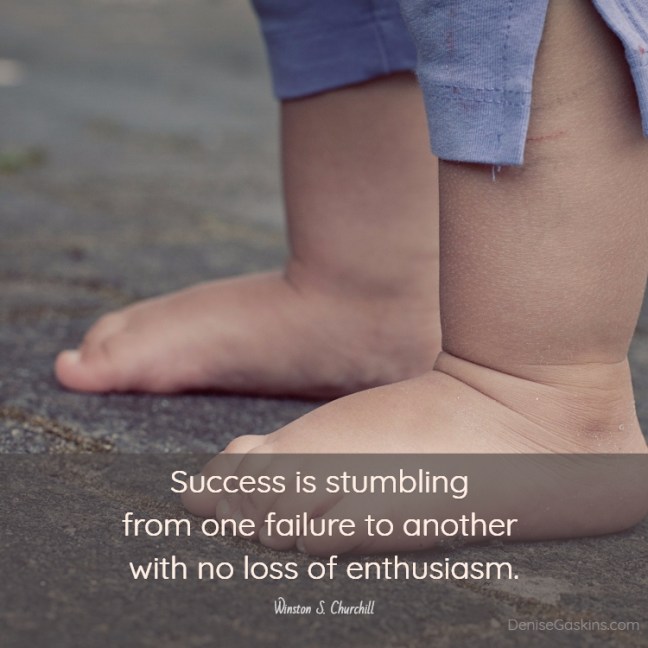
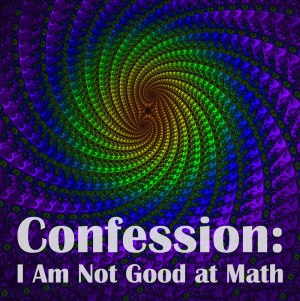
Playing with a new image editor, I came across this Winston Churchill quote. What a great description of how it feels to learn math!

If you have a student who struggles with math or is suffering from a loss of enthusiasm, check out Jo Boaler’s free online course on developing a mathematical mindset:

Or explore some of the playful activity ideas for all ages in her Week of Inspirational Math.

How to Talk Math With Your Kids

A friend shared this video, and I loved it! From Kent Haines, a father who happens to also be a math teacher…

“I hope that this video helps parents find new ways of interacting with their kids on math topics.”

Kent Haines

More from Kent Haines

Advice and Examples of Talking Math with Kids

Danielson-Talking Math

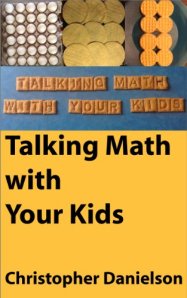
If you enjoyed Kent’s video, you’ll love Christopher Danielson’s book and blog.

It’s a short book with plenty of great stories, advice, and conversation-starters. While Danielson writes directly to parents, the book will also interest grandparents, aunts & uncles, teachers, and anyone else who wants to help children notice and think about math in daily life.

“You don’t need special skills to do this. If you can read with your kids, then you can talk math with them. You can support and encourage their developing mathematical minds.
 
“You don’t need to love math. You don’t need to have been particularly successful in school mathematics. You just need to notice when your children are being curious about math, and you need some ideas for turning that curiosity into a conversation.
 
“In nearly all circumstances, our conversations grow organically out of our everyday activity. We have not scheduled “talking math time” in our household. Instead, we talk about these things when it seems natural to do so, when the things we are doing (reading books, making lunch, riding in the car, etc) bump up against important mathematical ideas.
 
“The dialogues in this book are intended to open your eyes to these opportunities in your own family’s life.”

— Christopher Danielson
Talking Math with Your Kids

 
* * *

This blog is reader-supported.

If you’d like to help fund the blog on an on-going basis, then please join me on Patreon for mathy inspiration, tips, and an ever-growing archive of printable activities.

If you liked this post, and want to show your one-time appreciation, the place to do that is PayPal: paypal.me/DeniseGaskinsMath. If you go that route, please include your email address in the notes section, so I can say thank you.

Which I am going to say right now. Thank you!

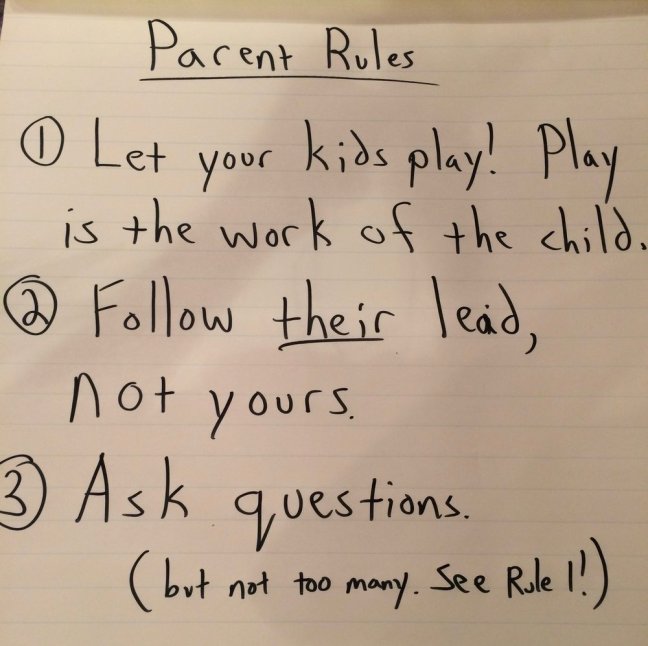
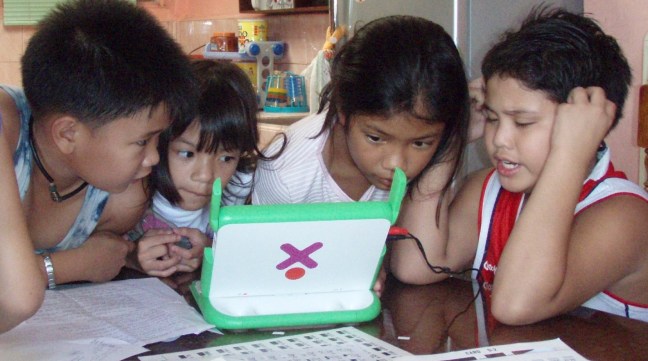
“How to Talk Math With Your Kids” copyright © 2017 by Denise Gaskins. “Kids Talk” photo (top) by Victoria Harjadi via Flickr (CC BY 2.0). “Parent Rules” by Kent Haines.

Even a Math Workbook Can Be a Game

Homeschool Memories…

My youngest daughter wanted to do Singapore math. Miquon Red was her main math text at the time, but we added a bit of Singapore Primary Math 1B whenever she was in the mood.

We turned to the lesson on subtracting with numbers in the 30-somethings.

Continue reading Even a Math Workbook Can Be a Game

There Ain’t No Free Candy

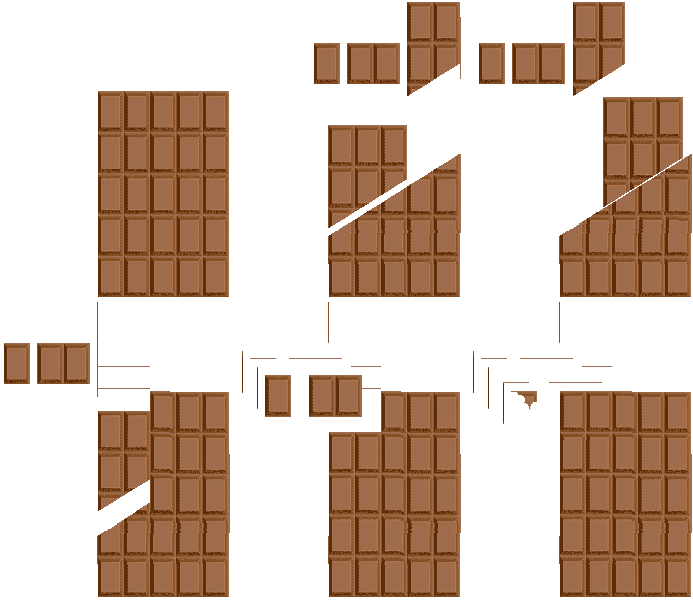
Ah, the infinite chocolate bar. If only it could work in real life! But can your children find the mistake? Where does the extra chocolate come from?

Here’s a hint: It’s related to this classic brainteaser. And here’s a video from Christopher Danielson (talkingmathwithkids.com), showing how the chocolate bar dissection really works.

Happy munchings!

CREDITS: Feature photo (top) by Yoori Koo via Unsplash. “Hershey Bar Math” video by Christopher Danielson via YouTube. The infinite chocolate gif went viral long ago, and I have no idea who was the original artist.

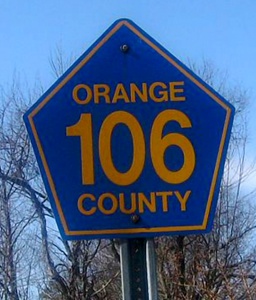
Playful Math Education Carnival 106 with Math Art

Do you enjoy math? I hope so! If not, browsing this post just may change your mind.
Welcome to the 106th edition of the Math Teachers At Play math education blog carnival — a smorgasbord of links to bloggers all around the internet who have great ideas for learning, teaching, and playing around with math from preschool to pre-college. Let the mathematical fun begin!

By tradition, we start the carnival with a puzzle in honor of our 106th edition. But if you would like to jump straight to our featured blog posts, click here to see the Table of Contents.

Try This Puzzle

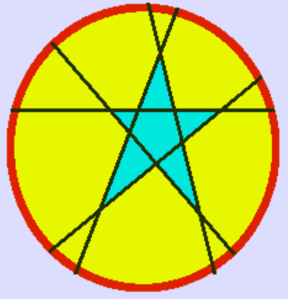
If you slice a pizza with a lightsaber, you’ll make straight cuts all the way across. Slice it once, and you get two pieces.
If you slice it five times, you’ll get a maximum of sixteen pieces. (And if you’re lucky you might get a star!)

  • How many times would you have to slice the pizza to get 106 pieces?

Click here for all the mathy goodness!

Dot Grid Doodling

What can you DO with a page full of dots?

Yesterday, I mentioned my new series of paperback dot grid notebooks, and I promised to share a few ideas for mathematical doodling.

But first, let me share my new dot-grid journals for kids. Aren’t they pretty?

Click Here for More Information

Doodling gives our minds a chance to relax, wander, and come back to our work refreshed. And though it goes against intuition, doodling can help us remember more of what we learn.

Math doodles let us experiment with geometric shapes and symmetries. We can feel our way into math ideas gradually, through informal play. Through doodles, our students will explore a wide range of mathematical structures and relationships.

Our own school experiences can make it hard for us to teach. What we never learned in school was the concept of playing around with math, allowing ideas to “percolate,” so to speak, before mastery occurs, and that process may take time.

—Julie Brennan

I like to doodle on dotty grid paper, like the pages in my math journals, but there’s No Purchase Necessary! You can design your own printable dot page at Incompetech’s PDF generator.

Patterns in Shape and Angle

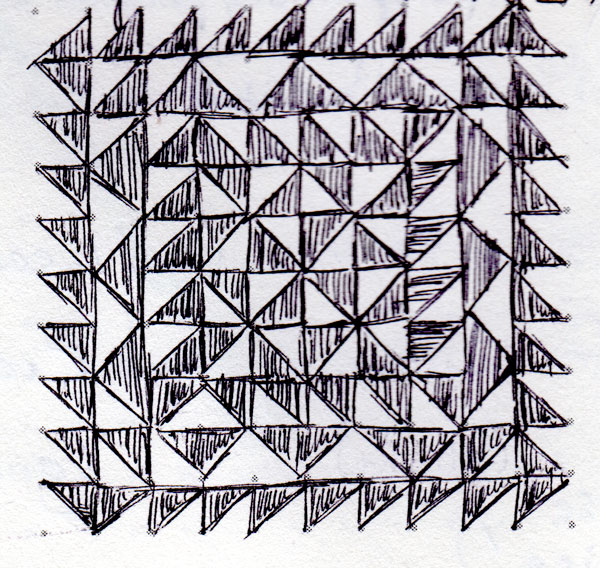
To make a faceted mathematical gemstone, start with any shape you like. Then build other shapes around it. What do you notice? Does your pattern grow outward from its center? Or flow around the corner of your page? How is each layer similar, and how is it different?

Arbitrary constraints can lead to mathematically interesting doodles. For instance, create a design out of 45-45-90 triangles by coloring exactly half of every grid square. How many variations can you find?

Symmetry Challenge

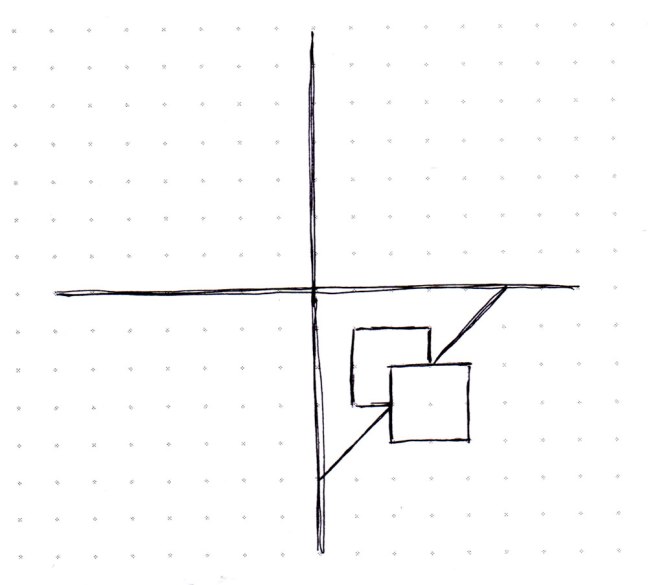
Play a symmetry puzzle game. Draw a line of symmetry and fill in part of the design. Then trade with a partner to finish each other’s doodles.

Make more complex symmetry puzzles with additional reflection lines.

Math Doodle Links

  • Who can talk about mathematical doodling without mentioning Vi Hart? If you’ve never seen her “Doodling in Math Class” video series, you’re in for a treat!
  • See if you can draw a rotational-symmetry design, like Don’s “Order 4” graphs.
  • Or experiment with the more flexible rules in John’s “Knot Fun” lesson.
  • And my latest obsession: the “ultimate” tutorial series on Celtic Knotwork, which explores the link between knots and their underlying graphs.
My favorite knot doodle so far.
Inspirations: A Recreational Mathematics Journal
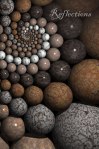
Reflections: A Math Teacher’s Journal
Explorations: A Math Student’s Journal
Contemplations: A Homeschooler’s Journal

Before you start doodling: How to Break In Your New Math Journal.

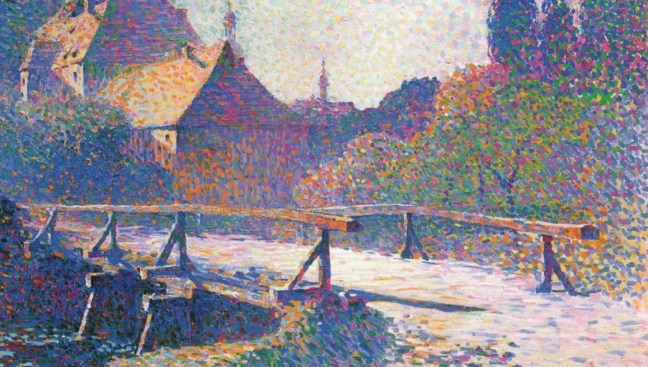
Feature photo (top): Sommermorgen (Alte Holzbrücke in Pretzfeld) by Curt Herrmann, via Wikimedia Commons. [Public domain]

Beauty in Math: A Fable

Have you ever wondered what mathematicians mean when they talk about a “beautiful” math proof?

“Beauty in mathematics is seeing the truth without effort.”

George Pólya

“There’s something striking about the economy of the counselor’s construction. He drew a single line, and that totally changed one’s vision of the geometry involved.

“Very often, there’s a simple introduction of something that’s not logically within the framework of the question — and it can be very simple — and it utterly changes your view of what the question really is about.”

Barry Mazur
The Moral of the Scale Fable

CREDITS: Castle photo (top) by Rachel Davis via Unsplash. “A Mathematical Fable” via YouTube. Story told by Barry Mazur. Animation by Pete McPartlan. Video by Brady Haran for Numberphile.

A Map of Mathematics

Pure mathematics, applied math, and more — all summarized in a single map! Watch the video by physicist and award-winning science writer Dominic Walliman:

Walliman says, “To err is to human, and I human a lot. I always try my best to be as correct as possible, but unfortunately I make mistakes…”

  • Can you find three mistakes in the map?

Check your answers in the description on Walliman’s YouTube page.

If you enjoy this video, you can purchase the poster (or T-shirt, coffee mug, tote bag, etc.) at Red Bubble.

 
* * *

CREDITS: Map of Mathematics poster by Dominic Walliman via Flickr (CC BY-NC-ND 2.0).

This blog is reader-supported.

If you’d like to help fund the blog on an on-going basis, then please head to my Patreon page.

If you liked this post, and want to show your one-time appreciation, the place to do that is PayPal: paypal.me/DeniseGaskinsMath. If you go that route, please include your email address in the notes section, so I can say thank you.

Which I am going to say right now. Thank you!

“A Map of Mathematics” copyright © 2017 by Denise Gaskins.

Confession: I Am Not Good at Math

I want to tell you a story. Everyone likes a story, right? But at the heart of my story lies a confession that I am afraid will shock many readers.

confessionPeople assume that because I teach math, blog about math, give advice about math on internet forums, and present workshops about teaching math — because I do all this, I must be good at math.

Apply logic to that statement.

The conclusion simply isn’t valid.

Continue reading Confession: I Am Not Good at Math

Math Inspirations: Why Study Mathematics?

why-study-math

What teacher hasn’t heard a student complain, “When am I ever going to have to use this?” Didn’t most of us ask it ourselves, once upon a time?

And unless we choose a math-intensive career like engineering, the truth is that after we leave school, most of us will never again use most of the math we learned.

But if math beyond arithmetic isn’t all that useful, then what’s the point?

If you or your student is singing the “Higher Math Blues,” here are some quotations that may cheer you up — or at least give you the strength of vision to keep on slogging.

We Study Mathematics…

To Understand Creation

I don’t want to convince you that mathematics is useful. It is, but utility is not the only criterion for value to humanity. Above all, I want to convince you that mathematics is beautiful, surprising, enjoyable, and interesting. In fact, mathematics is the closest that we humans get to true magic. How else to describe the patterns in our heads that — by some mysterious agency — capture patterns of the universe around us? Mathematics connects ideas that otherwise seem totally unrelated, revealing deep similarities that subsequently show up in nature.

— Ian Stewart
The Magical Maze

That vast book which stands forever open before our eyes, the universe, cannot be read until we have learnt the language in which it is written. It is written in mathematical language, and the letters are triangles, circles, and other geometrical figures, without which means it is humanly impossible to comprehend a single word.

— Galileo Galilei
quoted by Clifford Pickover, A Passion for Mathematics

To Train Our Minds

The investigation of mathematical truths accustoms the mind to method and correctness in reasoning, and is an employment peculiarly worthy of rational beings.

— George Washington
quoted by William Dunham, The Mathematical Universe

I told myself, “Lincoln, you can never make a lawyer if you do not understand what demonstrate means.” So I left my situation in Springfield, went home to my father’s house, and stayed there till I could give any proposition in the six books of Euclid at sight. I then found out what “demonstrate” means, and went back to my law studies.

— Abraham Lincoln
quoted by William Dunham, The Mathematical Universe

To Understand History

In most sciences, one generation tears down what another has built, and what one has established another undoes. In mathematics alone, each generation adds a new story to the old structure.

— Herman Henkel
quoted by Noah benShea, Great Quotes to Inspire Great Teachers

Biographical history, as taught in our public schools, is still largely a history of boneheads: ridiculous kings and queens, paranoid political leaders, compulsive voyagers, ignorant generals — the flotsam and jetsam of historical currents. The men who radically altered history, the great scientists and mathematicians, are seldom mentioned, if at all.

— Martin Gardner
quoted by G. Simmons, Calculus Gems

I will not go so far as to say that constructing a history of thought without profound study of mathematical ideas is like omitting Hamlet from the play named after him. But it is certainly analogous to cutting out the part of Ophelia. For Ophelia is quite essential to the play, she is very charming. . . and a little mad.

— Alfred North Whitehead
quoted in The Viking Book of Aphorisms

To Appreciate the Beauty

The mathematician does not study pure mathematics because it is useful, he studies it because he delights in it, and he delights in it because it is beautiful.

— Henri Poincaré
quoted by Theoni Pappas, More Joy of Mathematics

A mathematician, like a painter or poet, is a maker of patterns. If his patterns are more permanent than theirs, it is because they are made with ideas. The mathematician’s patterns, like the painter’s or the poet’s, must be beautiful. The ideas, like the colors or the words, must fit together in a harmonious way. Beauty is the first test: there is no permanent place in this world for ugly mathematics.

— Godfrey H. Hardy
A Mathematician’s Apology

And Most of All, to Play

Mathematics is a world created by the mind of men, and mathematicians are people who devote their lives to what seems to me a wonderful kind of play!

Constance Reid

At age eleven, I began Euclid, with my brother as tutor. This was one of the great events of my life, as dazzling as first love. I had not imagined there was anything so delicious in the world.

— Bertrand Russell
The Autobiography of Bertrand Russell

I love mathematics … principally because it is beautiful, because man has breathed his spirit of play into it, and because it has given him his greatest game — the encompassing of the infinite.

Rózsa Péter
quoted by Rosemary Schmalz, Out of the Mouths of Mathematicians

Did you enjoy these? You can find plenty more on my Math & Education Quotations page.

  • I would LOVE to hear YOUR favorite mathematics, education, or inspirational quote. Please share in the Comments section below!

CREDITS: Never Ending Math Problem photo (above) by Danny (blog post title added) via Flickr (CC BY 2.0).