Talking Math with Your Kids

Danielson-Talking Math

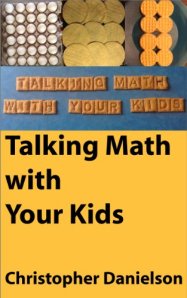
Christopher Danielson, one of my favorite math bloggers, has a new book out that is perfect for parents of preschool and elementary-age children:

It’s a short book with plenty of great stories, advice, and conversation-starters. While Danielson writes directly to parents, the book will also interest grandparents, aunts & uncles, teachers, and anyone else who wants to help children notice and think about math in daily life.

“You don’t need special skills to do this. If you can read with your kids, then you can talk math with them. You can support and encourage their developing mathematical minds.
 
“You don’t need to love math. You don’t need to have been particularly successful in school mathematics. You just need to notice when your children are being curious about math, and you need some ideas for turning that curiosity into a conversation.
 
“In nearly all circumstances, our conversations grow organically out of our everyday activity. We have not scheduled “talking math time” in our household. Instead, we talk about these things when it seems natural to do so, when the things we are doing (reading books, making lunch, riding in the car, etc) bump up against important mathematical ideas.
 
“The dialogues in this book are intended to open your eyes to these opportunities in your own family’s life.”

— Christopher Danielson
Talking Math with Your Kids

 
* * *

This blog is reader-supported.

If you’d like to help fund the blog on an on-going basis, then please join me on Patreon for mathy inspiration, tips, and an ever-growing archive of printable activities.

If you liked this post, and want to show your one-time appreciation, the place to do that is PayPal: paypal.me/DeniseGaskinsMath. If you go that route, please include your email address in the notes section, so I can say thank you.

Which I am going to say right now. Thank you!

“Talking Math with Your Kids” copyright © 2013 by Denise Gaskins.

Puzzle: Algebra on Rectangles

Gordon Hamilton of Math Pickle recently posted these videos on how to make algebra 1 puzzles on rectangles. As I was watching, Kitten came in and looked over my shoulder. She said, “Those look like fun!”

They look like fun to me, too, and I bet your beginning algebra students will enjoy them:

Continue reading Puzzle: Algebra on Rectangles

A Pretty Math Problem?

As we were doing Buddy Math (taking turns through the homework exercises) today, my daughter said, “Oooo! I want to do this one. It’s pretty!”

CodeCogsEqn

She has always loved seeing patterns in math. I remember once, years ago, when she insisted that we change the problems on a worksheet to make the answers come out symmetrical. 🙂

Math That Is Fun: Infinite Primes

Oh, my! Ben Orlin over at Math with Bad Drawings just published my new favorite math proof ever:

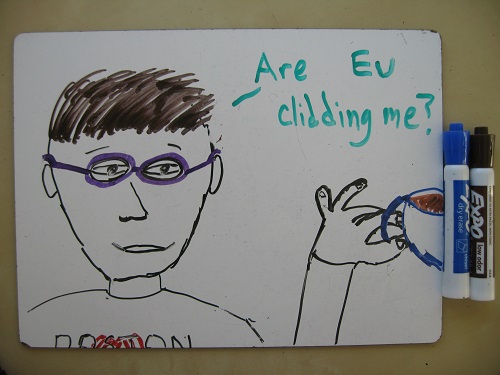
I had a fight with Euclid on the nature of the primes.
It got a little heated – you know how the tension climbs.

It started out most civil, with a honeyed cup of tea;
we traded tales of scholars, like Descartes and Ptolemy.
But as the tea began to cool, our chatter did as well.
We’d had our fill of gossip. We sat silent for a spell.
That’s when Euclid turned to me, and said, “Hear this, my friend:
did you know the primes go on forever, with no end?” …

15-eu-must-be-clidding

Click here to read the whole post at Math with Bad Drawings.

Quotable: Learning the Math Facts

Feature photo above by USAG- Humphreys via Flickr (CC BY 2.0).

During off-times, at a long stoplight or in grocery store line, when the kids are restless and ready to argue for the sake of argument, I invite them to play the numbers game.

“Can you tell me how to get to twelve?”

My five year old begins, “You could take two fives and add a two.”

“Take sixty and divide it into five parts,” my nearly-seven year old says.

“You could do two tens and then take away a five and a three,” my younger son adds.

Eventually we run out of options and they begin naming numbers. It’s a simple game that builds up computational fluency, flexible thinking and number sense. I never say, “Can you tell me the transitive properties of numbers?” However, they are understanding that they can play with numbers.

photo by Mike Baird via flickr

I didn’t learn the rules of baseball by filling out a packet on baseball facts. Nobody held out a flash card where, in isolation, I recited someone else’s definition of the Infield Fly Rule. I didn’t memorize the rules of balls, strikes, and how to get someone out through a catechism of recitation.

Instead, I played baseball.

John Spencer
Memorizing Math Facts

Conversational Math

The best way for children to build mathematical fluency is through conversation. For more ideas on discussion-based math, check out these posts:

Learning the Math Facts

For more help with learning and practicing the basic arithmetic facts, try these tips and math games:

 
* * *

This blog is reader-supported.

If you’d like to help fund the blog on an on-going basis, then please join me on Patreon for mathy inspiration, tips, and an ever-growing archive of printable activities.

If you liked this post, and want to show your one-time appreciation, the place to do that is PayPal: paypal.me/DeniseGaskinsMath. If you go that route, please include your email address in the notes section, so I can say thank you.

Which I am going to say right now. Thank you!

“Quotable: Learning the Math Facts” copyright © 2013 by Denise Gaskins. Image at the top of the post copyright © USAG- Humphreys via Flickr (CC BY 2.0).

How To Master Quadratic Equations

G'Day Math logo

Feature photo above by Junya Ogura via Flickr (CC BY 2.0).

A couple of weeks ago, James Tanton launched a wonderful resource: a free online course devoted to quadratic equations. (And he promises more topics to come.)

Kitten and I have been working through the lessons, and she loves it!

We’re skimming through pre-algebra in our regular lessons, but she has enjoyed playing around with simple algebra since she was in kindergarten. She has a strong track record of thinking her way through math problems, and earlier this year she invented her own method for solving systems of equations with two unknowns.

I would guess her background is approximately equal to an above-average Algebra 1 student near the end of the first semester.

After few lessons of Tanton’s course, she proved — within the limits of experimental error — that a catenary (the curve formed by a hanging chain) cannot be described by a quadratic equation. Last Friday, she easily solved the following equations:

\left ( x+4 \right )^2 -1=80

and:

w^2 + 90 = 22 w - 31

and (though it took a bit more thought):

4x^2 + 4x + 4 = 172

We’ve spent less than half an hour a day on the course, as a supplement to our AoPS Pre-Algebra textbook. We watch each video together, pausing occasionally so she can try her hand at an equation before listening to Tanton’s explanation. Then (usually the next day) she reads the lesson and does the exercises on her own.

So far, she hasn’t needed the answers in the Companion Guide to Quadratics, but she did use the “Dots on a Circle” activity — and knowing that she has the answers available helps her feel more independent.

Continue reading How To Master Quadratic Equations

Quotable: The Adventure of Learning Math

Math mascot Moby Snoodles

As for mathematics itself, it’s one of the most adventurous endeavors a young child can experience. Mathematics is exotic, even bizarre. It is surprising and unpredictable. And it can be more exciting, scary and dangerous than sailing the high seas!

But most parents and educators don’t present math this way. They just want the children to develop their mathematical skills rather than going for something more nebulous, like the mathematical state of mind.

Children marvel as snowflakes magically become fractals, inviting explorations of infinity, symmetry and recursion. Cookies offer gameplay in combinatorics and calculus. Paint chips come in beautiful gradients, and floor tiles form tessellations. Bedtime routines turn into children’s first algorithms. Cooking, then mashing potatoes (and not the other way around!) humorously introduces commutative property. Noticing and exploring math becomes a lot more interesting, even addictive.

Unlike simplistic math that quickly becomes boring, these deep experiences remain fresh, because they grow together with children’s and parents’ understanding of mathematics.

— Maria Droujkova and Yelena McManaman
Adventurous Math For the Playground Set (Scientific American online)

Homeschooling High School Math

photo by ddluong via flickr

Feature photo (above) by Sphinx The Geek via flickr.

Most homeschoolers feel at least a small tinge of panic as their students approach high school. “What have we gotten ourselves into?” we wonder. “Can we really do this?” Here are a few tips to make the transition easier.

Before you move forward, it may help to take a look back. How has homeschooling worked for you and your children so far?

If your students hate math, they probably never got a good taste of the “Aha!” factor, that Eureka! thrill of solving a challenging puzzle. The early teen years may be your last chance to convince them that math can be fun, so consider putting aside your textbooks for a few months to:

On the other hand, if you have delayed formal arithmetic, using your children’s elementary years to explore a wide variety of mathematical adventures, now is a good time to take stock of what these experiences have taught your students.

  • How much of what society considers “the basics” have your children picked up along the way?
  • Are there any gaps in their understanding of arithmetic, any concepts you want to add to their mental tool box?

Continue reading Homeschooling High School Math