A bit of April Fool’s Day fun from Google Maps:
More Beautiful Math: The Dragon Curve
Happy Pi Day III: Visualizing Pi
Hundred Chart Idea #28: Hang It on the Wall
Math is beautiful when it communicates an abstract idea clearly and provides new insight. Yelena’s hundred chart poster does just that:
[From the Moebius Noodles blog]
Check out my newest home decor item, a hundred chart. The amount of work I put into it, I consider getting it framed to be proudly displayed in the living room. The thing is monumental in several ways:
1. It is monumentally different from my usual approach to choosing math aids. My rule is if it takes me more than 5 minutes to prepare a math manipulative, I skip it and find another way.
2. It is monumentally time-consuming to create from scratch all by yourself.
3. It is monumentally fun to show to a child.
— Yelena McManaman
Moebius Noodles
Now she’s provided a fantastic set of free hundred chart printables:
- The Hundred Chart and Game Cards
If you print and cut out the individual cards, you can arrange them so the bigger numbers are higher up, as shown in Yelena’s original blog post.
Thanks, Yelena!
Share Your Ideas
It began with a humble list of seven things in the first (now out of print) edition of my book about teaching home school math. Over the years I added new ideas, and online friends contributed, too, so the list grew to become one of the most popular posts on my blog:
Can you think of anything else we might do with a hundred chart? Add your ideas in the Comments section below, and I’ll add the best ones to our master list.
Quotable: Why Study Algebra?
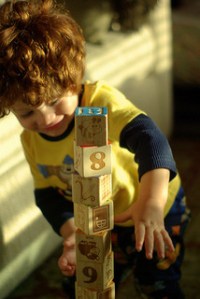
[Photo by AlphaTangoBravo / Adam Baker via flickr.]
One reason to study algebra: because it’s a building block. And just as it was really hard at first to get those blocks to do what you wanted them to do, so also it can be really hard at first to get algebra to work. But if you persevere, who knows what you might build someday?
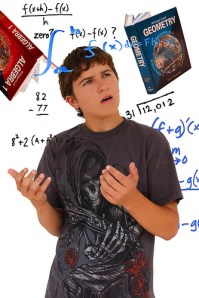
Algebra is the beginning of a journey that gives you the skills to solve more complex problems.
…
So, try not to think of Algebra as a boring list of rules and procedures to memorize. Consider algebra as a gateway to exploring the world around us all.— Jason Gibson
Why Study Algebra?
Nrich: Math Puzzles and More
Nrich recently updated their amazing website. I love exploring their backlog of puzzles and games — what a mother lode of resources for math club or a homeschool co-op class!
PUFM 1.5 Multiplication, Part 2

Poster by Maria Droujkova of NaturalMath.com. In this Homeschooling Math with Profound Understanding (PUFM) Series, we are studying Elementary Mathematics for Teachers and applying its lessons to home education.
Multiplication is taught and explained using three models. Again, it is important for understanding that students see all three models early and often, and learn to use them when solving word problems.
— Thomas H. Parker & Scott J. Baldridge
Elementary Mathematics for Teachers
I hope you are playing the Tell Me a (Math) Story game often, making up word problems for your children and encouraging them to make up some for you. As you play, don’t fall into a rut: Keep the multiplication models from our lesson in mind and use them all. For even greater variety, use the Multiplication Models at NaturalMath.com to create your word problems.
New Math by Tom Lehrer
While I was working on the next post in my PUFM Series, I stumbled on an old favorite video. Since I couldn’t think of an excuse to use it in a post about multiplication, I decided to share it today. Enjoy!
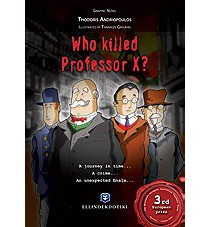
Who Killed Professor X?
What a Fun Book!
Who Killed Professor X? is a work of fiction based on actual incidents, and its heroes are real people who left their mark on the history of mathematics. The murder takes place in Paris in 1900, and the suspects are the greatest mathematicians of all time. Each suspect’s statement to the police leads to a mathematical problem, the solution of which requires some knowledge of secondary-school mathematics. But you don’t have to solve the puzzles in order to enjoy the book.
Fourteen pages of endnote biographies explain which parts of the mystery are true, which details are fictional, and which are both (true incidents slightly modified for the sake of the story).
My daughter Kitten, voracious as always, devoured it in one sitting — and even though she hasn’t studied high school geometry yet, she was able to work a couple of the problems.
Trouble with Times Tables
[feature photo above by dsb nola via flickr.]
Food for thought:
Imagine that you wanted your children to learn the names of all their cousins, aunts and uncles. But you never actually let them meet or play with them. You just showed them pictures of them, and told them to memorize their names.
Each day you’d have them recite the names, over and over again. You’d say, “OK, this is a picture of your great-aunt Beatrice. Her husband was your great-uncle Earnie. They had three children, your uncles Harpo, Zeppo, and Gummo. Harpo married your aunt Leonie … yadda, yadda, yadda.
— Brian Foley
Times Tables – The Worst Way to Teach Multiplication
On the other hand, if you want your children to develop relationships with the numbers, to learn the math facts naturally, then be sure to tell lots of math stories. And when you are ready to focus on multiplication, be sure to study the patterns and relationships within the times tables.