For anyone who can’t make it to Peoria this weekend but is still interested in my math workshops — and just in case we run out of handouts at said workshop — I am posting my math handouts here. These are pdf files, so if you have a sluggish dial-up connection like ours (ah, the joys of rural life!), you can right-click and save each file as a download.
Bill Gates Proportions II

[Feature photo above by Remy Steinegger via Wikimedia Commons (CC BY 2.0).]
Another look at the Bill Gates proportion… Even though I couldn’t find any data on his real income, I did discover that the median American family’s net worth was $93,100 in 2004 (most of that is home equity) and that the figure has gone up a bit since then. This gives me another chance to play around with proportions.
So I wrote a sample problem for my Advanced Math Monsters workshop at the APACHE homeschool conference:
The median American family has a net worth of about $100 thousand. Bill Gates has a net worth of $56 billion. If Average Jane Homeschooler spends $100 in the vendor hall, what would be the equivalent expense for Gates?
Putting Bill Gates in Proportion

[Feature photo above by Baluart.net.]
A friend gave me permission to turn our email discussion into an article…
Can you help us figure out how to figure out this problem? I think we have all the information we need, but I’m not sure:
The average household income in the United States is $60,000/year. And a man’s annual income is $56 billion. Is there a way to figure out what this man’s value of $1mil is, compared to the person who earns $60,000/year? In other words, I would like to say — $1,000,000 to us is like 10 cents to Bill Gates.
Secret Message
My algebra students could stand to hear this, too:
(2)(-4x2)n is not equal to (-8 )nx2n.
AAAAAARRRRGGGHH!!!!
From Secret Message to My Calculus Students at Learning Curves blog.
Hexa-Trex Puzzles
These puzzles look like a lot of fun for whole number and integer arithmetic review. I think they would make a great warm-up at the beginning of a class or math club meeting.
Hat tip: MathPuzzle.com
Skit: The Handshake Problem

[Feature photo above by Tobias Wolter (CC-BY-SA-3.0) via Wikimedia Commons.]
If seven people meet at a party, and each person shakes the hand of everyone else exactly once, how many handshakes are there in all?
In general, if n people meet and shake hands all around, how many handshakes will there be?
Our homeschool co-op held an end-of-semester assembly. Each class was supposed to demonstrate something they had learned. I threatened to hand out a ten question pop quiz on integer arithmetic, but instead my pre-algebra students presented this skit. You may adjust the script to fit the available number of players.
Nothing Is Everything
Does this proof at squareCircleZ blog mean that, if I get nothing done today, I can cross off everything on my list?
Poetry for Pi Day
Here are two poems in honor of pi, from the Mathematical Poetry site:
The Case of the Mysterious Story Problem
[Feature photo above by Carla216 via flickr (CC BY 2.0). This post was rescued from my old blog.]
I love story problems. Like a detective, I enjoy sifting out clues and solving the mystery. But what do you do when you come across a real stumper? Acting out story problems could make a one-page assignment take all week.
You don’t have to bake a pie to study fractions or jump off a cliff to learn gravity. Use your imagination instead. The following suggestions will help you find the clues you need to solve the case.
Improper Fractions: A Mathematical Trauma

Feature photo (above) by Jimmie via flickr. Photo (right) by Old Shoe Woman via Flickr.
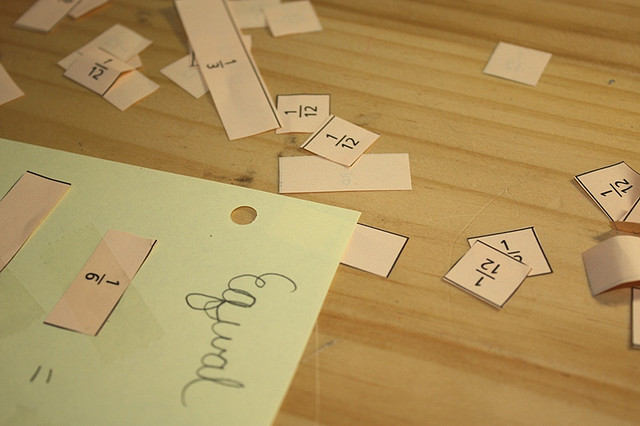
Nearing the end of Miquon Blue today, my youngest daughter encountered fractions greater than one. She collapsed on the floor of my bedroom in tears.
The worksheet started innocently enough:
![\frac{1}{2} \times 8=\left[ \quad \right]](https://s0.wp.com/latex.php?latex=%5Cfrac%7B1%7D%7B2%7D+%5Ctimes+8%3D%5Cleft%5B+%5Cquad+%5Cright%5D&bg=ffffff&fg=303030&s=2&c=20201002)
 Denise Gaskins' Let's Play Math

