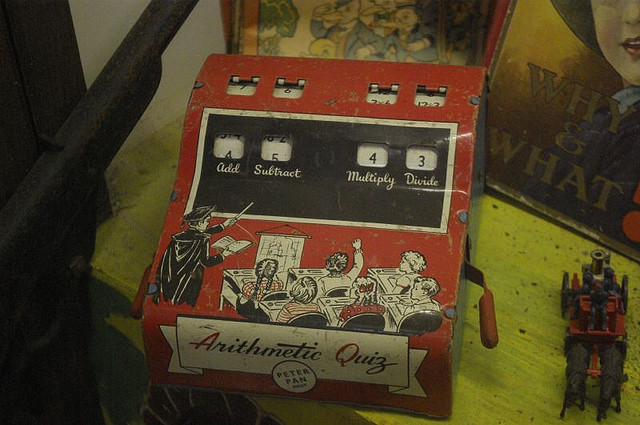
Teaching the Standard Algorithms

[Feature photo above by Samuel Mann, Analytical Engine photo below by Roͬͬ͠͠͡͠͠͠͠͠͠͠͠sͬͬ͠͠͠͠͠͠͠͠͠aͬͬ͠͠͠͠͠͠͠ Menkman, both (CC BY 2.0) via Flickr.]
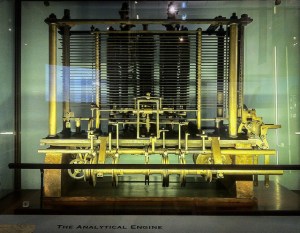
Babbage's Analytical Engine

An algorithm is a set of steps to follow that produce a certain result. Follow the rules carefully, and you will automatically get the correct answer. No thinking required — even a machine can do it.

This photo shows one section of the first true computer, Charles Babbage’s Analytical Engine. Using a clever arrangement of gears, levers, and switches, the machine could crank out the answer to almost any arithmetic problem. Rather, it would have been able to do so, if Babbage had ever finished building the monster.

One of the biggest arguments surrounding the Common Core State Standards in math is when and how to teach the standard algorithms. But this argument is not new. It goes back at least to the late 19th century.

Here is a passage from a book that helped shape my teaching style, way back when I began homeschooling in the 1980s…

Ruth Beechick on Teaching Abstract Notation

“Understanding this item is the key to choosing your strategy for the early years of arithmetic teaching. The question is: Should you teach abstract notation as early as the child can learn it, or should you use the time, instead, to teach in greater depth in the mental image mode?
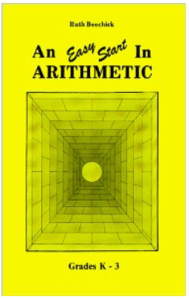
Beechick-EasyStartArithmetic

“Abstract notation includes writing out a column of numbers to add, and writing one number under another before subtracting it. The digits and signs used are symbols. The position of the numbers is an arbitrary decision of society. They are conventions that adult, abstract thinkers use as a kind of shorthand to speed up our thinking.

“When we teach these to children, we must realize that we simply are introducing them to our abstract tools. We are not suddenly turning children into abstract thinkers. And the danger of starting too early and pushing this kind of work is that we will spend an inordinate amount of time with it. We will be teaching the importance of making straight columns, writing numbers in certain places, and other trivial matters. By calling them trivial, we don’t mean that they are unnecessary. But they are small matters compared to real arithmetic thinking.

“If you stay with meaningful mental arithmetic longer, you will find that your child, if she is average, can do problems much more advanced than the level listed for her grade. You will find that she likes arithmetic more. And when she does get to abstractions, she will understand them better. She will not need two or three years of work in primary grades to learn how to write out something like a subtraction problem with two-digit numbers. She can learn that in a few moments of time, if you just wait.”
— Ruth Beechick
An Easy Start in Arithmetic (Grades K-3)
(emphasis mine)

December Advent Math from Nrich

[Feature photo (above) by Austin Kirk via Flickr (CC BY 2.0).]

Click on the pictures below to explore a mathy Advent Calendar with a new game, activity, or challenge puzzle for each day during the run-up to Christmas. Enjoy!

Advent Calendar 2014 – Primary

adventprimary

Advent Calendar 2014 – Secondary

adventsecondary

Roadmap to Mathematics: 1st Grade

[Feature photo (above) by woodleywonderworks. (CC BY 2.0 via Flickr)]

roadmap1

A frequently-asked question on homeschooling forums is, “Are my children working at grade level? What do they need to know?”

The Council of the Great City Schools has published a handy 6-page pdf summary of first grade math concepts, with suggestions for how parents can support their children’s learning:

Whether you are a radical unschooler or passionately devoted to your textbook — or, like me, somewhere in between — you can help your children toward these grade-level goals by encouraging them to view mathematics as mental play. Don’t think of the standards as a “to do” list, but as your guide to an adventure of exploration. The key to learning math is to see it the mathematician’s way, as a game of playing with ideas.

The following are excerpts from the roadmap document, along with links to related posts from the past eight years of playing with math on this blog…

Continue reading Roadmap to Mathematics: 1st Grade

Roadmap to Mathematics: Kindergarten

[Feature photo (above) by MIKI Yoshihito. (CC BY 2.0 via Flickr)]

RoadmapK

A frequently-asked question on homeschooling forums is, “Are my children working at grade level? What do they need to know?”

The Council of the Great City Schools has published a handy 6-page pdf summary of kindergarten math concepts, with suggestions for how parents can support their children’s learning:

Whether you are a radical unschooler or passionately devoted to your textbook — or, like me, somewhere in between — you can help your children toward these grade-level goals by encouraging them to view mathematics as mental play. Don’t think of the standards as a “to do” list, but as your guide to an adventure of exploration. The key to learning math is to see it the mathematician’s way, as a game of playing with ideas.

The following are excerpts from the roadmap document, along with links to related posts from the past eight years of playing with math on this blog…

Continue reading Roadmap to Mathematics: Kindergarten

Horseshoes: A Place Value Game

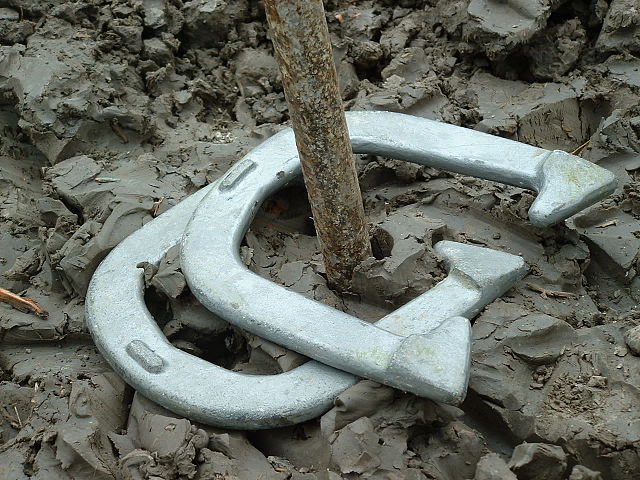
[Feature photo above by Johnmack161 via Wikimedia Commons (CC BY 2.5).]

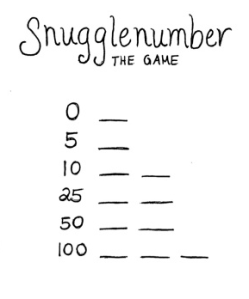
I first saw place value games on the old PBS Square One TV show (video below). Many teachers have posted versions of the game online, but Snugglenumber by Anna Weltman is by far the cutest variation. Anna kindly gave me permission to use the game in my upcoming Math You Can Play book series, and I added the following variation:

Horseshoes

snugglenumber

Math Concepts: place value, strategic thinking.
Players: two or more.
Equipment: one deck of playing cards, or a double deck for more than three players.

Separate out the cards numbered ace (one) through nine, plus cards to represent the digit zero. We use the queens (Q is round enough for pretend), but you could also use the tens and just count them as zero.

Shuffle well and deal eleven cards to each player. Arrange your cards in the snugglenumber pattern shown here, one card per blank line, to form numbers that come as close to each target number as you can get it.

Continue reading Horseshoes: A Place Value Game

Quotable: Focus on Being Silent

Children Reading Pratham Books and Akshara[Photo by Pratham Books via Flickr (CC BY 2.0).]

I discovered this gem in my blog reading today. One of the secrets of great teaching:

Audrey seemed, for once, at a loss for words. She was thinking about the question.

I try to stay focused on being silent after I ask young children questions, even semi-serious accidental ones. Unlike most adults, they actually take time to think about their answers and that often means waiting for a response, at least if you want an honest answer.

If you’re only looking for the “right” answer, it’s fairly easy to gently badger a child into it, but I’m not interested in doing that.

Thomas Hobson
Thank You For Teaching Me

Learn Math by Asking Questions

The best way for children to build mathematical fluency is through conversation. For more ideas on discussion-based math, check out these posts:

And be sure to follow Christopher Danielson’s Talking Math with Your Kids blog!

 
* * *

This blog is reader-supported.

If you’d like to help fund the blog on an on-going basis, then please join me on Patreon for mathy inspiration, tips, and an ever-growing archive of printable activities.

If you liked this post, and want to show your one-time appreciation, the place to do that is PayPal: paypal.me/DeniseGaskinsMath. If you go that route, please include your email address in the notes section, so I can say thank you.

Which I am going to say right now. Thank you!

“Quotable: Focus on Being Silent” copyright © 2013 by Denise Gaskins. Image at the top of the post copyright © Pratham Books via Flickr (CC BY 2.0).

Maze Game: Land or Water?

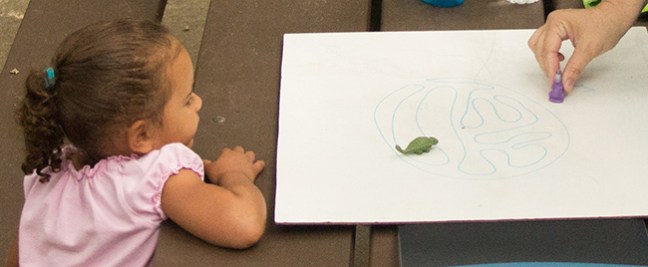
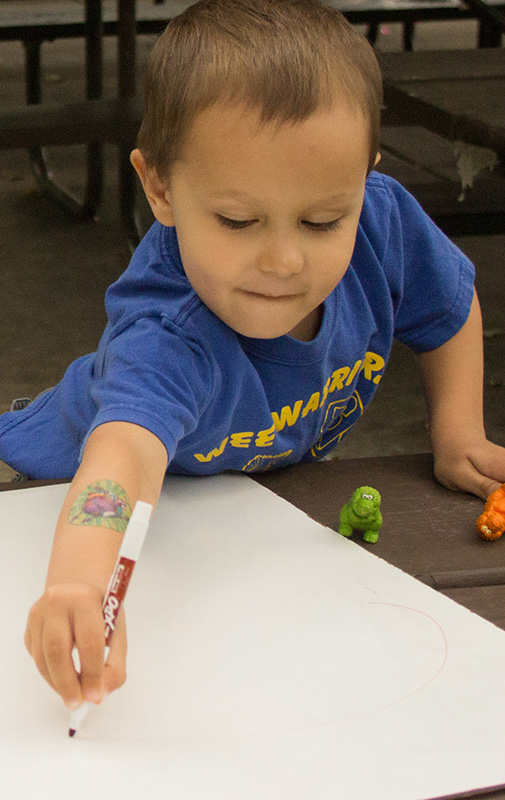
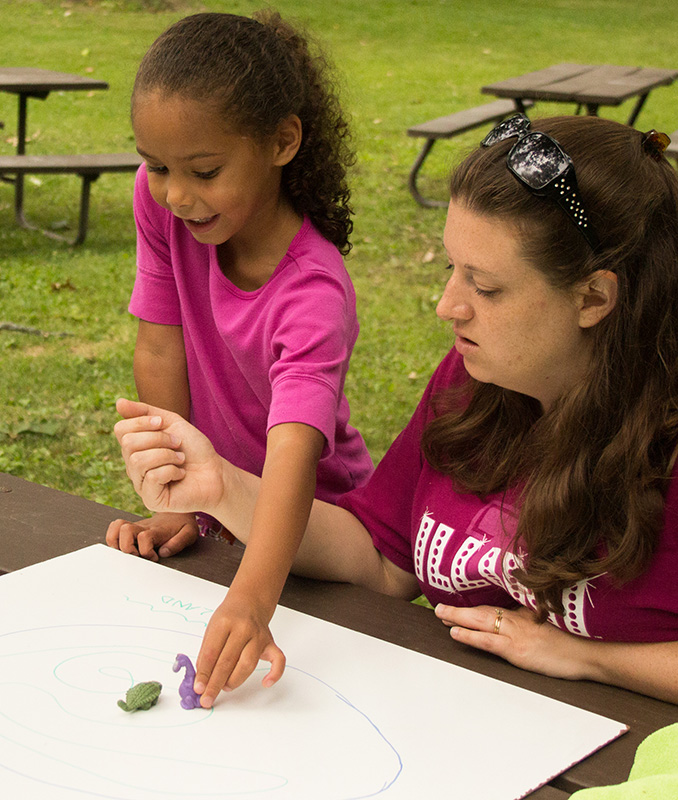
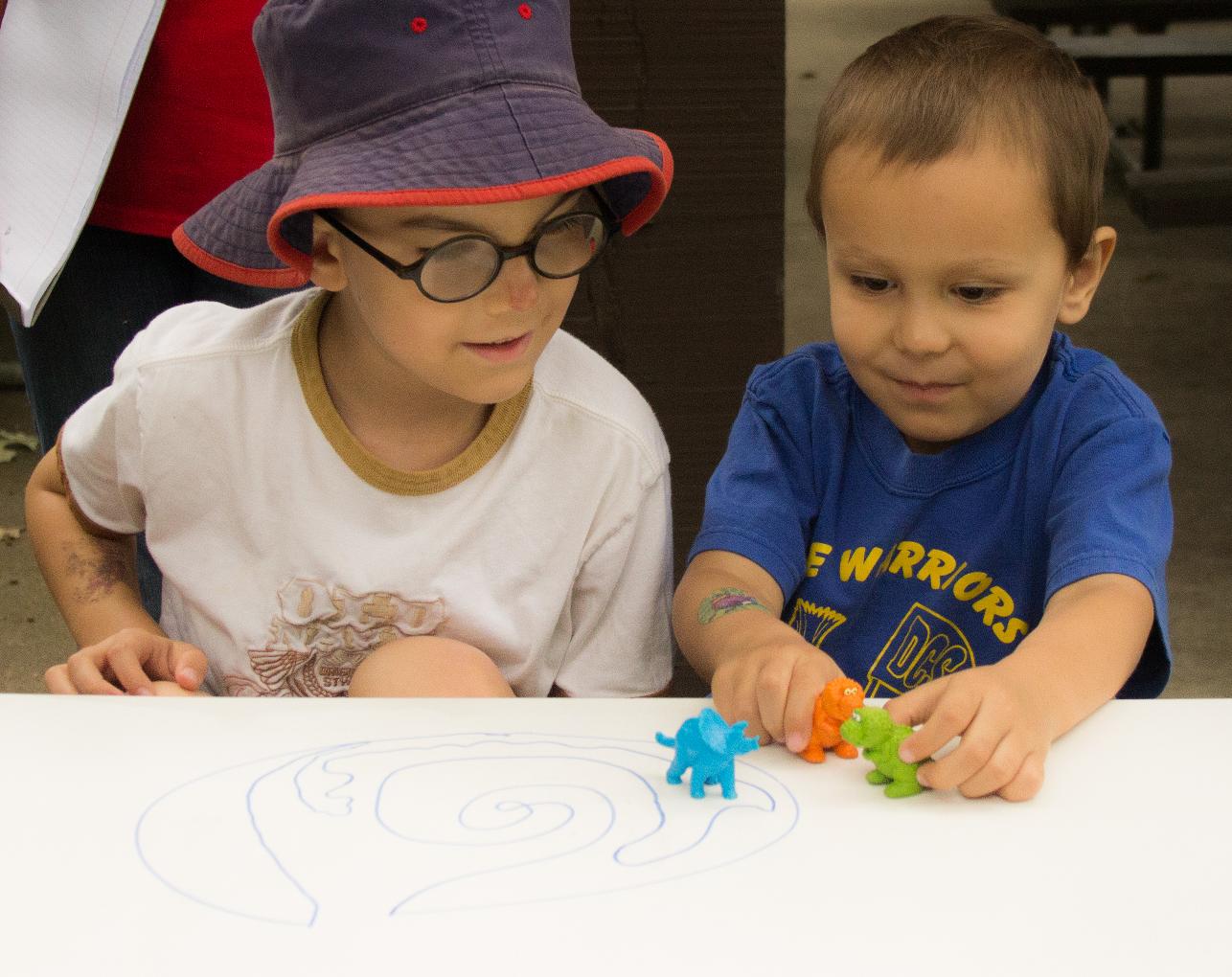
This was a fun activity from Moebius Noodles for our PK-1st grade Homeschool Math in the Park group. The children take turns making a maze and setting a dinosaur inside. Then the other dinosaurs (parents or siblings) try to guess whether their friend is on the land or in the water.

Draw the maze

Player

(1) First, draw a big circle on the white board. This is your lake.

(2) With a finger or a bit of cloth, erase a small section of the circle to create the opening for your maze.

(3) Starting at one edge of the opening, draw a random squiggle inside the circle. Make your squiggle end at the other edge of the opening.

Looks like Land

(4) Set your dinosaur anywhere inside the maze.

Player

(1) Now it’s your turn to guess. Is the dinosaur standing on the land? Is it swimming in the water?

(2) How will you figure out if you guessed right?

(3) Check by jumping across the lines of the maze. Each jump takes you across a boundary: Splash! (Into the water.) Thump! (Back on the land.) Splash! Thump! … Until you reach the dinosaur inside.

(4) Or go to the maze entrance and walk your dinosaur along the path. Can you find your way?

land or water

 
* * *

This blog is reader-supported.

If you’d like to help fund the blog on an on-going basis, then please join me on Patreon for mathy inspiration, tips, and an ever-growing archive of printable activities.

If you liked this post, and want to show your one-time appreciation, the place to do that is PayPal: paypal.me/DeniseGaskinsMath. If you go that route, please include your email address in the notes section, so I can say thank you.

Which I am going to say right now. Thank you!

“Maze Game: Land or Water?” copyright © 2013 by Denise Gaskins. All photos copyright © Denise Gaskins.

Talking Math with Your Kids

Danielson-Talking Math

Christopher Danielson, one of my favorite math bloggers, has a new book out that is perfect for parents of preschool and elementary-age children:

It’s a short book with plenty of great stories, advice, and conversation-starters. While Danielson writes directly to parents, the book will also interest grandparents, aunts & uncles, teachers, and anyone else who wants to help children notice and think about math in daily life.

“You don’t need special skills to do this. If you can read with your kids, then you can talk math with them. You can support and encourage their developing mathematical minds.
 
“You don’t need to love math. You don’t need to have been particularly successful in school mathematics. You just need to notice when your children are being curious about math, and you need some ideas for turning that curiosity into a conversation.
 
“In nearly all circumstances, our conversations grow organically out of our everyday activity. We have not scheduled “talking math time” in our household. Instead, we talk about these things when it seems natural to do so, when the things we are doing (reading books, making lunch, riding in the car, etc) bump up against important mathematical ideas.
 
“The dialogues in this book are intended to open your eyes to these opportunities in your own family’s life.”

— Christopher Danielson
Talking Math with Your Kids

 
* * *

This blog is reader-supported.

If you’d like to help fund the blog on an on-going basis, then please join me on Patreon for mathy inspiration, tips, and an ever-growing archive of printable activities.

If you liked this post, and want to show your one-time appreciation, the place to do that is PayPal: paypal.me/DeniseGaskinsMath. If you go that route, please include your email address in the notes section, so I can say thank you.

Which I am going to say right now. Thank you!

“Talking Math with Your Kids” copyright © 2013 by Denise Gaskins.

Quotable: Learning the Math Facts

Feature photo above by USAG- Humphreys via Flickr (CC BY 2.0).

During off-times, at a long stoplight or in grocery store line, when the kids are restless and ready to argue for the sake of argument, I invite them to play the numbers game.

“Can you tell me how to get to twelve?”

My five year old begins, “You could take two fives and add a two.”

“Take sixty and divide it into five parts,” my nearly-seven year old says.

“You could do two tens and then take away a five and a three,” my younger son adds.

Eventually we run out of options and they begin naming numbers. It’s a simple game that builds up computational fluency, flexible thinking and number sense. I never say, “Can you tell me the transitive properties of numbers?” However, they are understanding that they can play with numbers.

photo by Mike Baird via flickr

I didn’t learn the rules of baseball by filling out a packet on baseball facts. Nobody held out a flash card where, in isolation, I recited someone else’s definition of the Infield Fly Rule. I didn’t memorize the rules of balls, strikes, and how to get someone out through a catechism of recitation.

Instead, I played baseball.

John Spencer
Memorizing Math Facts

Conversational Math

The best way for children to build mathematical fluency is through conversation. For more ideas on discussion-based math, check out these posts:

Learning the Math Facts

For more help with learning and practicing the basic arithmetic facts, try these tips and math games:

 
* * *

This blog is reader-supported.

If you’d like to help fund the blog on an on-going basis, then please join me on Patreon for mathy inspiration, tips, and an ever-growing archive of printable activities.

If you liked this post, and want to show your one-time appreciation, the place to do that is PayPal: paypal.me/DeniseGaskinsMath. If you go that route, please include your email address in the notes section, so I can say thank you.

Which I am going to say right now. Thank you!

“Quotable: Learning the Math Facts” copyright © 2013 by Denise Gaskins. Image at the top of the post copyright © USAG- Humphreys via Flickr (CC BY 2.0).

Quotable: The Adventure of Learning Math

Math mascot Moby Snoodles

As for mathematics itself, it’s one of the most adventurous endeavors a young child can experience. Mathematics is exotic, even bizarre. It is surprising and unpredictable. And it can be more exciting, scary and dangerous than sailing the high seas!

But most parents and educators don’t present math this way. They just want the children to develop their mathematical skills rather than going for something more nebulous, like the mathematical state of mind.

Children marvel as snowflakes magically become fractals, inviting explorations of infinity, symmetry and recursion. Cookies offer gameplay in combinatorics and calculus. Paint chips come in beautiful gradients, and floor tiles form tessellations. Bedtime routines turn into children’s first algorithms. Cooking, then mashing potatoes (and not the other way around!) humorously introduces commutative property. Noticing and exploring math becomes a lot more interesting, even addictive.

Unlike simplistic math that quickly becomes boring, these deep experiences remain fresh, because they grow together with children’s and parents’ understanding of mathematics.

— Maria Droujkova and Yelena McManaman
Adventurous Math For the Playground Set (Scientific American online)