Hooray! The MathCounts Mini videos are back. September’s edition is all about translating word problems into algebra:
You can practice turning words into math with these MathCounts Problems of the Week.
Hooray! The MathCounts Mini videos are back. September’s edition is all about translating word problems into algebra:
You can practice turning words into math with these MathCounts Problems of the Week.
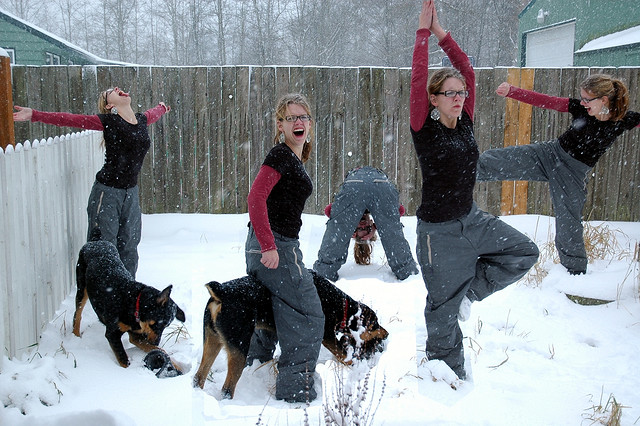
Photo of Evil Erin times 5 (and dog times 2), via flickr.
Perhaps the biggest challenge for any middle-elementary math student is to master the multiplication facts. It can seem like an unending task to memorize so many facts and be able to pull them out of mental storage in any order on demand. Too often, the rote aspect of such memory work overwhelms students, eclipsing their view of the principles behind the math. Yet rote memory is not enough: A student may be able to recite the times tables perfectly and still be reduced to counting on fingers in the middle of a long division problem.
We will use the world’s oldest interactive game — conversation — to learn the multiplication facts one bite at a time. But first, let’s take some time to think about what multiplication really means.
As I continue to polish the manuscript for my math games book, I’ve been looking for short quotations to put at the beginning of each chapter. I’ve gathered a lot of math quotations over the years, from my own reading and from quote-collection websites. But there’s a problem with using most of these in a book, since to do it right I would have to dig up the original source of each quote and then write a letter to the publisher for permission to use it. And pay a fee that, depending on the publisher’s sense of self-importance, can run into the hundreds of dollars. Bother!
So I went digging around my rss reader to see what sort of inspiration I could find. Bloggers love to be quoted, right? And most of them are happy to give permission via email, which makes my job ever so much easier.
Here are some of the gems I’m considering. I’d love to hear your favorite quotes from math bloggers, too — or favorite passages from your own blog. Please comment!
It’s amazing that this vision of math as “getting to the right answer on your first try” even exists. I have to make, unmake, remake so many mistakes to get where I’m going. I think all mathematicians work that way.
Somehow, a big part of the experience of math is trouble. Frustration is the status quo. But when you get something—the thrill!


Welcome to the Math Teachers At Play blog carnival — which is not just for math teachers! If you like to learn new things and play around with ideas, you are sure to find something of interest.
Several of these articles were submitted by the bloggers; others were drawn from my overflowing blog reader. Don’t try to skim everything all at once, but take the time to enjoy browsing. Savor a few posts today, and then come back for another helping tomorrow or next week.
Most of the photos below are from the 2010 MAA Found Math Gallery; click each image for more details. Quotations are from Mike Cook’s Canonical List of Math Jokes.
Let the mathematical fun begin…

With news reports of radiation from Japan being found from California to Massachusetts — and now even in milk — math teachers need to help our students put it all in perspective.
xkcd to the rescue!
Pajamas Media offers a brief history of radiation, plus an analysis of our exposure in Banana Equivalent Doses:
And the EPA offers a FAQ:
[T]he levels being seen now are 25 times below the level that would be of concern even for infants, pregnant women or breastfeeding women, who are the most sensitive to radiation… At this time, there is no need to take extra precautions… Iodine-131 disappears relatively quickly in the environment.
— Centers for Disease Control and Prevention (CDC)
pages 4-5 of EPA FAQ
[Hat tip: Why Homeschool.]

Welcome to the Math Teachers At Play blog carnival — which is not just for math teachers.
Do you enjoy math? I hope so! If not, browsing these links just may change your mind. Most of these posts were submitted by the bloggers themselves; others are drawn from my overflowing Google Reader. From preschool to high school, there are plenty of interesting things to learn.
Let the mathematical fun begin…

<a href="http://www.flickr.com/photos/goetter/2352128932/"Photo by Raphael Goetter via Flickr
Alex and Leon enjoyed their baby sister, but they were amazed at how much work taking care of a baby could be. One particularly colicky night, everyone in the family took turns holding the baby, rocking the baby, patting her back, and walking her around before she finally succumbed to sleep.
Then Alex collapsed on the couch, and Leon sank into the recliner. They teased each other with these story problems.
Remember the Math Adventurer’s Rule: Figure it out for yourself! Whenever I give a problem in an Alexandria Jones story, I will try to post the answer soon afterward. But don’t peek! If I tell you the answer, you miss out on the fun of solving the puzzle. So if you haven’t worked these problems yet, go back to the original posts. If you’re stuck, read the hints. Then go back and try again. Figure them out for yourself — and then check the answers just to prove that you got them right.
This post offers hints and answers to puzzles from these blog posts:

[Photo by Arwen Abendstern.]
If a girl and a half
can read a book and a half
in a day and a half,
then how many books can one girl read in the month of June?
Kitten reads voraciously, but she decided to skip our library’s summer reading program this year. The Border’s Double-Dog Dare Program was a lot less hassle and had a better prize: a free book! Of course, it didn’t take her all summer to finish 10 books.
How fast does Kitten read?

[Photo by OliBac. Visit OliBac’s photostream for more.]
The elementary grades 1-4 laid the foundations, the basics of arithmetic: addition, subtraction, multiplication, division, and fractions. In grade 5, students are expected to master most aspects of fraction math and begin working with the rest of the Math Monsters: decimals, ratios, and percents (all of which are specialized fractions).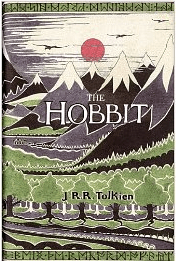
Word problems grow ever more complex as well, and learning to explain (justify) multi-step solutions becomes a first step toward writing proofs.
This installment of my elementary problem solving series is based on the Singapore Primary Mathematics, Level 5A. For your reading pleasure, I have translated the problems into the world of J.R.R. Tolkien’s classic, The Hobbit.
UPDATE: Problems have been genericized to avoid copyright issues.
Continue reading Hobbit Math: Elementary Problem Solving 5th Grade
 Denise Gaskins' Let's Play Math