More Fun with Hexa-Trex

Hexa-trex turtle logo

My elementary Math Club students had fun practicing their math facts and “out of the box” thinking with Hexa-Trex puzzles. The object of Hexa-Trex is to find a path through all the number and operation tiles to make a true equation. The “Easy” puzzles are just the right level for my 4th-5th grade students, although they get stumped whenever the equations require Order of Operations. One girl enjoyed the puzzles enough to take our extra pages home for her dad.

Hexa-Trex puzzles were featured in the October issue of Games magazine, and now you can enjoy Hexa-Trex away from the computer with Bogusia Gierus‘s new book, The First Book of Hexa-Trex Puzzles. If you are thinking ahead to Christmas (can it be that time already?!), and if you have a puzzle lover in the family, this little book would make a fun stocking-stuffer.

Quiz: Those Frustrating Fractions

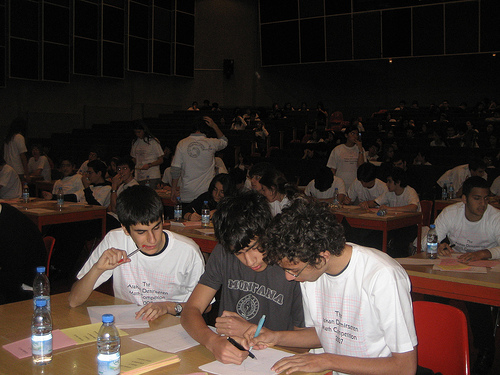
[Photo by jimmiehomeschoolmom.]

Fractions confuse almost everybody. In fact, fractions probably cause more math phobia among children (and their parents) than any other topic before algebra. Middle school textbooks devote a tremendous number of pages to teaching fractions, and still many students find fractions impossible to understand. Standardized tests are stacked with fraction questions.

Fractions are a filter, separating the math haves from the luckless have nots. One major source of difficulty with fractions is that the rules do not seem to make sense. Can you explain these to your children?

Start with an easy one…

Question #1

If you need a common denominator to add or subtract fractions…

  • Why don’t you need a common denominator when you multiply?

Continue reading Quiz: Those Frustrating Fractions

How to Solve Math Problems

That’s a Tough One!

What can you do when you are stumped? Too many students sit and stare at the page, waiting for inspiration to strike — and when the solution doesn’t crack their heads open and step out, fully formed, they complain: “Math is too hard!”

So this year I have given my Math Club students a couple of mini-posters to put up on the wall above their desk, or wherever they do their math homework. The first gives four questions to ask yourself as you think through a math problem, and the second is a list of problem-solving strategies.

Continue reading How to Solve Math Problems

What Do We Mean by “Assume”?

Almost all math problems call for the student to assume one thing or another. Without assumptions — definitions, postulates, axioms, common notions, or whatever you want to call them — mathematics of any kind is impossible. Tony at Pencils Down (who plans to be a math teacher when he grows up) reminds us that, necessary though it may be, we are stepping on dangerous ground when we assume:

Random Samples: Making an Ass of You and Me

Continue reading What Do We Mean by “Assume”?

Quotations XVI: Back to the Blackboard

Classes are back in session at our homeschool co-op, so I am again collecting short quotes for the blackboard. Here are the ones I used in September:

Any fool can know. The point is to understand.

Albert Einstein

Life without geometry is pointless.

Anonymous

You don’t understand anything until you learn it more than one way.

Marvin Minsky

Ben Franklin Math: Elementary Problem Solving 3rd Grade

The ability to solve word problems ranks high on any math teacher’s list of goals. How can I teach my students to solve math problems? I must help them develop the ability to translate “real world” situations into mathematical language.

In two previous posts, I introduced the problem-solving tools algebra and bar diagrams. These tools help our students organize the information in a word problem and translate it into a mathematical calculation.

Working Math Problems with Poor Richard

This time I will demonstrate these problem-solving tools in action with a series of 3rd-grade problems based on the Singapore Primary Math series, level 3A. For your reading pleasure, I have translated the problems into the life of Ben Franklin, inspired by the biography Poor Richard by James Daugherty.

Continue reading Ben Franklin Math: Elementary Problem Solving 3rd Grade

Reading to Learn Math

[Photo by Betsssssy.]

Do you ever take your kids’ math tests? It helps me remember what it is like to be a student. I push myself to work quickly, trying to finish in about 1/3 the allotted time, to mimic the pressure students feel. And whenever I do this, I find myself prone to the same stupid mistakes that students make.

Even teachers are human.

In this case, it was a multi-step word problem, a barrage of information to stumble through. In the middle of it all sat this statement:

…and there were 3/4 as many dragons as gryphons…

My eyes saw the words, but my mind heard it this way:

…and 3/4 of them were dragons…

What do you think — did I get the answer right? Of course not! Every little word in a math problem is important, and misreading even the smallest word can lead a student astray. My mental glitch encompassed several words, and my final tally of mythological creatures was correspondingly screwy.

But here is the more important question: Can you explain the difference between these two statements?

Continue reading Reading to Learn Math