Math War for Simultaneous Equations

Just updated my blog post Math Game: War with Special Decks to add a game I missed the first time around:

Math War is the most worksheety of all the math games I play with kids. But you can add a level of choice by playing the Trumps version.

Math War Trumps: Instead of playing for the highest sum, as in Julie’s original game, have each player draw 3 cards. The player whose turn it is first names “X” or “Y” as trump, then all players lay down a card. Highest trump value wins the skirmish.

Variation: Let the player naming trump also decide whether the highest or lowest value will win.

For more great math games, visit My Best (Free) Math Games for All Ages.

 
* * *

This blog is reader-supported.

If you’d like to help fund the blog on an on-going basis, then please join me on Patreon for mathy inspiration, tips, and an ever-growing archive of printable activities.

If you liked this post, and want to show your one-time appreciation, the place to do that is PayPal: paypal.me/DeniseGaskinsMath. If you go that route, please include your email address in the notes section, so I can say thank you.

Which I am going to say right now. Thank you!

“Math War for Simultaneous Equations” copyright © 2022 by Denise Gaskins. “Red playing cards” photo by José Pablo Iglesias via Unsplash.com.

Playful Math Carnival #154: The Math Journaling Edition

Welcome to the 154th edition of the Playful Math Education Blog Carnival — a smorgasbord of delectable tidbits of mathy fun. It’s like a free online magazine devoted to learning, teaching, and playing around with math from preschool to high school.

Bookmark this post, so you can take your time browsing.

There’s so much playful math to enjoy!

By tradition, we start the carnival with a puzzle/activity in honor of our 154th edition. But if you’d rather jump straight to our featured blog posts, click here to see the Table of Contents.

Try This Puzzle/Activity

Since 154 is a nonagonal number, I think you might enjoy visiting some of my old “Adventures of Alexandria Jones” posts about figurate numbers:

And then try this math journaling prompt: Build or draw your own nonagonal numbers — numbers built from 9-sided polygons.

How many nonagonal numbers can you find? What do you notice? Does it make you wonder?

Click here for all the mathy goodness!

How To Respond to Your Child’s Math Writing

In previous posts, I encouraged parents, homeschoolers, and teachers to explore the world of math and introduced one of my favorite learning tools, the math journal. Then I shared several of my favorite types of journaling prompts to get your kids started writing about math.

Math journal prompts offer a wide range of options for students to explore. Most of the prompts do not have a “right” or “wrong” answer. Our goal is to root around in some small corner of the world of math, to lift a stone and peek underneath it, just to see what we can find.

The idea that being good at math means finding the right answers is a huge myth. Of course, many problems in math do have a single right answer. But even for those problems, the answer is not the real math of the problem.

Math is all about thinking.

It’s like taking a road trip. You may have a destination, but there are many paths you could take to get there. Different students may take different paths — they may think about the problem in different ways.

It’s this reasoning that is the real math, and the right answer is just a side effect of reasoning well.

Continue reading How To Respond to Your Child’s Math Writing

5 Ways To Enrich Your Student’s Experience of Math

In previous posts, I encouraged parents, homeschoolers, and teachers to explore the world of math and introduced one of my favorite learning tools, the math journal.

But you may be wondering, what can my students do with their journal? How do I find good math prompts?

Here are five different ways your children can explore math through writing, classified by the type of reasoning involved.

#1: Game Prompts

Ask your children to play a number or strategy game and then write about it.

Game prompts break through the idea that math is dull and boring. They help students develop a positive attitude toward math while practicing their number skills or strategic thinking.

Continue reading 5 Ways To Enrich Your Student’s Experience of Math

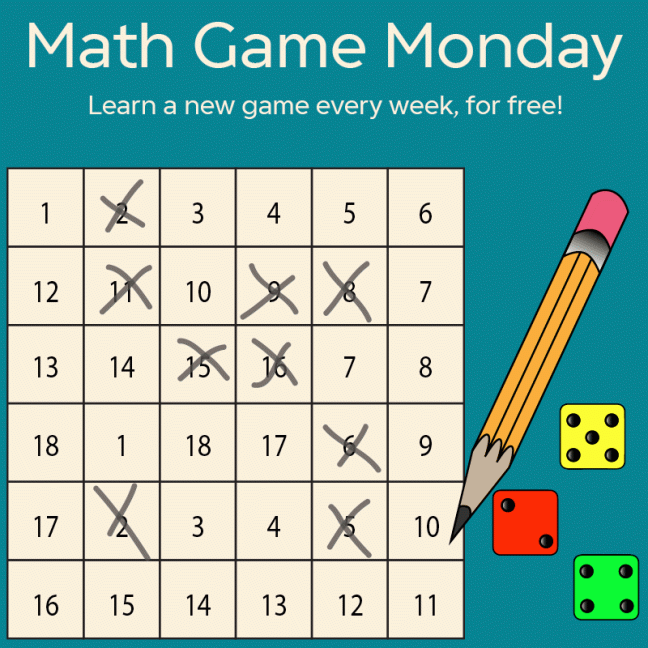
Why Math Game Monday?

Learn a new game with Math Game Monday

There’s a new Math Game Monday this week.

Have your kids tried it yet?

This week’s game is one of my favorites for early elementary grades, a logic game that makes children think about numbers and strategy.

Or, if you’re reading this post later and missed that one, there’s another great new game this week for you to play.

Check it out:

Visit Math Game Monday

Continue reading Why Math Game Monday?

What Is a Math Journal?

In my previous post, I encouraged parents, homeschoolers, and teachers to think of math as a nature walk through an infinite world of wonder.

A math journal is a record of your child’s journey through this world of mathematics.

In a math journal, children explore their own concepts about numbers, shapes, and patterns through drawing or writing in response to a question. Journaling teaches them to see with mathematical eyes — not just to remember what we adults tell them, but to create their own math.

Journaling brings math back into the liberal arts. It makes abstract ideas accessible and stretches children’s understanding, building math fluency and creating a solid foundation for future learning.

Continue reading What Is a Math Journal?

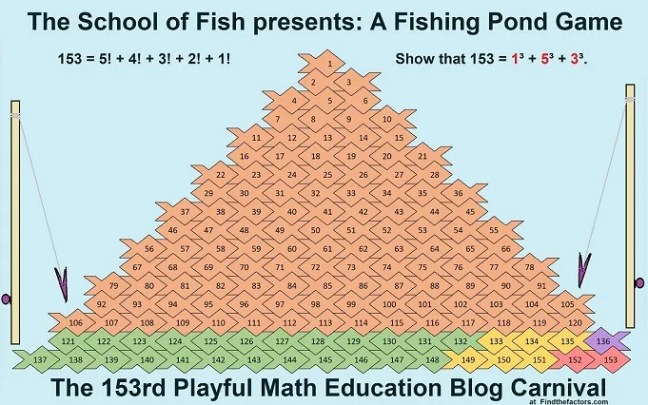
Playful Math Carnival 153 via Find the Factors

Would you like some great ideas for playing math with your kids?

Iva Sallay put together a delightful collection of games, activities, and inspiration in the latest Playful Math Carnival:

You’ll find a fantastic collection of maker math, games, puzzles, activities, inspiration, and other mathematical delights.

What are you waiting for? Come join the fun!

Click Here to Read the Carnival Blog

Help Us Keep the Carnival Going

The Playful Math Blog Carnival wants you!

Each monthly Playful Math Carnival brings you a great new collection of puzzles, math conversations, teaching tips, and all sorts of mathy fun. It’s like a free online magazine of mathematical adventures, helpful and inspiring no matter when you read them.

The carnival is a joint effort. We depend on our volunteer hosts to collect blog posts and write the carnival each month.

Putting together a blog carnival can be a lot of work, but it’s a great opportunity to share the work of bloggers you admire and to discover new math-friends online. I love that part of being a host!

Classroom teachers, homeschoolers, college professors, unschoolers, or anyone who likes to play around with math — if you would like to take a turn hosting the carnival, please speak up!

CREDITS: Feature photo (top) by Iva Sallay.

The Creative Way To Help Your Kids Learn Math

Are you a parent, homeschooler, or teacher? Do your children struggle to learn math? Are you worried about them falling behind?

So many parents (and teachers, too!) feel like they are “not a math person,” yet they know how important math is for their children to learn. How can we teach something we don’t really understand ourselves?

Others feel comfortable with math themselves — and may even love it — yet still struggle to pass on their knowledge to their kids. How can we share the joy we see in numbers, shapes, and patterns with youngsters who think they hate math?

Continue reading The Creative Way To Help Your Kids Learn Math

How Will You Celebrate this Epic Twosday?

Tomorrow is Tuesday 2/22/22 (or 22/2/22, if you prefer). What a wonderfully epic Twosday!

Here’s a puzzle your family or class may enjoy…

The “All 2s” Challenge

Use only the digit 2, and try to use as few of them as you can for each calculation. You may use any math operations you know.

For example:
0 = 2 − 2
8 = 2 + 2 + 2 + 2

  • Can you find a way to make 8 using fewer than four 2s?
  • What other numbers can you make?
  • Can you calculate all the numbers from 1–20? 1–100?

Putting 2 in Perspective

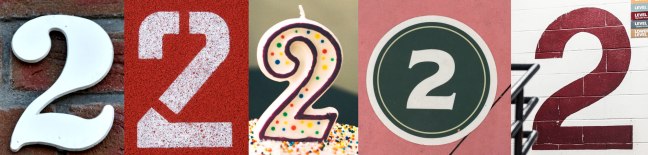
You might enjoy practicing your math art skills with this 2-digit challenge from Steve Wyborney.

How many blocks make the digit 2? How did you count them?

Playful Math #152: Auld Lang Syne Edition

Welcome to the 152nd edition of the Playful Math Education Blog Carnival — a smorgasbord of delectable tidbits of mathy fun. It’s like a free online magazine devoted to learning, teaching, and playing around with math from preschool to high school.

Bookmark this post, so you can take your time browsing. There’s so much playful math to enjoy!

We didn’t have a volunteer host for January, so I’m squeezing this in between other commitments. This is my third no-host-emergency carnival in the last year, which is NOT sustainable. If you’d like to help keep the Playful Math Carnival alive, we desperately need hosts for 2022!

By tradition, we start the carnival with a puzzle or activity in honor of our 152nd edition. But if you’d rather jump straight to our featured blog posts, click here to see the Table of Contents.

Math Journaling with Prime Numbers

Cool facts about 152: The eighth prime number is 19, and 8 × 19 = 152. When you square 152, you get a number that contains all the digits from 0–4. You can make 152 as the sum of eight consecutive even numbers, or as the sum of four consecutive prime numbers.

But 152 has two real claims to fame:

  • It’s the smallest number that is the sum of the cubes of two distinct odd primes.
  • And it’s the largest known even number you can write as the sum of two primes in exactly four ways.

So here’s your math investigation prompt:

  • Play around with prime numbers. Explore their powers, their sums, and anything else about them you like.
  • What do you notice? What do you wonder?
  • What’s the most interesting number relationship you can find?

Continue reading Playful Math #152: Auld Lang Syne Edition