The carnival features numberless problems, math circles, bookmaking, talking with kids, infinite series, division, number routines, calculus, inspiring tips for teachers, and much more.
My youngest daughter wanted to do Singapore math. Miquon Red was her main math text at the time, but we added a bit of Singapore Primary Math 1B whenever she was in the mood.
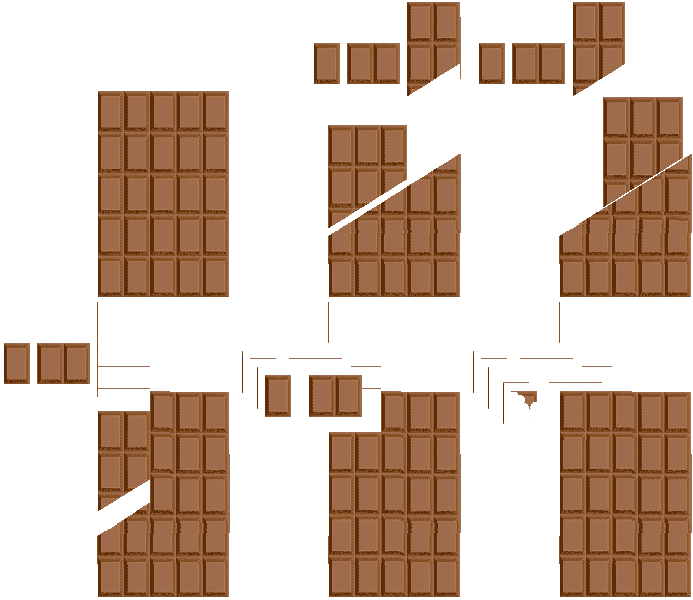
We turned to the lesson on subtracting with numbers in the 30-somethings.
Check out the new carnival of playful math for all ages at Give Me a Sine blog. Each month’s carnival brings you a great new collection of puzzles, math conversations, crafts, teaching tips, and all sorts of mathy fun.
This month’s post features symmetry, origami, and an ant hotel. Percents, fractions, decimals, and the bathroom sink. Algebra, geometry, and trig. And much more!
Do you write an education or family blog? Classroom teacher, math coach, homeschooler, parent, college professor, unschooler — anyone interested in helping kids play around with math? Please consider volunteering to host the MTaP blog carnival for one month.
We still need volunteer hosts for fall semester 2017. Or plan ahead: 2018 is wide open.
You choose the month that fits your schedule and decide how much effort you want to put in. Writing the carnival can take a couple of hours for a simple post — or you can spend several days searching out and polishing playful math gems to share.
Well, I hadn’t planned on spending my day that way. But one of the great things about homeschooling is the freedom to follow rabbit trails.
While browsing the Carnival of Homeschooling, I found a link to Farm School blog’s article Fib Foolery, which sent me to Gotta Book for his articles The Fib and More Fibbery (read the comments on both threads, but be warned that some are crude) and several other posts, all of which set me off on a morning of poetic fun.
A “Fib” is a Fibonacci poem. It’s based on syllable count, like a haiku, but the lines follow the Fibonacci counting series: 1, 1, 2, 3, 5, 8… Each number is the sum of the previous two numbers.
Do you enjoy math? I hope so! If not, browsing this post just may change your mind.
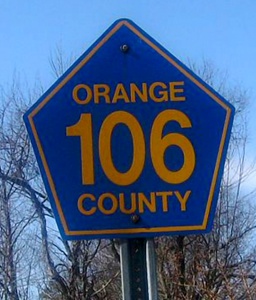
Welcome to the 106th edition of the Math Teachers At Play math education blog carnival — a smorgasbord of links to bloggers all around the internet who have great ideas for learning, teaching, and playing around with math from preschool to pre-college. Let the mathematical fun begin!
By tradition, we start the carnival with a puzzle in honor of our 106th edition. But if you would like to jump straight to our featured blog posts, click here to see the Table of Contents.
Try This Puzzle
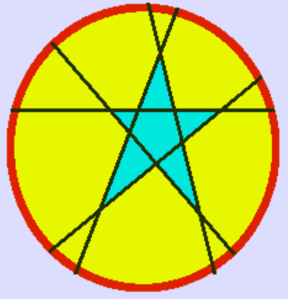
If you slice a pizza with a lightsaber, you’ll make straight cuts all the way across. Slice it once, and you get two pieces.
If you slice it five times, you’ll get a maximum of sixteen pieces. (And if you’re lucky you might get a star!)
How many times would you have to slice the pizza to get 106 pieces?
Doodling gives our minds a chance to relax, wander, and come back to our work refreshed. And though it goes against intuition, doodling can help us remember more of what we learn.
Math doodles let us experiment with geometric shapes and symmetries. We can feel our way into math ideas gradually, through informal play. Through doodles, our students will explore a wide range of mathematical structures and relationships.
Our own school experiences can make it hard for us to teach. What we never learned in school was the concept of playing around with math, allowing ideas to “percolate,” so to speak, before mastery occurs, and that process may take time.
—Julie Brennan
I like to doodle on dotty grid paper, like the pages in my math journals, but there’s No Purchase Necessary! You can design your own printable dot page at Incompetech’s PDF generator.
Patterns in Shape and Angle
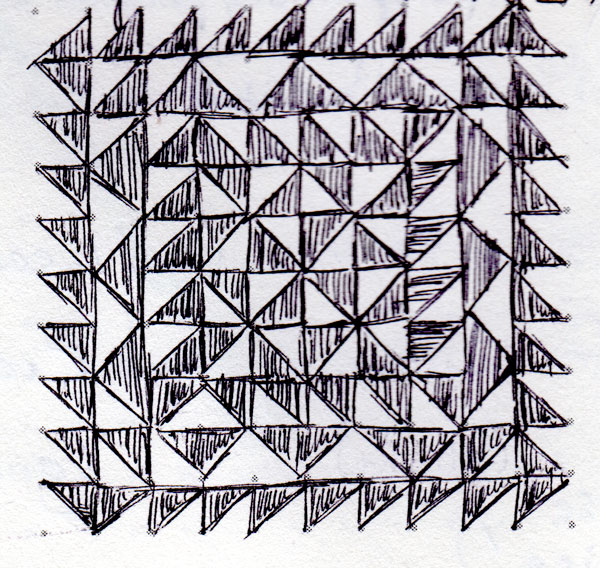
To make a faceted mathematical gemstone, start with any shape you like. Then build other shapes around it. What do you notice? Does your pattern grow outward from its center? Or flow around the corner of your page? How is each layer similar, and how is it different?
Arbitrary constraints can lead to mathematically interesting doodles. For instance, create a design out of 45-45-90 triangles by coloring exactly half of every grid square. How many variations can you find?
Symmetry Challenge
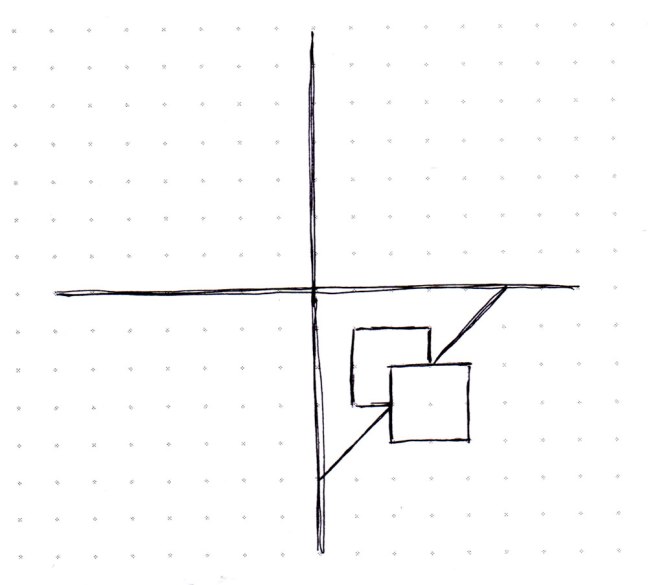
Play a symmetry puzzle game. Draw a line of symmetry and fill in part of the design. Then trade with a partner to finish each other’s doodles.
Make more complex symmetry puzzles with additional reflection lines.
Math Doodle Links
Who can talk about mathematical doodling without mentioning Vi Hart? If you’ve never seen her “Doodling in Math Class” video series, you’re in for a treat!
Or experiment with the more flexible rules in John’s “Knot Fun” lesson.
And my latest obsession: the “ultimate” tutorial series on Celtic Knotwork, which explores the link between knots and their underlying graphs.
Finally, check out my Math Doodling board at Pinterest.
My favorite knot doodle so far.Inspirations: A Recreational Mathematics JournalReflections: A Math Teacher’s JournalExplorations: A Math Student’s JournalContemplations: A Homeschooler’s Journal
“There’s something striking about the economy of the counselor’s construction. He drew a single line, and that totally changed one’s vision of the geometry involved.
“Very often, there’s a simple introduction of something that’s not logically within the framework of the question — and it can be very simple — and it utterly changes your view of what the question really is about.”
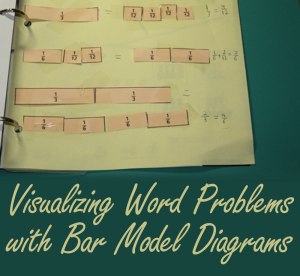
A friend emailed me, frustrated with her child’s math lesson on bar diagrams: “Why do they have to make it so complicated? Why can’t we just solve the blasted problem?”
I told her bar models themselves are not the goal. The real question for parents and teachers is:
What can you do when your child is stumped by a math word problem?
To solve word problems, students must be able to read and understand what is written. They need to visualize this information in a way that will help them translate it into a mathematical expression.
Bar model diagrams are one very useful tool to aid this visualization. These pictures model the word problem in a way that makes the solution appear almost like magic.
It is a trick well worth learning, no matter which math program you use.
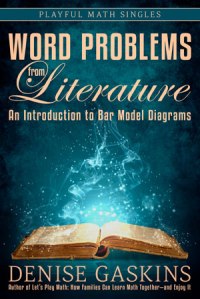
I’ve started working on a book about bar model diagrams, and I’d love to hear your input. Have you tried using them? Do they help your children? What questions do you have?
Update: My New Book
You can help prevent math anxiety by giving your children the mental tools they need to conquer the toughest story problems.
Check out the new carnival of playful math for all ages at Mrs. E Teaches Math. Each month’s carnival brings you a great new collection of puzzles, math conversations, crafts, teaching tips, and all sorts of mathy fun.
 Check out the new Math Teachers at Play blog carnival at Math Hombre blog. You’re sure to enjoy this month’s collection of playful math for all ages.
 Do you enjoy math? I hope so! If not, browsing this post just may change your mind.
 If you slice a pizza with a lightsaber, you’ll make straight cuts all the way across. Slice it once, and you get two pieces.








 Denise Gaskins' Let's Play Math
.jpg)