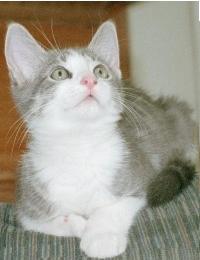
I found this worksheet on the KISS Grammar website, and I loved the quotations so much I just had to share them:
In a cat’s eye, all things belong to cats.
— English proverb
One cat just leads to another.
— Ernest Hemingway
I found this worksheet on the KISS Grammar website, and I loved the quotations so much I just had to share them:
In a cat’s eye, all things belong to cats.
— English proverb
One cat just leads to another.
— Ernest Hemingway
Someone asked me if I was ever sorry I had chosen mathematics. I said, “I didn’t choose! Mathematics is an addiction with me!”
If we are to teach mathematics at all, real success is not possible unless we know that the subject is beautiful as well as useful. Mere utility of the moment without any feeling of beauty becomes a hopeless bit of drudgery, a condition which leads to stagnation.
…What would mathematics have amounted to without the imagination of its devotees—its giants and their followers? There never was a discovery made without the urge of imagination—of imagination which broke the roadway through the forest in order that cold logic might follow.
Procrastination is the art of keeping up with yesterday.
Joyful Days kindly nominated me for the Thinking Blogger Award back in the days of the dinosaurs. Well, she isn’t that old, really — it was only last April. I am grateful to her for thinking of me, and ever since then I have been thinking deeply about whom to nominate in my turn. Or, to be more precise, I printed out the nomination post as a reminder, and then it got lost in a pile of “to sort/read/file” papers on a shelf under my desk…
Registrations have been rolling in for our homeschool co-op, and the most popular classes are full already. Math doesn’t seem to be a “most popular” class. I can’t imagine why! Still, many of my students from last year are coming back for another go, and I am getting spill-over from the science class waiting list.
Anyway, I have started planning in earnest for our fall session. As usual, I look to those wiser than myself for inspiration…
Many teachers are concerned about the amount of material they must cover in a course. One cynic suggested a formula: since, he said, students on the average remember only about 40% of what you tell them, the thing to do is to cram into each course 250% of what you hope will stick.
Continue reading Quotations XIII: Mathematics Education Is Much More Complicated than You Expected
This week’s quotes for teachers:
It is the duty of all teachers, and of teachers of mathematics in particular, to expose their students to problems much more than to facts.
There are many things you can do with problems besides solving them. First you must define them, pose them. But then, of course, you can also refine them, depose them, or expose them, even dissolve them! A given problem may send you looking for analogies, and some of these may lead you astray, suggesting new and different problems, related or not to the original. Ends and means can get reversed. You had a goal, but the means you found didn’t lead to it, so you found new goal they do lead to. It’s called play.
Creative mathematicians play a lot; around any problem really interesting they develop a whole cluster of analogies, of playthings.
— David Hawkins
The Spirit of Play [pdf, 1.4MB]
quoted by Rosemary Schmalz, Out of the Mouths of Mathematicians
We will be heading out soon on vacation, so I will not be blogging for awhile. The rest of this week is devoted to packing. (I hate packing!) But before I leave, here is a longish quote on teaching math from the book I am reading this week: Ian Stewart’s Letters to a Young Mathematician.
A second reason why few students ever realize that there is mathematics outside the textbook is that no one ever tells them that.
I don’t blame the teachers… If your students are having problems remembering how to solve quadratic equations, the wise teacher will stay well clear of cubic equations, which are even more difficult….
More quotations especially for teachers:
There is no Royal Road to Geometry.
— Euclid
Teaching is the royal road to learning.
The title which I most covet is that of teacher. The writing of a research paper and the teaching of freshman calculus, and everything in between, falls under this rubric. Happy is the person who comes to understand something and then gets to explain it.
We continue to plan our co-op courses for next fall. Some of the classes I had hoped for will not happen, and my children are going to have to make some tough choices between the remaining topics. Unfortunately, they have not yet mastered the ability to be in two classrooms at once.
I have three math courses to plan, and I think I will focus as much as I can on teaching math through problems, even at the elementary level. These are once-a-week enrichment classes for homeschooled students, so I assume they have a “normal” math program at home. I want to introduce a few topics they might not otherwise see, to deepen their understanding of the topics they have studied, and to give them a taste of that “Aha!” feeling that comes from conquering a challenging problem. Has anybody done something like this, and can you recommend some good resources?
Aaaargh! My Internet service is on the brink again. But since I had to run into my husband’s office to check email, I’ll take a few minutes to post a quick note. Here are a couple of quotes especially for teachers:
The only teaching that a professor can give, in my opinion, is that of thinking in front of his students.
A good student is one who will teach you something.
Our homeschool co-op classes are done for the semester, so this will be my last compilation of blackboard quotes for awhile. I love collecting quotations, however, so I will be treating you to some of my favorites “just for teachers” over the summer. Stay tuned!
It is better to solve one problem five different ways, than to solve five problems one way.
Education is the key to unlock the golden door of freedom.
Continue reading Quotations VIII: The Essence of Mathematics
 Denise Gaskins' Let's Play Math