Do you enjoy math? I hope so! If not, browsing this post just may change your mind. Welcome to the Math Teachers At Play blog carnival — a smorgasbord of ideas for learning, teaching, and playing around with math from preschool to pre-college.
Let the mathematical fun begin!
POLYHEDRON PUZZLE
By tradition, we start the carnival with a puzzle in honor of our 62nd edition:
An Archimedean solid is a polyhedron made of two or more types of regular polygons meeting in identical vertices. A rhombicosidodecahedron (see image above) has 62 sides: triangles, squares, and pentagons.
How many of each shape does it take to make a rhombicosidodecahedron?
Click for template.
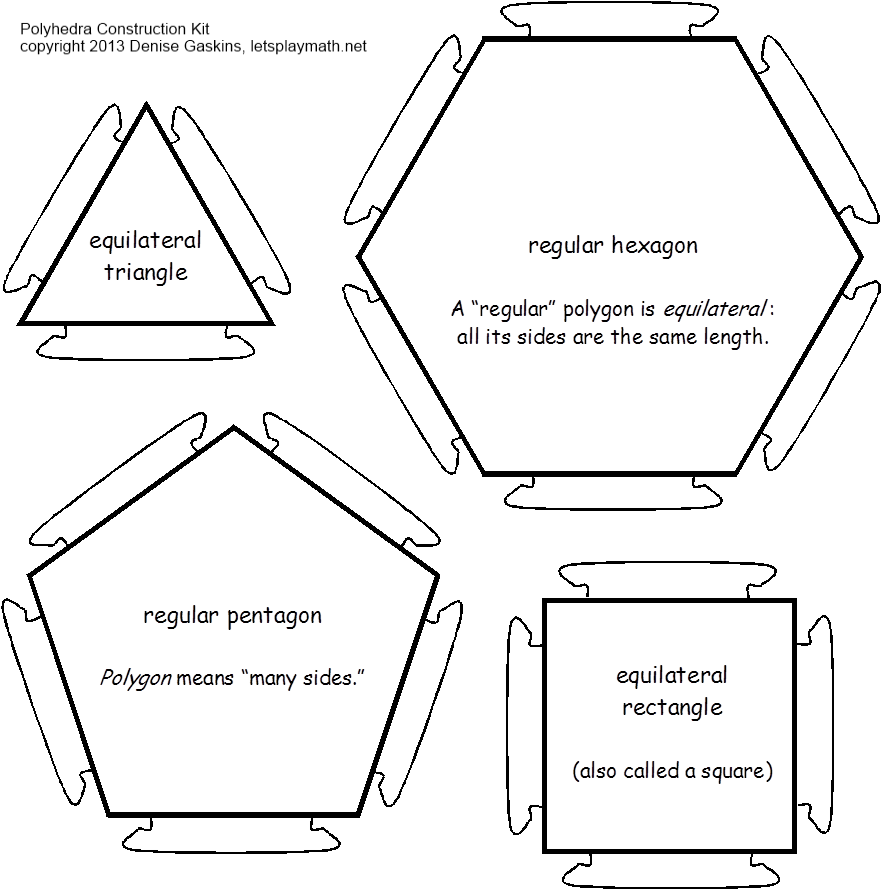
My math club students had fun with a Polyhedra Construction Kit. Here’s how to make your own:
Collect a bunch of empty cereal boxes. Cut the boxes open to make big sheets of cardboard.
Print out the template page (→) and laminate. Cut out each polygon shape, being sure to include the tabs on the sides.
Turn your cardboard brown-side-up and trace around the templates, making several copies of each polygon. I recommend 20 each of the pentagon and hexagon, 40 each of the triangle and square.
Draw the dark outline of each polygon with a ballpoint pen, pressing hard to score the cardboard so the tabs will bend easily.
Cut out the shapes, being careful around the tabs.
Use small rubber bands to connect the tabs. Each rubber band will hold two tabs together, forming one edge of a polyhedron.
So, for instance, it takes six squares and twelve rubber bands to make a cube. How many different polyhedra (plural of polyhedron) will you make?
Can you build a rhombicosidodecahedron?
And now, on to the main attraction: the 62 blog posts. Many of the following articles were submitted by their authors; others were drawn from the immense backlog in my blog reader. If you’d like to skip directly to your area of interest, here’s a quick Table of Contents:
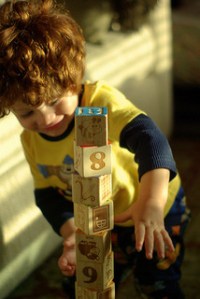
As for mathematics itself, it’s one of the most adventurous endeavors a young child can experience. Mathematics is exotic, even bizarre. It is surprising and unpredictable. And it can be more exciting, scary and dangerous than sailing the high seas!
But most parents and educators don’t present math this way. They just want the children to develop their mathematical skills rather than going for something more nebulous, like the mathematical state of mind.
…
Children marvel as snowflakes magically become fractals, inviting explorations of infinity, symmetry and recursion. Cookies offer gameplay in combinatorics and calculus. Paint chips come in beautiful gradients, and floor tiles form tessellations. Bedtime routines turn into children’s first algorithms. Cooking, then mashing potatoes (and not the other way around!) humorously introduces commutative property. Noticing and exploring math becomes a lot more interesting, even addictive.
Unlike simplistic math that quickly becomes boring, these deep experiences remain fresh, because they grow together with children’s and parents’ understanding of mathematics.
Now is the accepted time to make your regular annual good resolutions. Next week you can begin paving hell with them as usual.
Yesterday, everybody smoked his last cigar, took his last drink, and swore his last oath. Today, we are a pious and exemplary community. Thirty days from now, we shall have cast our reformation to the winds and gone to cutting our ancient shortcomings considerably shorter than ever. We shall also reflect pleasantly upon how we did the same old thing last year about this time.
However, go in, community. New Year’s is a harmless annual institution, of no particular use to anybody save as a scapegoat for promiscuous drunks, and friendly calls, and humbug resolutions, and we wish you to enjoy it with a looseness suited to the greatness of the occasion.
For many homeschoolers, January is the time to assess our progress and make a few New Semester’s Resolutions. This year, we resolve to challenge ourselves to more math puzzles. Would you like to join us? Pump up your mental muscles with the 2013 Mathematics Game!
One reason to study algebra: because it’s a building block. And just as it was really hard at first to get those blocks to do what you wanted them to do, so also it can be really hard at first to get algebra to work. But if you persevere, who knows what you might build someday?
Algebra is the beginning of a journey that gives you the skills to solve more complex problems.
…
So, try not to think of Algebra as a boring list of rules and procedures to memorize. Consider algebra as a gateway to exploring the world around us all.
Imagine that you wanted your children to learn the names of all their cousins, aunts and uncles. But you never actually let them meet or play with them. You just showed them pictures of them, and told them to memorize their names.
Each day you’d have them recite the names, over and over again. You’d say, “OK, this is a picture of your great-aunt Beatrice. Her husband was your great-uncle Earnie. They had three children, your uncles Harpo, Zeppo, and Gummo. Harpo married your aunt Leonie … yadda, yadda, yadda.
I finally got around to reading a bit of the backlog in my Google Reader. I love Malke’s blog!
I used to think that math was some kind of inaccessible, abstract magic trick, a sort of in-joke that excluded us common folk, but now I realize that math is completely not that at all. The reality of math as most of us know it is like that story where three men are standing in a dark room touching different parts of an elephant. None of them has the full picture because they’re only perceiving individual elements of the whole animal.
The reality, I’m discovering, is that math is just like that elephant: a large, expansive, three-dimensional, intelligent, sensitive, expressive creature.
The problem is that most of us have been standing around in that dark room since about kindergarten, grasping its tail, thinking “this is what math is and, personally, I don’t think it’s for me.” We’ve been blind to the larger, incredibly beautiful picture that would emerge if only we would turn on the lights and open our eyes.
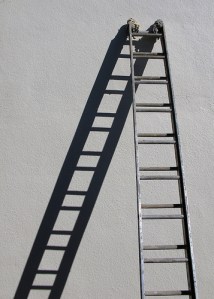
The physical five oranges goes up the ladder to the picture of the five oranges which goes up to the representation of the five oranges as a numeral.
This points in the direction of a definition of abstraction: when we abstract we voluntarily ignore details of a context, so that we can accomplish a goal.
Most remarks made by children consist of correct ideas very badly expressed. A good teacher will be very wary of saying ‘No, that’s wrong.’ Rather, he will try to discover the correct idea behind the inadequate expression. This is one of the most important principles in the whole of the art of teaching.
I had the most beautiful set of theories you ever knew when I started out as a schoolma’am, but every one of them has failed me at some pinch or another.





 Denise Gaskins' Let's Play Math