Build Mathematical Skills by Delaying Arithmetic, Part 4

To my fellow homeschoolers,

While Benezet originally sought to build his students’ reasoning powers by delaying formal arithmetic until seventh grade, pressure from “the deeply rooted prejudices of the educated portion of our citizens” forced a compromise. Students began to learn the traditional methods of arithmetic in sixth grade, but still the teachers focused as much as possible on mental math and the development of thinking strategies.

Notice how waiting until the children were developmentally ready made the work more efficient. Benezet’s students studied arithmetic for only 20-30 minutes per day. In a similar modern-day experiment, Daniel Greenberg of Sudbury School discovered the same thing: Students who are ready to learn can master arithmetic quickly!

Grade VI

[20 to 25 minutes a day]

At this grade formal work in arithmetic begins. Strayer-Upton Arithmetic, book III, is used as a basis.

[Note: Essentials of Arithmetic by George Wentworth and David Eugene Smith is available free and would probably work as a substitute.]

The processes of addition, subtraction, multiplication, and division are taught.

Care is taken to avoid purely mechanical drill. Children are made to understand the reason for the processes which they use. This is especially true in the case of subtraction.

Problems involving long numbers which would confuse them are avoided. Accuracy is insisted upon from the outset at the expense of speed or the covering of ground, and where possible the processes are mental rather than written.

Before starting on a problem in any one of these four fundamental processes, the children are asked to estimate or guess about what the answer will be and they check their final result by this preliminary figure. The teacher is careful not to let the teaching of arithmetic degenerate into mechanical manipulation without thought.

Fractions and mixed numbers are taught in this grade. Again care is taken not to confuse the thought of the children by giving them problems which are too involved and complicated.

Multiplication tables and tables of denominate numbers, hitherto learned, are reviewed.

— L. P. Benezet
The Teaching of Arithmetic II: The Story of an experiment

Continue reading Build Mathematical Skills by Delaying Arithmetic, Part 4

Build Mathematical Skills by Delaying Arithmetic, Part 3

To my fellow homeschoolers,

How can our children learn mathematics if we delay teaching formal arithmetic rules? Ask your librarian to help you find some of the wonderful living books about math. Math picture books are great for elementary students. Check your library for the Time-Life “I Love Math” books or the “Young Math Book” series. You’ll be amazed at the advanced topics your children can understand!

Benezet’s students explored their world through measurement, estimation, and mental math. Check out my PUFM Series for mental math thinking strategies that build your child’s understanding of number patterns and relationships.

Grade IV

Still there is no formal instruction in arithmetic.

By means of foot rules and yard sticks, the children are taught the meaning of inch, foot, and yard. They are given much practise in estimating the lengths of various objects in inches, feet, or yards. Each member of the class, for example, is asked to set down on paper his estimate of the height of a certain child, or the width of a window, or the length of the room, and then these estimates are checked by actual measurement.

The children are taught to read the thermometer and are given the significance of 32 degrees, 98.6 degrees, and 212 degrees.

They are introduced to the terms “square inch,” “square foot,” and “square yard” as units of surface measure.

With toy money [or real coins, if available] they are given some practise in making change, in denominations of 5’s only.

All of this work is done mentally. Any problem in making change which cannot be solved without putting figures on paper or on the blackboard is too difficult and is deferred until the children are older.

Toward the end of the year the children will have done a great deal of work in estimating areas, distances, etc., and in checking their estimates by subsequent measuring. The terms “half mile,” “quarter mile,” and “mile” are taught and the children are given an idea of how far these different distances are by actual comparisons or distances measured by automobile speedometer.

The table of time, involving seconds, minutes, and days, is taught before the end of the year. Relation of pounds and ounces is also taught.

— L. P. Benezet
The Teaching of Arithmetic II: The Story of an experiment

Continue reading Build Mathematical Skills by Delaying Arithmetic, Part 3
Build Mathematical Skills by Delaying Arithmetic, Part 2

To my fellow homeschoolers,

Most young children are not developmentally ready to master abstract, pencil-and-paper rules for manipulating numbers. But they are eager to learn about and explore the world of ideas. Numbers, patterns, and shapes are part of life all around us. As parent-teachers, we have many ways to feed our children’s voracious mental appetites without resorting to workbooks.

To delay formal arithmetic does not mean that we avoid mathematical topics — only that we delay math fact drill and the memorization of procedures. Notice the wide variety of mathematics Benezet’s children explored through books and through their own life experiences:

Grade I

There is no formal instruction in arithmetic. In connection with the use of readers, and as the need for it arises, the children are taught to recognize and read numbers up to 100. This instruction is not concentrated into any particular period or time but comes in incidentally in connection with assignments of the reading lesson or with reference to certain pages of the text.

Meanwhile, the children are given a basic idea of comparison and estimate thru [sic] the understanding of such contrasting words as: more, less; many. few; higher, lower; taller, shorter; earlier, later; narrower, wider; smaller, larger; etc.

As soon as it is practicable the children are taught to keep count of the date upon the calendar. Holidays and birthdays, both of members of the class and their friends and relatives, are noted.

— L. P. Benezet
The Teaching of Arithmetic II: The Story of an experiment

Continue reading Build Mathematical Skills by Delaying Arithmetic, Part 2

Build Mathematical Skills by Delaying Arithmetic, Part 1

To my fellow homeschoolers,

It’s counter-intuitive, but true: Our children will do better in math if we delay teaching them formal arithmetic skills. In the early years, we need to focus on conversation and reasoning — talking to them about numbers, bugs, patterns, cooking, shapes, dinosaurs, logic, science, gardening, knights, princesses, and whatever else they are interested in.

In the fall of 1929 I made up my mind to try the experiment of abandoning all formal instruction in arithmetic below the seventh grade and concentrating on teaching the children to read, to reason, and to recite — my new Three R’s. And by reciting I did not mean giving back, verbatim, the words of the teacher or of the textbook. I meant speaking the English language.

— L. P. Benezet
The Teaching of Arithmetic I: The Story of an experiment

Continue reading Build Mathematical Skills by Delaying Arithmetic, Part 1

PUFM 1.2 Place Value

Photo by Chrissy Johnson1 via flickr. In this Homeschooling Math with Profound Understanding (PUFM) Series, we are studying Elementary Mathematics for Teachers and applying its lessons to home education.

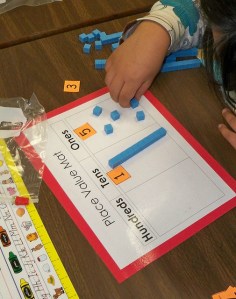
Our decimal system of recording numbers is ingenious. Once learned, it is a simple, versatile, and efficient way of writing numbers. … But the system is not obvious nor easily learned. The use of place value is subtle, and mastering it is the single most challenging aspect of elementary school mathematics.

Ironically, these challenges are largely invisible to untrained parents and teachers — place value is so ingrained in adults’ minds that it is difficult to appreciate how important it is and how hard it is to learn.

— Thomas H. Parker & Scott J. Baldridge
Elementary Mathematics for Teachers

In other words, we take place value for granted. I know this was true of me when I started teaching my kids. Every year, their textbooks would start with the obligatory chapters on place value, which seemed to me just busywork. I began to appreciate the vital importance of place value when I read Liping Ma’s book and saw how the American teachers were unable to properly explain subtraction or multi-digit multiplication.

Place value is the heart of our number system, the foundation on which all the rest of arithmetic must be built. Because of place value, “The simplest schoolboy is now familiar with facts for which Archimedes would have sacrificed his life.”

Continue reading PUFM 1.2 Place Value

Update: My Math Books

photo by goXunuReviews via Flickr

Are you a homeschooler? Are you happy with your current curriculum, or would you like to break out of the textbook mold and explore math through “living” books and activities? Whether you hope to replace your math program or just to supplement it, I can show you ways to turn math into a learning adventure for the whole family. Your children will build a stronger foundation of understanding when you teach math as a game, playing with ideas.

Nearly a year ago, I wrote:

This blog originally grew out of my books, and now it’s coming full circle: New, expanded editions of my long-out-of-print books are ripening on the vine, growing out of the blog. To bring them to harvest, I’m going to need your help.

It has taken much longer than I had hoped to whip the manuscripts into form. My new goal is to publish ebook editions, since I will be able to sell them for about half what the original books cost twelve years ago. I’m hoping that I can finish at least a couple of the ebooks by mid-summer.

Continue reading Update: My Math Books

PUFM 1.1 Counting

Photo by Iain Watson via flickr. In this Homeschooling Math with Profound Understanding (PUFM) Series, we are studying Elementary Mathematics for Teachers and applying its lessons to home education.

Many things in mathematics need to be understood relationally — that is, in relationship to other concepts. But some things just need to be memorized. How do you know which is which? A homeschooling friend pointed out that one thing children definitely need to memorize is the counting sequence from 1-100 and beyond. While there are some patterns that make counting easier, one does just have to memorize which “nonsense sounds” we have attached to each number.

Another sort-of counting that young students should master is subitizing — recognizing at a glance how many items are in a small group. Children do this instinctively, but we can help them develop the skill by playing subitizing games.

[Aside: In writing this blog post, I ran into some nostalgia. Back when we first did these PUFM lessons, my daughter Kitten was only a toddler. I wrote, “I’ve tried to do lots of counting with my youngest, who hasn’t quite gotten beyond, ‘…eleven, twelve, firteen, firteen, nineteen, seven,…’ The numbers tend to start appearing randomly after she gets past 10.” Ah, memories.]

Continue reading PUFM 1.1 Counting

Working on My Let’s Play Math! Books

Workplace stress caused by an unsuitable work ...
Image via Wikipedia

This blog originally grew out of my books, and now it’s coming full circle: New, expanded editions of my long-out-of-print books are ripening on the vine, growing out of the blog. To bring them to harvest, I’m going to need your help.

The Books

I’m working on the games books first because I think they will be the most helpful supplements to any math program.

  • Let’s Play Math! Number Games for All Ages
    This book will include games like Tens Concentration and Hit Me, as well as tips for teaching negative numbers, the times table, and more. Never before published, because it was planned as the fifth book in my earlier how-to-teach-homeschool-math series, but my self-publishing experiment ended after book four.
  • Others to be announced, if I ever get the first two done…

Continue reading Working on My Let’s Play Math! Books

Planning a New Math Club

[Photo by Waponi.]

A few years ago, I had several (potentially) future engineers in our homeschool math club, and we enjoyed the challenge of MathCounts and AMC puzzles — but the current crop of local homeschool students is another story.

Last year’s contest-based club meetings dwindled to one student. Even before the recent MathCounts rule changes, I knew I needed a new plan. The final straw was Kitten, whose moaning complaint that she “hates math” has begun to drive me crazy.

So, what’s a homeschool math teacher to do?

Continue reading Planning a New Math Club

MathCounts: Grandfather Clause for Existing Homeschool Teams

Click here for the official update. Small schools are not mentioned, but it seems logical that their existing teams would also be grandfathered in. Maybe? and according to Mathmom’s comment below, small schools are left out in the cold.

… After taking all concerns into account, a compromise was crafted that would grandfather in homeschools and virtual schools that participated in the 2009-2010 program year to allow them to participate on teams in this year’s Competition Program. All new homeschool and virtual school participants must abide by the new eligibility rules that require those participants to register only as individuals. This compromise was brought to the MATHCOUNTS Board of Directors and approved unanimously.

Therefore, for the 2010-2011 school year, all homeschool and virtual school groups that registered for the MATHCOUNTS Competition Program either as teams OR individuals during the 2009-2010 program year will be allowed to register teams or as individuals for the upcoming 2010-2011 program year, following all of the 2009-2010 requirements for participation.