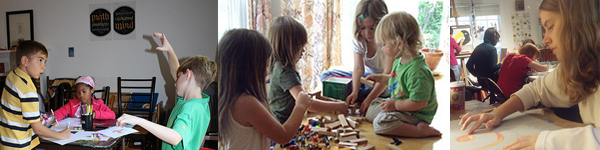
During off-times, at a long stoplight or in grocery store line, when the kids are restless and ready to argue for the sake of argument, I invite them to play the numbers game.
“Can you tell me how to get to twelve?”
My five year old begins, “You could take two fives and add a two.”
“Take sixty and divide it into five parts,” my nearly-seven year old says.
“You could do two tens and then take away a five and a three,” my younger son adds.
Eventually we run out of options and they begin naming numbers. It’s a simple game that builds up computational fluency, flexible thinking and number sense. I never say, “Can you tell me the transitive properties of numbers?” However, they are understanding that they can play with numbers.
…
photo by Mike Baird via flickr
I didn’t learn the rules of baseball by filling out a packet on baseball facts. Nobody held out a flash card where, in isolation, I recited someone else’s definition of the Infield Fly Rule. I didn’t memorize the rules of balls, strikes, and how to get someone out through a catechism of recitation.
If you’d like to help fund the blog on an on-going basis, then please join me on Patreon for mathy inspiration, tips, and an ever-growing archive of printable activities.
If you liked this post, and want to show your one-time appreciation, the place to do that is PayPal: paypal.me/DeniseGaskinsMath. If you go that route, please include your email address in the notes section, so I can say thank you.
A couple of weeks ago, James Tanton launched a wonderful resource: a free online course devoted to quadratic equations. (And he promises more topics to come.)
Kitten and I have been working through the lessons, and she loves it!
We’re skimming through pre-algebra in our regular lessons, but she has enjoyed playing around with simple algebra since she was in kindergarten. She has a strong track record of thinking her way through math problems, and earlier this year she invented her own method for solving systems of equations with two unknowns.
I would guess her background is approximately equal to an above-average Algebra 1 student near the end of the first semester.
After few lessons of Tanton’s course, she proved — within the limits of experimental error — that a catenary (the curve formed by a hanging chain) cannot be described by a quadratic equation. Last Friday, she easily solved the following equations:
and:
and (though it took a bit more thought):
We’ve spent less than half an hour a day on the course, as a supplement to our AoPS Pre-Algebra textbook. We watch each video together, pausing occasionally so she can try her hand at an equation before listening to Tanton’s explanation. Then (usually the next day) she reads the lesson and does the exercises on her own.
So far, she hasn’t needed the answers in the Companion Guide to Quadratics, but she did use the “Dots on a Circle” activity — and knowing that she has the answers available helps her feel more independent.
Do you enjoy math? I hope so! If not, browsing this post just may change your mind. Welcome to the Math Teachers At Play blog carnival — a smorgasbord of ideas for learning, teaching, and playing around with math from preschool to pre-college.
Let the mathematical fun begin!
POLYHEDRON PUZZLE
By tradition, we start the carnival with a puzzle in honor of our 62nd edition:
An Archimedean solid is a polyhedron made of two or more types of regular polygons meeting in identical vertices. A rhombicosidodecahedron (see image above) has 62 sides: triangles, squares, and pentagons.
How many of each shape does it take to make a rhombicosidodecahedron?
Click for template.
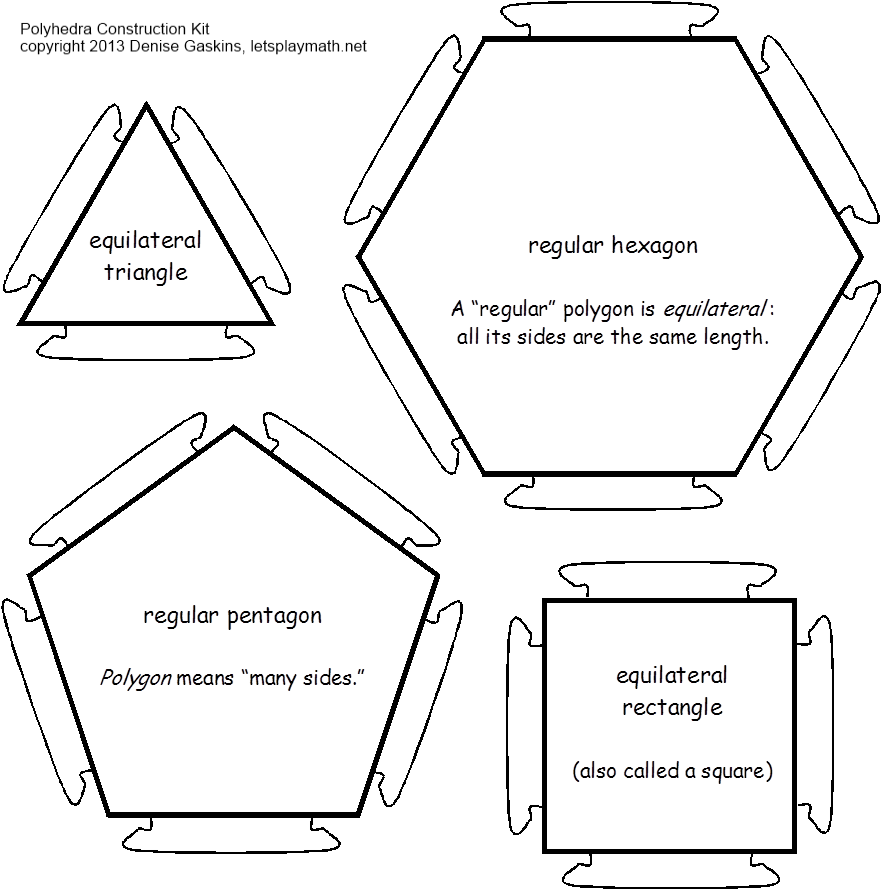
My math club students had fun with a Polyhedra Construction Kit. Here’s how to make your own:
Collect a bunch of empty cereal boxes. Cut the boxes open to make big sheets of cardboard.
Print out the template page (→) and laminate. Cut out each polygon shape, being sure to include the tabs on the sides.
Turn your cardboard brown-side-up and trace around the templates, making several copies of each polygon. I recommend 20 each of the pentagon and hexagon, 40 each of the triangle and square.
Draw the dark outline of each polygon with a ballpoint pen, pressing hard to score the cardboard so the tabs will bend easily.
Cut out the shapes, being careful around the tabs.
Use small rubber bands to connect the tabs. Each rubber band will hold two tabs together, forming one edge of a polyhedron.
So, for instance, it takes six squares and twelve rubber bands to make a cube. How many different polyhedra (plural of polyhedron) will you make?
Can you build a rhombicosidodecahedron?
And now, on to the main attraction: the 62 blog posts. Many of the following articles were submitted by their authors; others were drawn from the immense backlog in my blog reader. If you’d like to skip directly to your area of interest, here’s a quick Table of Contents:
Most homeschoolers feel at least a small tinge of panic as their students approach high school. “What have we gotten ourselves into?” we wonder. “Can we really do this?” Here are a few tips to make the transition easier.
Before you move forward, it may help to take a look back. How has homeschooling worked for you and your children so far?
If your students hate math, they probably never got a good taste of the “Aha!” factor, that Eureka! thrill of solving a challenging puzzle. The early teen years may be your last chance to convince them that math can be fun, so consider putting aside your textbooks for a few months to:
Remodel the house. From financing to floor coverings, that is real math in action.
On the other hand, if you have delayed formal arithmetic, using your children’s elementary years to explore a wide variety of mathematical adventures, now is a good time to take stock of what these experiences have taught your students.
How much of what society considers “the basics” have your children picked up along the way?
Are there any gaps in their understanding of arithmetic, any concepts you want to add to their mental tool box?
Homeschoolers, after-schoolers, unschoolers, or anyone else: if you’re a parent with kids at home, you need this book. If you work with children in any way (grandparent, aunt/uncle, teacher, child care, baby sitter, etc.) you need this book. Or if you hated math in school and never understood how anyone could enjoy it, you need this book!
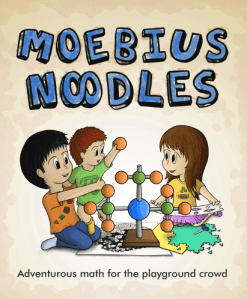
Moebius Noodles is a travel guide to the Math Universe for adventurous families (and it has lots of beautiful pictures, too!) featuring games and activities that draw out the rich, mathematical properties of everyday objects in ways accessible to parents and children:
A snowflake is an example of a fractal and an invitation to explore symmetry.
Cookies offer combinatorics and calculus games.
Paint chips come in beautiful gradients, and floor tiles form tessellations.
After teaching co-op math classes for several years, I’ve become known as the local math maven. Upon meeting one of my children, fellow homeschoolers often say, “Oh, you’re Denise’s son/daughter? You must be really good at math.”
The kids do their best to smile politely — and not to roll their eyes until the other person has turned away.
I hear similar comments after teaching a math workshop: “Wow, your kids must love math!” But my children are individuals, each with his or her own interests. A couple of them enjoy an occasional geometry or logic puzzle, but they never voluntarily sit down to slog through a math workbook page.
In fact, one daughter expressed the depth of her youthful perfectionist angst by scribbling all over the cover of her Miquon math workbook:
“I hate math! Hate, hate, hate-hate-HATE MATH!!!”
Translation: “If I can’t do it flawlessly the first time, then I don’t want to do it at all.”
Check out my newest home decor item, a hundred chart. The amount of work I put into it, I consider getting it framed to be proudly displayed in the living room. The thing is monumental in several ways:
1. It is monumentally different from my usual approach to choosing math aids. My rule is if it takes me more than 5 minutes to prepare a math manipulative, I skip it and find another way.
2. It is monumentally time-consuming to create from scratch all by yourself.
It began with a humble list of seven things in the first (now out of print) edition of my book about teaching home school math. Over the years I added new ideas, and online friends contributed, too, so the list grew to become one of the most popular posts on my blog:
Can you think of anything else we might do with a hundred chart? Add your ideas in the Comments section below, and I’ll add the best ones to our master list.
I love math, but had forgotten why I developed a love for math in the first place. This book made me realize how experiences in my childhood lit a spark in me … Denise Gaskins shows us how we can ignite this fire in our own children.
I believe her suggestions are invaluable for homeschoolers, but essential for the many parents whose children are learning to dislike math in school.
If you’ve wavered on whether to pick up my math book, be warned: This is the last month for the introductory sale price. In January, the ebook price will go up to $5.99.
Two of my daughters are attempting NaNoWriMo this year. So I’m thinking I might keep them company and give the EBookWriMo Challenge a try. What topic should I write about?
Don’t like any of my ideas? Enter your suggestion in the poll, or leave a comment below!
Since the last recession, our homeschool co-op has been too small to support a blogging class, and I have seriously neglected my Blogging 2 Learn blog. So last week, I decided to refresh everything by starting up a new Blogging 101 Series. If your student has been longing to start a blog, you may want to check it out.