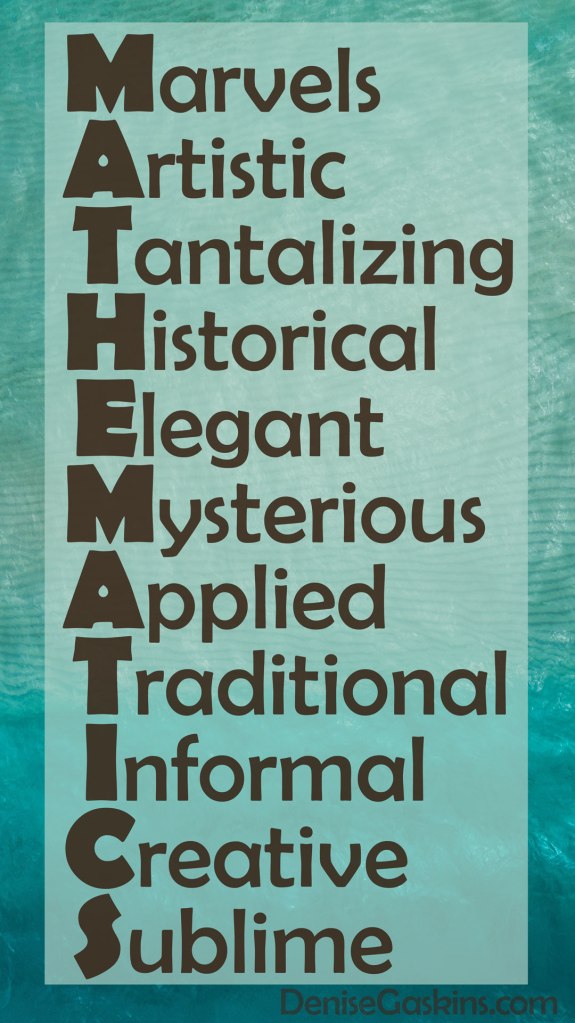
Mathematics: An Acrostic

What Is Your Child’s Experience of Math?

If your children made an acrostic for the word “Mathematics,” what would they include?

Would they think of adjectives like artistic, mysterious, or sublime?

Or would they focus on words like answers, maddening, and stress?

I love taking a playful approach to mathematics. Puzzles, games and art projects lay down a foundation of wonder and enjoyment. This creates a strong, positive base to support our kids through the inevitable difficulties of learning an abstract subject like math.

There are many rich math resources these days! So different from back when I started homeschooling. If you need ideas to help you transform your child’s experience of math, check out my Free Math on the Internet pages.

Internet Math Resources

In fact, I have a huge folder of even more bookmarks and links that I hope to add to my resource pages, whenever I find the time…

Does your family have a favorite way to play with math?

 
* * *

This blog is reader-supported.

If you’d like to help fund the blog on an on-going basis, then please join me on Patreon for mathy inspiration, tips, and an ever-growing archive of printable activities.

If you liked this post, and want to show your one-time appreciation, the place to do that is PayPal: paypal.me/DeniseGaskinsMath. If you go that route, please include your email address in the notes section, so I can say thank you.

Which I am going to say right now. Thank you!

“Mathematics: An Acrostic” copyright © 2019 by Denise Gaskins. Image at the top of the post copyright © Ishan via Unsplash.
Get Your Weekly KenKen Puzzles for Kids

KenKen6x6

KenKen arithmetic puzzles build mental math skills, logical reasoning, persistence, and mathematical confidence.

Free via email every Friday during the school year.

What a great way to prepare your children for success in math!

Sign up anytime:

Click Here for KenKen Classroom Newsletter

How to Play

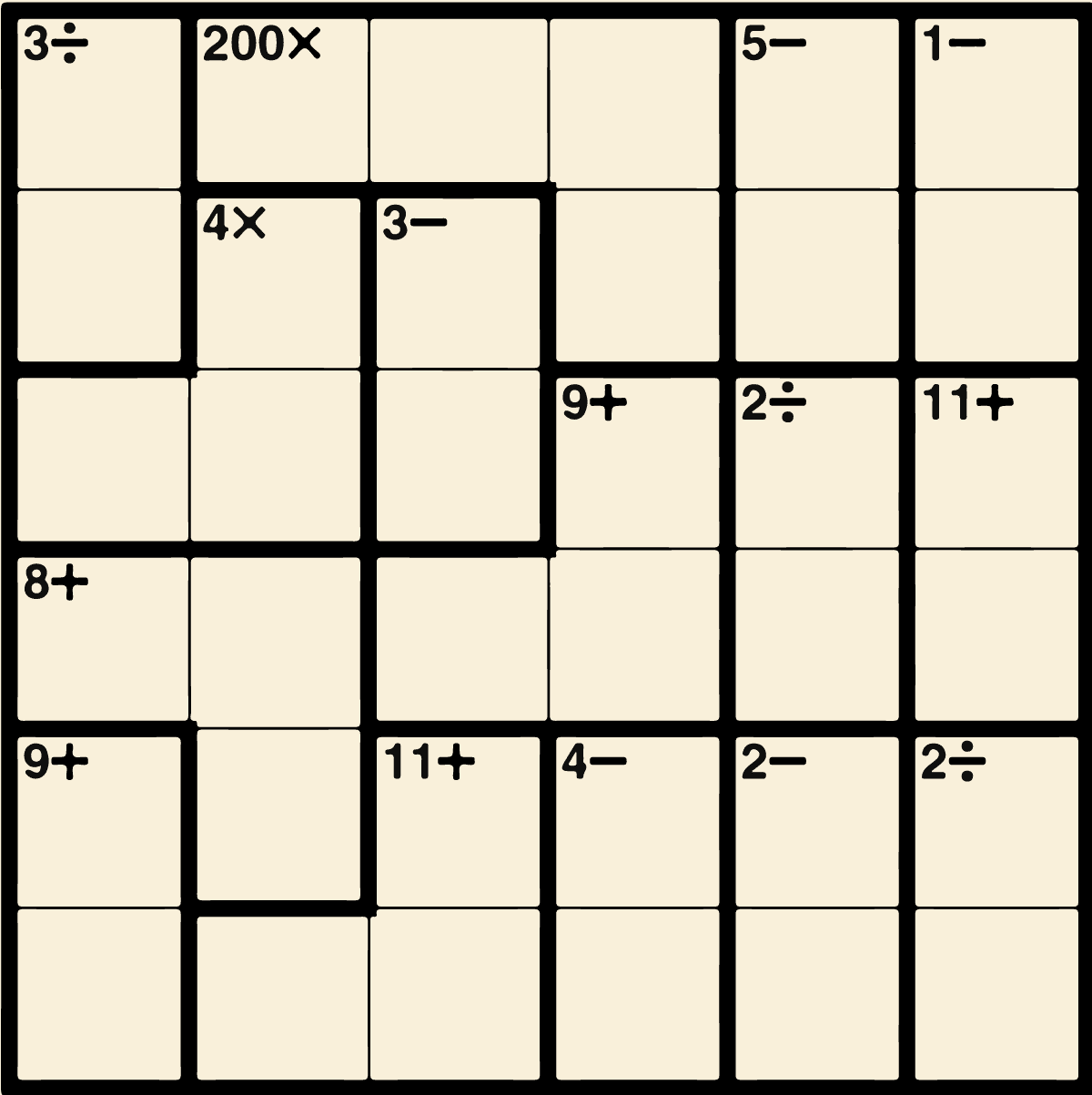
For easy printing, right-click to open the image above in a new tab.

Place the numbers from 1 to 6 into each row and column. None of the numbers may repeat in any row or column. Within the black “cages,” the numbers must add, subtract, multiply, or divide to give the answer shown.

How to Talk Math With Your Kids

A friend shared this video, and I loved it! From Kent Haines, a father who happens to also be a math teacher…

“I hope that this video helps parents find new ways of interacting with their kids on math topics.”

Kent Haines

More from Kent Haines

Advice and Examples of Talking Math with Kids

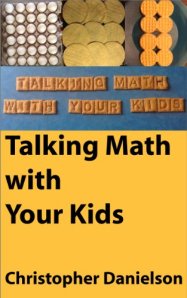
Danielson-Talking Math

If you enjoyed Kent’s video, you’ll love Christopher Danielson’s book and blog.

It’s a short book with plenty of great stories, advice, and conversation-starters. While Danielson writes directly to parents, the book will also interest grandparents, aunts & uncles, teachers, and anyone else who wants to help children notice and think about math in daily life.

“You don’t need special skills to do this. If you can read with your kids, then you can talk math with them. You can support and encourage their developing mathematical minds.
 
“You don’t need to love math. You don’t need to have been particularly successful in school mathematics. You just need to notice when your children are being curious about math, and you need some ideas for turning that curiosity into a conversation.
 
“In nearly all circumstances, our conversations grow organically out of our everyday activity. We have not scheduled “talking math time” in our household. Instead, we talk about these things when it seems natural to do so, when the things we are doing (reading books, making lunch, riding in the car, etc) bump up against important mathematical ideas.
 
“The dialogues in this book are intended to open your eyes to these opportunities in your own family’s life.”

— Christopher Danielson
Talking Math with Your Kids

 
* * *

This blog is reader-supported.

If you’d like to help fund the blog on an on-going basis, then please join me on Patreon for mathy inspiration, tips, and an ever-growing archive of printable activities.

If you liked this post, and want to show your one-time appreciation, the place to do that is PayPal: paypal.me/DeniseGaskinsMath. If you go that route, please include your email address in the notes section, so I can say thank you.

Which I am going to say right now. Thank you!

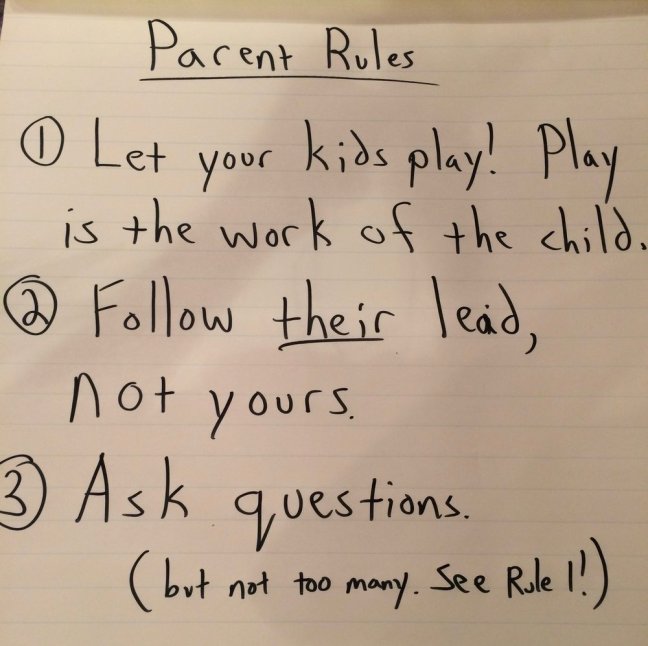
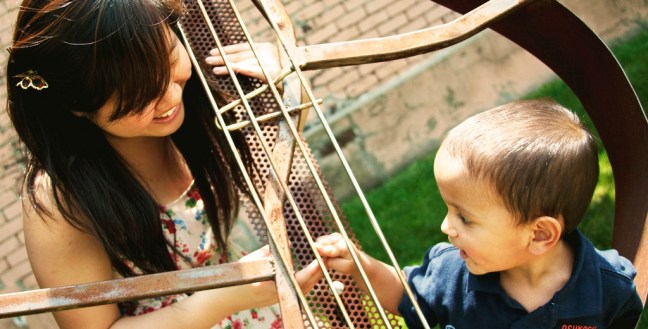
“How to Talk Math With Your Kids” copyright © 2017 by Denise Gaskins. “Kids Talk” photo (top) by Victoria Harjadi via Flickr (CC BY 2.0). “Parent Rules” by Kent Haines.

Math Humor and Copywork

Homeschool Memories…

The more years we spent homeschooling, the more I appreciated Charlotte Mason’s work and tried to incorporate her ideas into our laid-back, eclectic, not-quite-unschooling program.

We never fit the typical Charlotte Mason mold. Mosquitos and natural laziness limited our nature walks, and our version of narration was much too informal.

But those are just techniques, methods.

What really interests me in Mason’s writing is the philosophy behind the methods. Two points resonated: That we must respect our children as persons in their own right. And that we must provide a generous, wide-ranging feast to their minds.

Striving to live out those principles had a profound influence on our day-to-day homeschooling.

Continue reading Math Humor and Copywork

Even a Math Workbook Can Be a Game

Homeschool Memories…

My youngest daughter wanted to do Singapore math. Miquon Red was her main math text at the time, but we added a bit of Singapore Primary Math 1B whenever she was in the mood.

We turned to the lesson on subtracting with numbers in the 30-somethings.

Continue reading Even a Math Workbook Can Be a Game

Rabbit Trails and Fibonacci Poetry

Homeschool Memories…

Well, I hadn’t planned on spending my day that way. But one of the great things about homeschooling is the freedom to follow rabbit trails.

While browsing the Carnival of Homeschooling, I found a link to Farm School blog’s article Fib Foolery, which sent me to Gotta Book for his articles The Fib and More Fibbery (read the comments on both threads, but be warned that some are crude) and several other posts, all of which set me off on a morning of poetic fun.

A “Fib” is a Fibonacci poem. It’s based on syllable count, like a haiku, but the lines follow the Fibonacci counting series: 1, 1, 2, 3, 5, 8… Each number is the sum of the previous two numbers.

I knew what I was going to share at our Tuesday Teatime and Poetry Reading that afternoon.

Continue reading Rabbit Trails and Fibonacci Poetry

How To Break In Your New Math Journal

I love my new paperback math journal series. The books are sturdy, inexpensive, and fit nicely in my purse.

But as with any paperback book, these have one problem. How do I use them without cracking the spine?

When we exercise, we need to warm up our bodies with a bit of stretching to prevent injury. In the same way, we need to warm up a new book to protect it. The process is called “breaking it in.”

It only takes a few minutes to break in a paperback book:

Step by Step

Never force the book but help it limber up gradually, and it will serve you well.

Because my journals are working books, I take the breaking-in process a bit further than shown in the video:

(1) Set the book on its back and follow the process above. Press down each cover, but not completely flat — let it bend at the fold line, about 1 cm from the actual spine. Then press a couple pages at a time, alternating front and back, down flat on each cover.

(2) Flip through the pages of the book forward and backward to limber them up.

(3) Repeat the steps of the video. This time, gently lean the main part of the book away from the part you are pressing down. Aim for a 130–140 degree angle.

(4) Flip through the pages again. For paperbacks, you can even roll the whole book back and forth a bit — gently curving the cover and pages almost as if you’re trying to fold the book in half — to encourage flexibility.

(5) Optional: Repeat the breaking-in process one more time. This time, fold each section back as close to 180 degrees as it will go.

And you’re done!

The pages will still curve in at the fold line, where they connect to the spine of the book. You want that because it makes the book strong. But now they’ll also open up to provide a nice, wide area for writing or math doodling.

FAQ: Homeschool Burnout

“Spring cleaning has made my desk look worse than before. Nobody feels like studying. The kids would rather be outside, and their mom would rather take a nap. If I line everyone up on the curb in the morning, do you think the yellow bus will take them?”

Homeschool burnout — it’s a perennial problem. If you’re suffering from lethargy and can’t face another day of school work, here are some ideas that kept me going long enough to graduate almost-five kids (my “baby” finishes homeschooling this spring!):

(1) Re-read the homeschooling books on your shelves, or get some new ones from the library. Write down your favorite quotes as you read. Try to read about one a month, to help get your enthusiasm back. And then read at least one new homeschooling book per year to help you stay inspired.

Continue reading FAQ: Homeschool Burnout

Join the Fun: Math & Magic Virtual Book Club

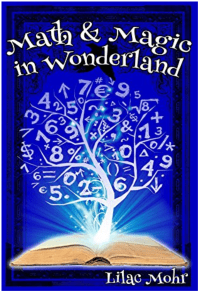
Math-Magic-WonderlandEleven weeks of mathematical playtime kicks off this week over at Learners in Bloom blog.

Each week, we’ll be playing with the math, language, and logic topics found in a single chapter. I’ll be posting ideas for extension activities, videos demonstrating the concepts for the week, and additional resources. I’m really excited for the opportunity to share all the extra ideas that have been floating around my brain which I didn’t have room to include in the book (as in Marco Polo’s famous words: “I did not tell half of what I saw.”)

— Lilac Mohr

Here’s a Quick Taste of Week One

This Week’s Activities

Lilac’s blog post includes a full schedule for the eleven-week book club, featuring plenty of classic math puzzlers to play with. Here are the topics for this week.

  • Read Chapter 1: Mrs. Magpie’s Manual
  • Alliteration
  • Memorizing digits of Pi
  • Palindromes
  • Calculating your age on other planets

It looks like a lot of fun. I highly recommend the book (read my review), and I’m sure you and your children will enjoy discovering math and magic with Lulu and Elizabeth.

Check it out: Math & Magic in Wonderland Virtual Book Club, Week One.

 
* * *

This blog is reader-supported.

If you’d like to help fund the blog on an on-going basis, then please join me on Patreon for mathy inspiration, tips, and an ever-growing archive of printable activities.

If you liked this post, and want to show your one-time appreciation, the place to do that is PayPal: paypal.me/DeniseGaskinsMath. If you go that route, please include your email address in the notes section, so I can say thank you.

Which I am going to say right now. Thank you!

“Join the Fun: Math & Magic Virtual Book Club” copyright © 2016 by Denise Gaskins.

FAQ: Trouble Finding the Right Math Program

“I can’t find a home school math program my son likes. We’ve tried Singapore Math, Right Start, Saxon, and Math Mammoth. We subscribed to a month of IXL Math to keep him in practice, but he hates that, too. I know I shouldn’t have changed so many times, but this was our first year of homeschooling, and I was trying to please him. But I’m running out of things to try. Do you think Life of Fred might work?”

Rock-Surfing

You’ve tried all those math programs in one year? Many people recommend that new homeschoolers take a few months off to “detox” from the classroom setting, to relax and enjoy the freedom of making their own choices. But your son might want a few months to detox from his homeschool experience.

I suggest you set aside all those books and focus on games and informal math. Try to avoid schoolish lessons until your son starts to enjoy learning for its own sake.

Continue reading FAQ: Trouble Finding the Right Math Program