Oh, Internet, Thou Fickle Friend!

photo of a grumpy cat at the computer

Whew! I just finished going through ALL of my massive Internet Math Resources pages and fixing the links that had broken since the (too long ago) last time I checked.

Way too many broken links. Pages lost to the ether: fun old hobby sites of a teacher who retired and lost their school-sponsored page, sites that have set up a payment wall, and sites that still exist but have been rearranged, breaking all the old connections.

Many I was able to fix, some I had to delete.

But still, there are plenty of great links left, so if you’re looking for an interesting way to play with math, head over and explore:

Hopefully, everything works now.

Until the next time…

 
* * *

Image at the top of the post copyright © sliper84 / Depositphotos.

Living Books for Math

What is a “living book”? English education reformer Charlotte Mason introduced this term for any book that brings the reader directly into contact with the major ideas that have fascinated humans across the ages.

We know that reading aloud helps build our children’s love for books. But did you know it works for math as well?

And that it can transform the parent’s attitude as well as the child’s?

A playful math book fleshes out the bones of abstract math,
brings it alive,
makes it human, relatable,
interesting to readers of all ages,
opening our eyes to the wonderful world of big ideas,
where concepts meet and topics intertwine
in a beautifully intricate dance
of understanding.

We live in an age of abundance, with more new creative math books being published every year, so many that I can’t keep track of them all, not to mention the older classics, some out of print, that can still be found in public libraries.

Here are a few of my favorite books of playful, living math, both old and new:

Continue reading Living Books for Math

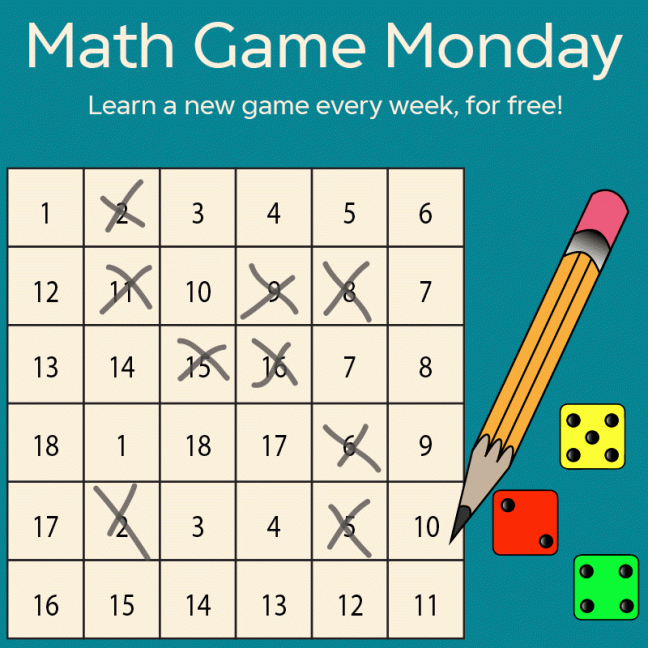
Why Math Game Monday?

Learn a new game with Math Game Monday

There’s a new Math Game Monday this week.

Have your kids tried it yet?

This week’s game is one of my favorites for early elementary grades, a logic game that makes children think about numbers and strategy.

Or, if you’re reading this post later and missed that one, there’s another great new game this week for you to play.

Check it out:

Visit Math Game Monday

Continue reading Why Math Game Monday?

How To Break In Your New Math Journal

I love my new paperback math journal series. The books are sturdy, inexpensive, and fit nicely in my purse.

But as with any paperback book, these have one problem. How do I use them without cracking the spine?

When we exercise, we need to warm up our bodies with a bit of stretching to prevent injury. In the same way, we need to warm up a new book to protect it. The process is called “breaking it in.”

It only takes a few minutes to break in a paperback book:

https://youtu.be/3fN_odVFivw&rel=0

Step by Step

Never force the book but help it limber up gradually, and it will serve you well.

Because my journals are working books, I take the breaking-in process a bit further than shown in the video:

(1) Set the book on its back and follow the process above. Press down each cover, but not completely flat — let it bend at the fold line, about 1 cm from the actual spine. Then press a couple pages at a time, alternating front and back, down flat on each cover.

(2) Flip through the pages of the book forward and backward to limber them up.

(3) Repeat the steps of the video. This time, gently lean the main part of the book away from the part you are pressing down. Aim for a 130–140 degree angle.

(4) Flip through the pages again. For paperbacks, you can even roll the whole book back and forth a bit — gently curving the cover and pages almost as if you’re trying to fold the book in half — to encourage flexibility.

(5) Optional: Repeat the breaking-in process one more time. This time, fold each section back as close to 180 degrees as it will go.

And you’re done!

The pages will still curve in at the fold line, where they connect to the spine of the book. You want that because it makes the book strong. But now they’ll also open up to provide a nice, wide area for writing or math doodling.

Socks Are Like Pants, Cats Are Like Dogs

https://youtu.be/8cSaDlG_2f8&rel=0

Support This New Book from Natural Math

Socks Are Like Pants, Cats Are Like Dogs by Malke Rosenfeld and Gordon Hamilton is filled with a diverse collection of math games, puzzles, and activities exploring the mathematics of choosing, identifying and sorting. The activities are easy to start and require little preparation.

The publisher’s crowdfunding goal is $4,000. The book is almost ready to go to press, and I can hardly wait to see it!

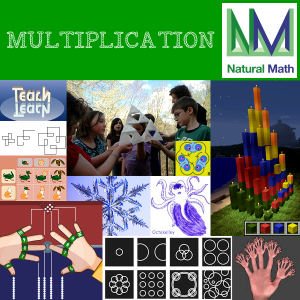
Natural Math Multiplication Course

NaturalMathMultiplication

This April, the creative people at Moebius Noodles are inviting parents, teachers, playgroup hosts, and math circle leaders to join an open online course about multiplication. My preschool-2nd grade homeschool math group is eager to start!

Each week there will be five activities to help kids learn multiplication by exploring patterns and structure, with adaptations for ages 2-12.

The course starts April 6 and runs for four weeks.

Preliminary Syllabus

Week 1: Introduction.
What is multiplication? Hidden dangers and precursors of math difficulties. From open play to patterns: make your own math. 60 ways to stay creative in math. Our mathematical worries and dreams.

Week 2: Inspired by calculus.
Tree fractals. Substitution fractals. Multiplication towers. Doubling and halving games. Zoom and powers of the Universe.

Week 3: Inspired by algebra.
Factorization diagrams. Mirror books and snowflakes. Combination and chimeras. Spirolaterals and Waldorf stars: drafting by the numbers. MathLexicon.

Week 4: Times tables.
Coloring the monster table. Scavenger hunt: multiplication models and intrinsic facts. Cuisenaire, Montessori, and other arrays. The hidden and exotic patterns. Healthy memorizing.

Sounds like lots of fun!

WOW – Multiplication! An Open Online Course for Parents and Teachers

CombinationsModel

Once again, the authors of Moebius Noodles are teaming up to offer a free course for families, math clubs, playgroups, and others who want to explore adventurous mathematics with kids of any age.

This short course will last only two weeks, and the topic is multiplication:

Both of my homeschool math circles (one with preschool-1st grade, and one with teens) thoroughly enjoyed the month-long problem solving course this summer, and we expect the new one to be just as much fun. Will you join us?

As with most of the Moebius Noodles courses, Maria and Yelena have adapted the activities for all ages from toddlers to adults. Where young ones go on a scavenger hunt for pretty snowflakes and cool truck wheels, older kids build bridges from multiplication to symmetry, spatial transformations, and proportions.

Visit the registration page to sign up no later than September 8. The main course activities will happen September 9th through 22nd. Expect to spend about two hours a week.

Continue reading WOW – Multiplication! An Open Online Course for Parents and Teachers

Homeschooling High School Math

photo by ddluong via flickr

Feature photo (above) by Sphinx The Geek via flickr.

Most homeschoolers feel at least a small tinge of panic as their students approach high school. “What have we gotten ourselves into?” we wonder. “Can we really do this?” Here are a few tips to make the transition easier.

Before you move forward, it may help to take a look back. How has homeschooling worked for you and your children so far?

If your students hate math, they probably never got a good taste of the “Aha!” factor, that Eureka! thrill of solving a challenging puzzle. The early teen years may be your last chance to convince them that math can be fun, so consider putting aside your textbooks for a few months to:

On the other hand, if you have delayed formal arithmetic, using your children’s elementary years to explore a wide variety of mathematical adventures, now is a good time to take stock of what these experiences have taught your students.

  • How much of what society considers “the basics” have your children picked up along the way?
  • Are there any gaps in their understanding of arithmetic, any concepts you want to add to their mental tool box?

Continue reading Homeschooling High School Math

Free Math from Dover Publications

I love Dover books, don’t you? They publish so-o-o-o-o many interesting titles at reasonable prices. I always have several Dover books on my wishlist, waiting for my next bit of extra cash.

But you don’t have to wait to enjoy free math from Dover books. Sign up for the Dover Sampler, and each week they will send an email with links to content from all sorts of books. Or try the Dover Children’s Sampler and Dover Teacher’s Sampler for coloring books, mazes, literature, and more. All the Dover samplers are completely free, and you can cancel at any time.

From Last Week’s Sampler

Last week’s email included a section on “Exploring Mathematics”:

And that’s only the beginning. Below, I’ve listed a wide variety of math-related links collected from past samplers. Though be warned: Dover does change its website from time to time, so these pages may disappear without notice.

Download, print, enjoy!

Continue reading Free Math from Dover Publications

Good News for a Change

As I was checking through archive posts and clearing out the dead links, I found a couple of links that I thought would be dead but which are still good. So I am re-posting them here, for your browsing pleasure:

Free Shakespeare for Fun and Copywork

CurrClick (which carries the Math Mammoth workbook series) is offering Quotations from Shakespeare’s Plays as a free download. This ebook includes copywork tips from Charlotte Mason and about 30 pages of passages from Macbeth, King Lear, Much Ado About Nothing, etc.

[And if you are planning a study of the Bard, you won’t want to miss the many other Internet resources in my original post.]

Great Leaders in a Crisis: Lincoln, Churchill

What does it take to lead your nation through a crisis? Character, determination, wisdom, the courage of your convictions. What can we learn about leadership from those who have been there, done that?

Abraham Lincoln and Winston Churchill are two of these great leaders — men whose courage and conviction took their nations through challenging moments and forever altered the course of Western civilization…

The Teaching Company (one of my favorite resources for homeschooling high school) is offering two free lectures for the downloading: Great Leaders: Abraham Lincoln and Winston Churchill.

[More details in my original post.]