My September “Let’s Play Math” newsletter went out last Friday to everyone who signed up for Tabletop Academy Press math updates. If you didn’t see it, check your Updates or Promotions tab (in Gmail) or your Spam folder. And to make sure you get all the future newsletter, add “Denise at Tabletop Academy Press” [TabletopAcademyPress@gmail.com] to your contacts or address book.
Do you have high school students, or do you enjoy puzzles yourself? Did you agree with my post last week, that Professor Povey’s new book looks like fun? If so, I’ve got some good news.
Welcome to the 90th edition of Math Teachers at Play (MTaP) Blog Carnival! I am so excited to host this carnival again. MTaP is a monthly blog carnival with a collection of tips, games, and activities for teachers and students. It is always great fun to participate in anyway to this Carnival ^_^ …
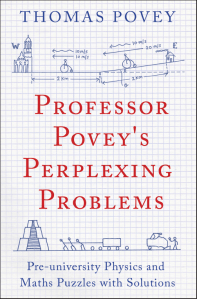
Check out this new puzzle book for upper-level high school students & adults:
Thomas Povey is a Professor of Engineering Science at the University of Oxford, where he researches jet-engine and rocket technology. In his new book Professor Povey’s Perplexing Problems, he shares his favorite idiosyncratic stumpers from pre-university maths and physics.
These problems “should test your ability to grapple with the unfamiliar,” Povey writes. “You will learn to tease new problems apart, and apply things you already know in ways you had never considered. You have all the tools you need, but you should see what amazing things you can do with them.”
Can You Solve This?
Alex Bellos shared one of Professor Povey’s puzzles in The Guardian. Can you figure it out?
The book starts off with geometry, but most of the chapters focus on various topics from physics. Some of the puzzles are accessible through applied common sense, but for many of them, it helps to have taken an algebra-based (high school level) physics course.
Kitten is just finishing up her physics textbook, and she still has one more year of homeschooling. I’m hoping to work several of these puzzles into our schedule this year. It should be great fun!
Spoiler
If like me you’re a bit rusty on your physics, don’t worry. Each answer is thoroughly explained—in fact, it takes a bit of discipline to close the book and try your hand at each problem before reading on. I wish they’d put the solutions in the back rather than in the main text, to make it easier to browse the problems without reading spoilers.
Speaking of which, here’s the answer to the video puzzle above…
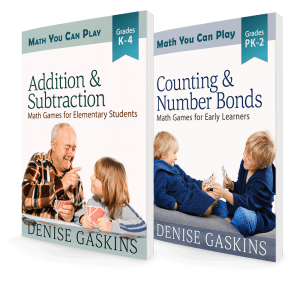
The Math You Can Play books grew from more than twenty years of playing math with children—at my house, at the library, in the park, and in group workshops. The 42 kid-tested games in these books are simple to learn, quick to play, and require minimal preparation.
I love these books because they help even the busiest parents enjoy playing math with their children.
Now that the publication dust has settled and the typos and formatting glitches have been sorted out, I’ve updated all the Math You Can Play ebook files to match the paperback editions.
In the Addition & Subtraction book, one new game: Dice Miner.
And in both books, assorted formatting and typographic fixes.
Do I Need an Update?
None of these changes have a major effect on the readability or value of the books. If you like your book as is, you aren’t missing anything vital.
Still, if you want the most up-to-date information, then check the title page of your ebook. Right under copyright date, the new edition says, “Ebook Version 1.3.”
If your book has a lower version number (or no version number at all), you may want to upgrade to the new edition.
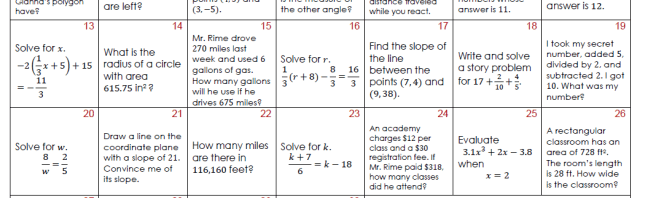
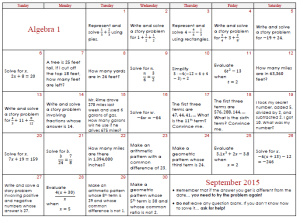
There are no explicit instructions about process being more important than the answer on these, so you’ll need to stress that in class.
I remind students that everyone already knows the answer to each of the questions, and that one of the things we’re practicing is explaining our reasoning…
Enjoy!
And if anyone else has a math review calendar to share, for any grade level, please add your link in the comment section below.
The August “Let’s Play Math” newsletter went out last week to everyone who signed up for Tabletop Academy Press math updates. This month’s issue focuses on logic puzzles for all ages, including a newly-discovered deleted scene from Harry Potter and the Sorcerer’s Stone. What fun!
If you missed this month’s edition, no worries—here are some great puzzles from the Let’s Play Math blog archive:
Counting all the fractional variations, my massive blog post 30+ Things to Do with a Hundred Chart now offers nearly forty ideas for playing around with numbers from preschool to prealgebra.
Here is the newest entry, a variation on #10, the “Race to 100” game:
(11.5) Play “Odd-Even-Prime Race.″ Roll two dice. If your token is starting on an odd number, move that many spaces forward. From an even number (except 2), move backward — but never lower than the first square. If you are starting on a prime number (including 2), you may choose to either add or multiply the dice and move that many spaces forward. The first person to reach or pass 100 wins the game. [Hat tip: Ali Adams in a comment on another post.]
And here’s a question for your students:
If you’re sitting on a prime number, wouldn’t you always want to multiply the dice to move farther up the board? Doesn’t multiplying always make the number bigger?
* * *
This blog is reader-supported.
If you’d like to help fund the blog on an on-going basis, then please join me on Patreon for mathy inspiration, tips, and an ever-growing archive of printable activities.
If you liked this post, and want to show your one-time appreciation, the place to do that is PayPal: paypal.me/DeniseGaskinsMath. If you go that route, please include your email address in the notes section, so I can say thank you.
From elementary addition to polar coordinates in high school — and all sorts of games, activities, and investigations in between — there’s plenty of fun to be had at this month’s math education carnival. Mrs. E has collected more than twenty great blog posts for us to enjoy:
“Welcome to the 89th edition of Math Teachers at Play (MTaP) Blog Carnival! MTaP is a monthly blog carnival with a collection of tips, games, and activities for teachers of students of all ages…”
 Update: The giveaway deadline has passed, but I’d still love to hear about your favorite book—I’m always looking for something new to read. 🙂




 Denise Gaskins' Let's Play Math