Algebra for (Almost) Any Age

VisualPatterns-org2

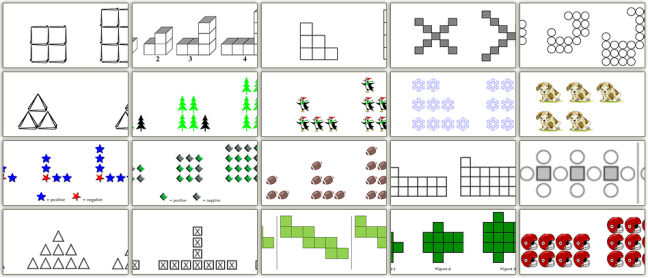
Fawn Nguyen’s Visual Patterns website just keeps getting better and better. Check it out:

In addition to the 115 puzzle patterns (as of this writing), the site features a Gallery page of patterns submitted by students. And under the “Teachers” tab, Fawn shares a form to guide students in thinking their way through to the algebraic formula for a pattern.

How can you use these patterns to develop algebraic thinking with younger students? Mike Lawler and sons demonstrate Pattern #1 in the YouTube video below.

Things To Do with a Hundred Chart #29

100chart puzzle

Here’s a new entry for my 20+ Things to Do with a Hundred Chart post:

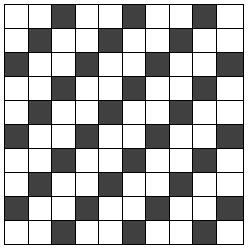
(29) Blank 100 Grid Number Investigations: Challenge your students to deduce the secret behind each pattern of shaded squares. Then have them make up pattern puzzles of their own.
[Created by Stuart Kay. Free registration required to download pdf printable.]

Share Your Ideas

Can you think of anything else we might do with a hundred chart? Add your ideas in the Comments section below, and I’ll add the best ones to our master list.

Maze Game: Land or Water?

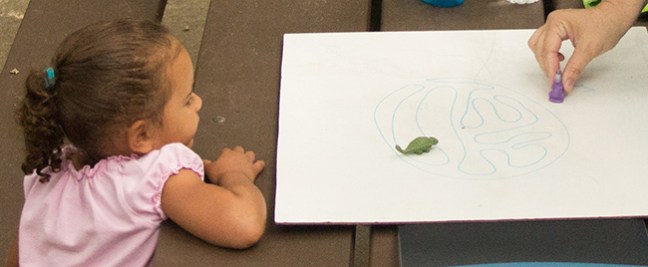
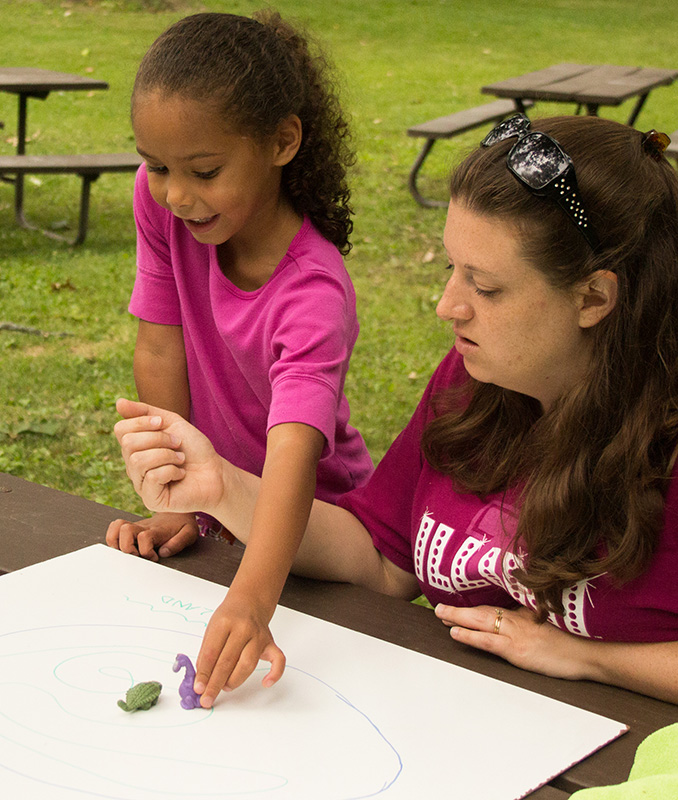
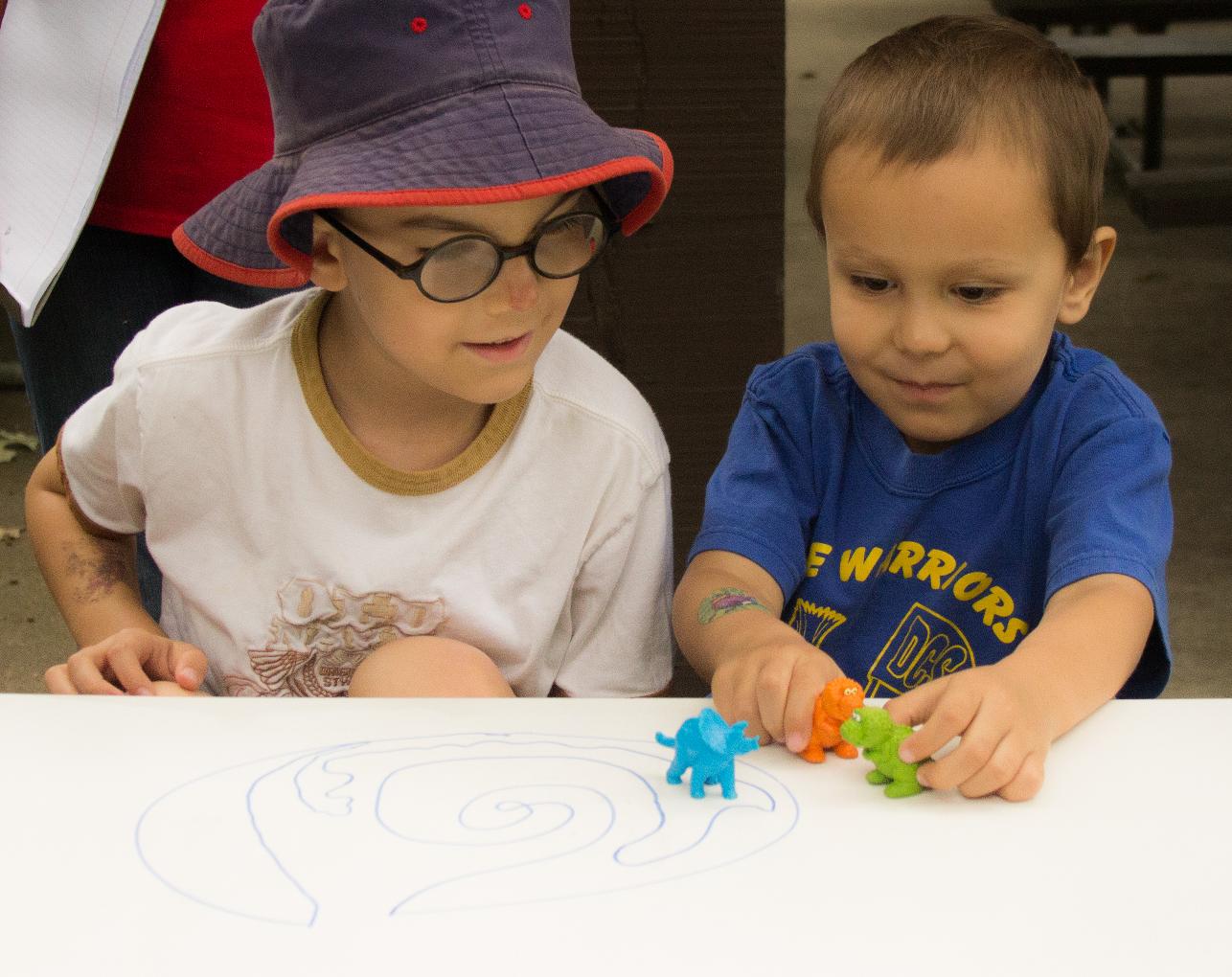
This was a fun activity from Moebius Noodles for our PK-1st grade Homeschool Math in the Park group. The children take turns making a maze and setting a dinosaur inside. Then the other dinosaurs (parents or siblings) try to guess whether their friend is on the land or in the water.

Draw the maze

Player #1

(1) First, draw a big circle on the white board. This is your lake.

(2) With a finger or a bit of cloth, erase a small section of the circle to create the opening for your maze.

(3) Starting at one edge of the opening, draw a random squiggle inside the circle. Make your squiggle end at the other edge of the opening.

Looks like Land

(4) Set your dinosaur anywhere inside the maze.

Player #2

(1) Now it’s your turn to guess. Is the dinosaur standing on the land? Is it swimming in the water?

(2) How will you figure out if you guessed right?

(3) Check by jumping across the lines of the maze. Each jump takes you across a boundary: Splash! (Into the water.) Thump! (Back on the land.) Splash! Thump! … Until you reach the dinosaur inside.

(4) Or go to the maze entrance and walk your dinosaur along the path. Can you find your way?

land or water

 
* * *

This blog is reader-supported.

If you’d like to help fund the blog on an on-going basis, then please join me on Patreon for mathy inspiration, tips, and an ever-growing archive of printable activities.

If you liked this post, and want to show your one-time appreciation, the place to do that is PayPal: paypal.me/DeniseGaskinsMath. If you go that route, please include your email address in the notes section, so I can say thank you.

Which I am going to say right now. Thank you!

“Maze Game: Land or Water?” copyright © 2013 by Denise Gaskins. All photos copyright © Denise Gaskins.

Happy Math Storytelling Day

Feature photo (above) by L. Marie. Math comic by davidd. Both via flickr (CC BY 2.0).
Math-ter and Commander

Hooray for September 25th — it’s Math Storytelling Day!

Celebrate Math Storytelling Day by making up and sharing math stories. Everyone loves a story, so this is a great way to motivate your children to play around with math. What might a math story involve? Patterns, logic, history, puzzles, relationships, fictional characters, … and yes, even numbers.

For inspiration, visit:

Have you and your children created any math stories? We’d love to hear! Please share your links in the comments section below.

Continue reading Happy Math Storytelling Day

Math Teachers at Play #66

[Feature photo above by Franz & P via flickr. Route 66 sign by Sam Howzit via flickr. (CC BY 2.0)]
Route 66 Sign

Welcome to the Math Teachers At Play blog carnival — which is not just for math teachers! If you like to learn new things and play around with ideas, you are sure to find something of interest.

By tradition, we start the carnival with a couple of puzzles in honor of our 66th edition.

Let the mathematical fun begin!

Puzzle 1

how crazy 66

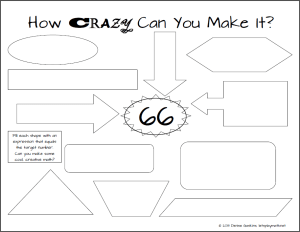
Our first puzzle is based on one of my favorite playsheets from the Miquon Math workbook series. Fill each shape with an expression that equals the target number. Can you make some cool, creative math?

Click the image to download the pdf playsheet set: one page has the target number 66, and a second page is blank so you can set your own target number.

Continue reading Math Teachers at Play #66

Puzzle: Algebra on Rectangles

Gordon Hamilton of Math Pickle recently posted these videos on how to make algebra 1 puzzles on rectangles. As I was watching, Kitten came in and looked over my shoulder. She said, “Those look like fun!”

They look like fun to me, too, and I bet your beginning algebra students will enjoy them:

Continue reading Puzzle: Algebra on Rectangles

What Do You Notice? What Do You Wonder?

Drawing Star

If you want your children to understand and enjoy math, you need to let them play around with beautiful things and encourage them to ask questions.

Here is a simple yet beautiful thing I stumbled across online today, which your children may enjoy:

It reminds me of string art designs, but the app makes it easy to vary the pattern and see what happens.

  • What do your students notice about the patterns?
  • What questions can they ask?

I liked the way the app uses “minutes” as the unit that describes the star you want the program to draw. That makes it easier (for me, at least) to notice and understand the patterns, since minutes are a more familiar and intuitive unit than degrees, let alone radians.

Continue reading What Do You Notice? What Do You Wonder?

Math Teachers at Play #62: A Carnival with Books

by Robert Webb

Do you enjoy math? I hope so! If not, browsing this post just may change your mind. Welcome to the Math Teachers At Play blog carnival — a smorgasbord of ideas for learning, teaching, and playing around with math from preschool to pre-college.

Let the mathematical fun begin!

POLYHEDRON PUZZLE

By tradition, we start the carnival with a puzzle in honor of our 62nd edition:

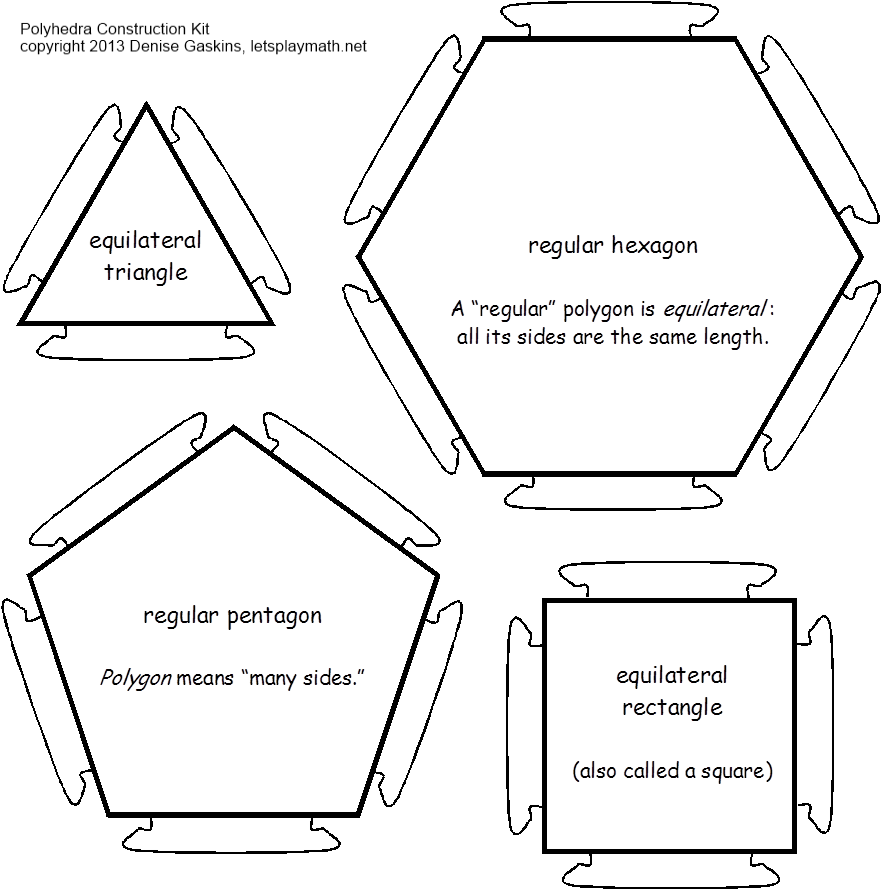
An Archimedean solid is a polyhedron made of two or more types of regular polygons meeting in identical vertices. A rhombicosidodecahedron (see image above) has 62 sides: triangles, squares, and pentagons.

  • How many of each shape does it take to make a rhombicosidodecahedron?
Click for full-size template.
Click for template.

My math club students had fun with a Polyhedra Construction Kit. Here’s how to make your own:

  1. Collect a bunch of empty cereal boxes. Cut the boxes open to make big sheets of cardboard.
  2. Print out the template page (→) and laminate. Cut out each polygon shape, being sure to include the tabs on the sides.
  3. Turn your cardboard brown-side-up and trace around the templates, making several copies of each polygon. I recommend 20 each of the pentagon and hexagon, 40 each of the triangle and square.
  4. Draw the dark outline of each polygon with a ballpoint pen, pressing hard to score the cardboard so the tabs will bend easily.
  5. Cut out the shapes, being careful around the tabs.
  6. Use small rubber bands to connect the tabs. Each rubber band will hold two tabs together, forming one edge of a polyhedron.

So, for instance, it takes six squares and twelve rubber bands to make a cube. How many different polyhedra (plural of polyhedron) will you make?

  • Can you build a rhombicosidodecahedron?

And now, on to the main attraction: the 62 blog posts. Many of the following articles were submitted by their authors; others were drawn from the immense backlog in my blog reader. If you’d like to skip directly to your area of interest, here’s a quick Table of Contents:

Continue reading Math Teachers at Play #62: A Carnival with Books

Moebius Noodles: New Must-Read Math Book

MoebiusNoodles2DCover

Homeschoolers, after-schoolers, unschoolers, or anyone else: if you’re a parent with kids at home, you need this book. If you work with children in any way (grandparent, aunt/uncle, teacher, child care, baby sitter, etc.) you need this book. Or if you hated math in school and never understood how anyone could enjoy it, you need this book!

Moebius Noodles is a travel guide to the Math Universe for adventurous families (and it has lots of beautiful pictures, too!) featuring games and activities that draw out the rich, mathematical properties of everyday objects in ways accessible to parents and children:

  • A snowflake is an example of a fractal and an invitation to explore symmetry.
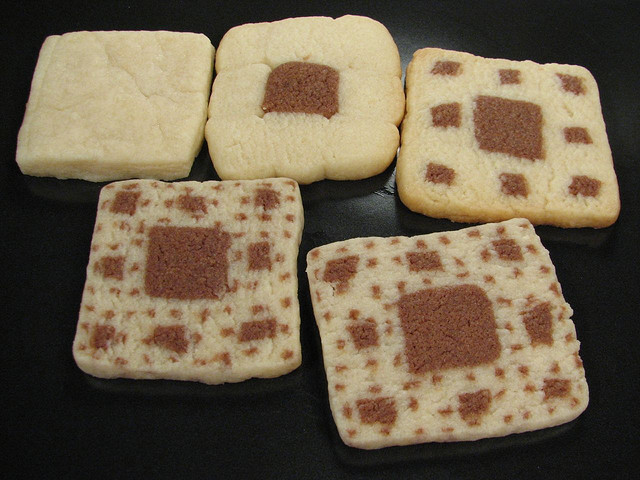
  • Cookies offer combinatorics and calculus games.
  • Paint chips come in beautiful gradients, and floor tiles form tessellations.

Continue reading Moebius Noodles: New Must-Read Math Book