Math Game Monday: Nine Cards

Learn a new math game every week, for free

This game helps young children build mental math skills. And it’s fun for older kids or adults to play along!

Many parents remember struggling to learn math. We hope to provide a better experience for our children.

And one of the best ways for children to enjoy learning is through hands-on play.

Nine Cards

Math Concepts: addition, number bonds for ten.

Players: two or more.

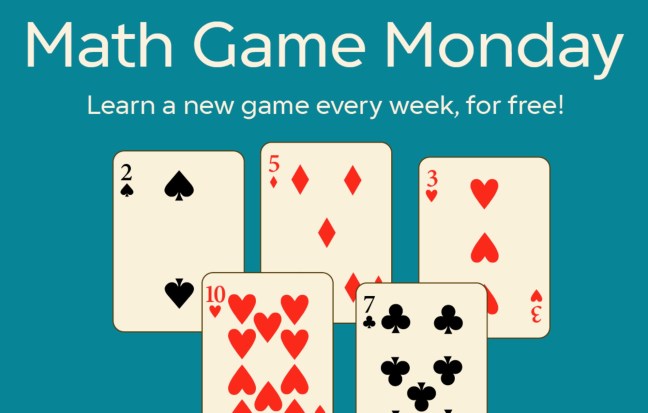
Equipment: one deck of playing cards, face cards and jokers removed.

Continue reading Math Game Monday: Nine Cards

Math Game Monday: Cross-Twenties

Learn a new math game every week, for free

This game gives young children practice adding numbers within twenty. And it’s great strategic fun for all ages!

Many parents remember struggling to learn math. We hope to provide a better experience for our children.

And one of the best ways for children to enjoy learning is through hands-on play.

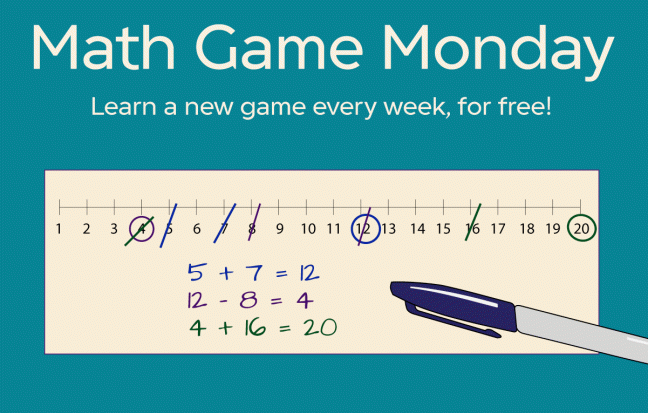
Cross-Twenties

Math Concepts: addition to twenty, thinking ahead.

Players: two or more.

Equipment: two decks of playing cards (face cards removed), six tokens per player.

Continue reading Math Game Monday: Cross-Twenties

Mental Math: Advanced Addition

photo of kids having fun with math

Mental math is doing calculations with our minds, and perhaps with the aid of scratch paper or a whiteboard to jot down notes along the way.

But we cannot simply transfer the standard pencil-and-paper calculations to a mental chalkboard. That’s far too complicated.

We still want to follow our basic strategies of using friendly numbers, estimating, and adjusting the answer. So how can we help children do math in their heads as the numbers get bigger and the problems more challenging?

How might kids figure out a multi-digit addition like 87 + 39?

Here are three useful strategies…

Continue reading Mental Math: Advanced Addition

Mental Math: Early Addition

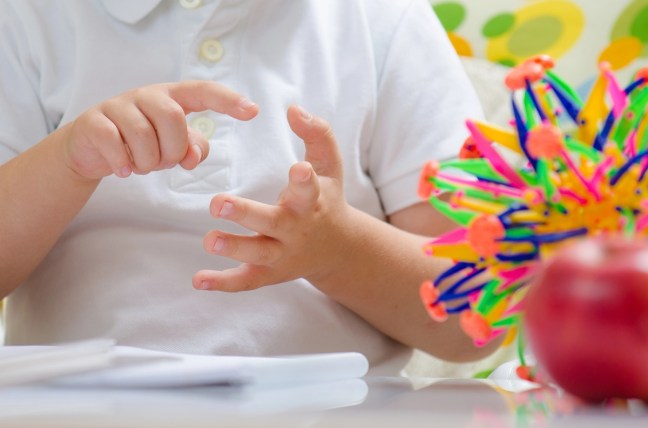
child counting on fingers

From the very beginning of a child’s experience with math, we want to focus on reasoning, making sense of numbers, thinking about how they relate to each other and how we can use these relationships to solve problems.

The basic idea of addition is putting like things together: combining parts to make a whole thing, putting together sets to make a collection, or starting with an original amount and adding the increase as it grows. Connecting two numbers in relationship with a third number we call the sum.

When you work with young children learning addition, remember the two key mental-math strategies I mentioned in the previous post.

  • Use friendly numbers.

For early single-digit addition, the most important friendly numbers are 5 and 10, the pairs of numbers that make 10, and the doubles.

  • Estimate, then adjust.

When children apply their creative minds to reasoning about math, they can use friendly numbers to get close to an answer, and then tweak the result as needed.

Continue reading Mental Math: Early Addition
Math Musings: Lies My Teacher Told Me

I mentioned last time that the common phrase “Multiplication is repeated addition” is a mathematical lie we tell our children. And it’s not the only one.

Did you ever say, “Subtraction means take-away”? Or how about “Division is sharing”? I know I have, but both of those statements are also mathematical lies.

One of the reasons I like Cuisenaire rods so much is that they can help us avoid lying to our children about math.

Continue reading Math Musings: Lies My Teacher Told Me

A Puzzle for Palindromes

If you haven’t seen the meme going around, this is a palindrome week because the dates (written American style and with the year shortened to ’19) are the same when reversed.

Here’s a math puzzle for palindrome week — or any time you want to play with math:

  • Print a 100 chart.
  • Choose a color code.
  • Play!

What do you think: Will all numbers eventually turn into palindromes?

Links

You can find all sorts of hundred charts on my Free Math Printable Files page.

Read about the history of palindromes on Nrich Math’s Palindromes page.

Find out more about the Palindromic Number Conjecture in Mark Chubb’s article An Unsolved Problem your Students Should Attempt.

Or play with Manan Shah’s advanced palindromic number questions.

Math Game: Thirty-One

Math Concepts: addition to thirty-one, thinking ahead.
Players: best for two.
Equipment: one deck of math cards.

How to Play

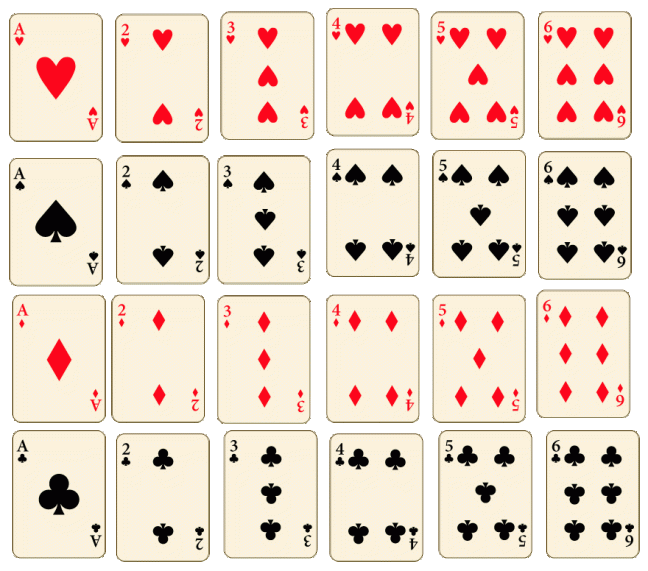
Lay out the ace to six of each suit in a row, face-up and not overlapping, one suit above another. You will have one column of four aces, a column of four twos, and so on‌—‌six columns in all.

The first player flips a card upside down and says its number value. Then the second player turns down a card, adds it to the first player’s number, and says the sum.

Players alternate, each time turning down one card, mentally adding its value to the running total, and saying the new sum out loud. The player who exactly reaches thirty-one, or who forces the next player to go over that sum, wins the game.

31-Game

Continue reading Math Game: Thirty-One

PUFM 1.3 Addition

Photo by Luis Argerich via flickr. In this Homeschooling Math with Profound Understanding (PUFM) Series, we are studying Elementary Mathematics for Teachers and applying its lessons to home education.

The basic idea of addition is that we are combining similar things. Once again, we meet the counting models from lesson 1.1: sets, measurement, and the numberline. As homeschooling parents, we need to keep our eyes open for a chance to use all of these models — to point them out in the “real world” or to weave them into oral story problems — so our children gain a well-rounded understanding of math.

Addition arises in the set model when we combine two sets, and in the measurement model when we combine objects and measure their total length, weight, etc.

One can also model addition as “steps on the number line”. In this number line model the two summands play different roles: the first specifies our starting point and the second specifies how many steps to take.

— Thomas H. Parker & Scott J. Baldridge
Elementary Mathematics for Teachers

Continue reading PUFM 1.3 Addition