Remember the Math Adventurer’s Rule: Figure it out for yourself! Whenever I give a problem in an Alexandria Jones story, I will try to post the answer soon afterward. But don’t peek! If I tell you the answer, you miss out on the fun of solving the puzzle. So if you haven’t worked these problems yet, go back to the original posts. Figure them out for yourself—and then check the answers just to prove that you got them right.
How to “Teach to the Test”
Excellent post (quoting Rafe Esquith, author of Teach Like Your Hair’s On Fire) over at Mindless Math Mutterings.
Another Egyptian Math Puzzle
 I have one last puzzle for those of you who are following my Alexandria Jones series on hieroglyphic math and the Egyptian scribe’s method of multiplication by doubling. Here is the “teaser” problem from the cover of the Sept./Oct.1998 issue of my newsletter:
One more Egyptian math puzzle (pdf, 53KB)
7 Things to Do with a Hundred Chart
This post has been revised to incorporate all the suggestions in the comments below, plus many more activities. Please update your bookmarks:
Or continue reading the original article…
Alex’s Puzzling Papyrus
(In the last episode, Dr. Fibonacci Jones discovered a torn scrap of papyrus, covered with hieroglyphic numbers. He promised to teach his daughter, Alexandria, how the ancient Egyptian scribes worked multiplication problems using only the times-two table.)
Back at their tent, Dr. Jones handed the papyrus scrap to Alexandria. “What do you see?” he asked.
“Well, there are two columns of numbers,” Alex said. “Let me write them down.” She got a piece of notebook paper and translated the hieroglyphs. 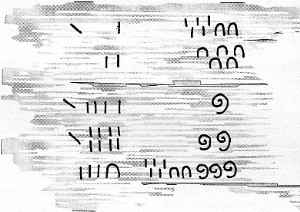
Click on the image for a larger view. Translate the numbers for yourself before reading on. If you need help, read Egyptian Math in Hieroglyphs.
Math Jokes
Blame it on MathNotations and his Corny Math Jokes (which actually included one I hadn’t heard before) — or maybe I have been reading too many of Chickenfoot’s strange tales — but anyway, I’m in a mood for humor.
So here are a couple of old favorites:
- The Frivolous Theorem of Arithmetic
Almost all natural numbers are very, very, very large.- The First Strong Law of Small Numbers
There are not enough small numbers to meet the many demands made of them.
Hat tip: These had gotten lost in the dustbunnies of my memory until I saw the Frivolous Theorem mentioned recently at Art of Problem Solving.
Edited to add: Scott at Grey Matters recently updated his Mathematical Humor post, which may be where I had originally read these. He links to several more great MathWorld jokes, including the ever-tasty Pizza Theorem.
Solving Complex Story Problems
[Dragon photo above by monkeywingand treasure chest by Tom Praison via flickr.]
Let’s play around with a middle-school/junior high word problem:
Cimorene spent an afternoon cleaning and organizing the dragon’s treasure. One fourth of the items she sorted was jewelry. 60% of the remainder were potions, and the rest were magic swords. If there were 48 magic swords, how many pieces of treasure did she sort in all?
[Problem set in the world of Patricia Wrede’s Enchanted Forest Chronicles. Modified from a story problem in Singapore Primary Math 6B. Think about how you would solve it before reading further.]
How can we teach our students to solve complex, multi-step story problems? Depending on how one counts, the above problem would take four or five steps to solve, and it is relatively easy for a Singapore math word problem. One might approach it with algebra, writing an equation like:
![x - \left[\frac{1}{4}x + 0.6\left(\frac{3}{4} \right)x \right] = 48](https://s0.wp.com/latex.php?latex=x+-+%5Cleft%5B%5Cfrac%7B1%7D%7B4%7Dx+%2B+0.6%5Cleft%28%5Cfrac%7B3%7D%7B4%7D+%5Cright%29x++%5Cright%5D++%3D+48&bg=ffffff&fg=303030&s=0&c=20201002)
…or something of that sort. But this problem is for students who have not learned algebra yet. Instead, Singapore math teaches students to draw pictures (called bar models or math models or bar diagrams) that make the solution appear almost like magic. It is a trick well worth learning, no matter what math program you use.
Hexa-Trex Puzzles
These puzzles look like a lot of fun for whole number and integer arithmetic review. I think they would make a great warm-up at the beginning of a class or math club meeting.
Hat tip: MathPuzzle.com
Percents: The Search for 100%
[Rescued from my old blog.]
Percents are one of the math monsters, the toughest topics of elementary and junior high school arithmetic. The most important step in solving any percent problem is to figure out what quantity is being treated as the basis, the whole thing that is 100%. The whole is whatever quantity to which the other things in the problem are being compared.
Percents: Key Concepts and Connections
[Rescued from my old blog.]
Paraphrased from a homeschool math discussion forum:
“I am really struggling with percents right now, and feel I am in way over my head!”
Percents are one of the math monsters, the toughest topics of elementary and junior high school arithmetic. Here are a few tips to help you understand and teach percents.

