
Math Concepts: addition, subtraction, place value to six or seven digits.
Players: two or more.
Equipment: pencil and paper.
Set-Up
Each player needs a sheet of blank or lined paper, and a pencil.
At the top of your page, write a 6-digit number. All the digits must be different, and none of them can be zero.
How to Play
On your turn, you go fishing for points. Ask one other player, “Give me your _____’s.” The blank is for the single-digit number of your choice.
The other player answers, “You get _____.” This blank is for the value of that digit in the other player’s number.
For example, suppose you asked for 5’s. If the other player has a 5 in the tens place of his number, you get 50 points. But if 5 was in the ten-thousands place, you would get 50,000. And if there is no 5 at all, you get zero.
You add those points to your number. The other player subtracts the points from his number.
Then it’s the next player’s turn to go fishing.
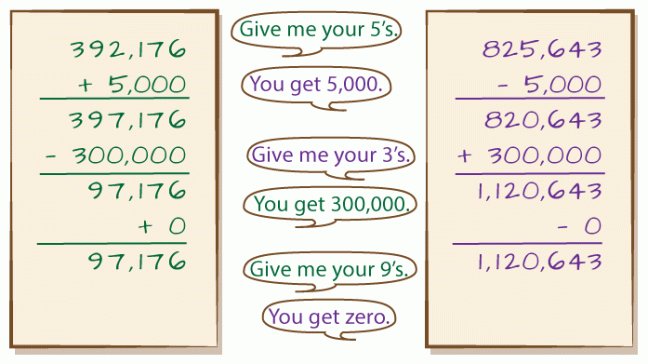
Notice These Rules
Your number may change with each turn (except when you get zero). Always use your most recent number to add or subtract the fishing points.
If you have more than one of the digit asked for (like the player on the left above, who has two 7’s), you may choose which one to give away. That is, you can give the other player 70 points and not even mention the 7,000.
Endgame
Keep taking turns until every player gets five chances to fish for points. After five rounds, whoever has the highest score wins the game.
UNLESS the winner made an arithmetic error.
Be sure to check each other’s math, because any player who makes a mistake automatically loses the game.
Share the Fun
If you try this math game with your kids, I’d love to hear how it goes. Please drop a comment below.
And tell us about your favorite math game, so we can all play that, too. 😀
* * *
This game comes from Michael Schiro’s book
Mega-Fun Math Games: 70 Quick-and-Easy Games to Build Math Skills.This blog is reader-supported.
If you’d like to help fund the blog on an on-going basis, then please join me on Patreon for mathy inspiration, tips, and an ever-growing archive of printable activities.
If you liked this post, and want to show your one-time appreciation, the place to do that is PayPal: paypal.me/DeniseGaskinsMath. If you go that route, please include your email address in the notes section, so I can say thank you.
Which I am going to say right now. Thank you!
“Math Game: Place Value Fish” copyright © 2019 by Denise Gaskins. Image at the top of the post copyright © Ruben Ortega via Unsplash.


 Are all numbers polite?







 of one hundred chart
 of that hundred chart
 of the pair of charts
 of the whole pair of charts.

 Denise Gaskins' Let's Play Math