Mathematics Is Worthy

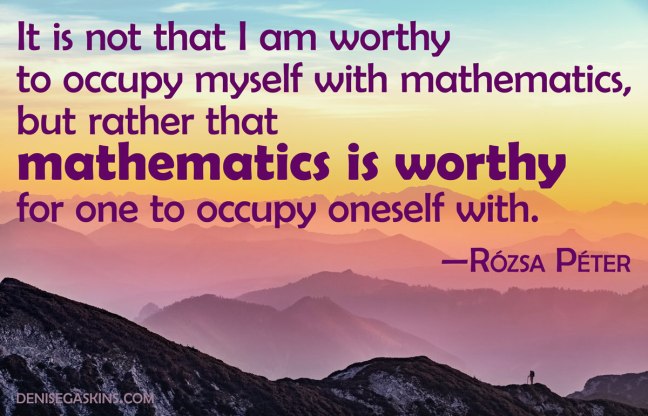
“When I began my college education, I still had many doubts about whether I was good enough for mathematics. Then a colleague said the decisive words to me: it is not that I am worthy to occupy myself with mathematics, but rather that mathematics is worthy for one to occupy oneself with.”

— Rózsa Péter
Mathematics is beautiful
essay in The Mathematical Intelligencer

Rózsa Péter and the Curious Students
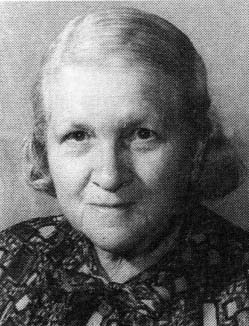
I would like to win over those who consider mathematics useful, but colourless and dry — a necessary evil…
 
No other field can offer, to such an extent as mathematics, the joy of discovery, which is perhaps the greatest human joy.
 
The schoolchildren that I have taught in the past were always attuned to this, and so I have also learned much from them.
 
It never would have occurred to me, for instance, to talk about the Euclidean Algorithm in a class with twelve-year-old girls, but my students led me to do it.
 
I would like to recount this lesson.
 
What we were busy with was that I would name two numbers, and the students would figure out their greatest common divisor. For small numbers this went quickly. Gradually, I named larger and larger numbers so that the students would experience difficulty and would want to have a procedure.
 
I thought that the procedure would be factorization into primes.
 
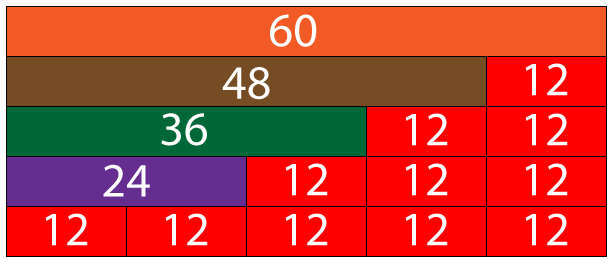
They had still easily figured out the greatest common divisor of 60 and 48: “Twelve!”
 
But a girl remarked: “Well, that’s just the same as the difference of 60 and 48.”


“That’s a coincidence,” I said and wanted to go on.
 
But they would not let me go on: “Please name us numbers where it isn’t like that.”
 
“Fine. 60 and 36 also have 12 as their greatest common divisor, and their difference is 24.”


Another interruption: “Here the difference is twice as big as the greatest common divisor.”
 
“All right, if this will satisfy all of you, it is in fact no coincidence: the difference of two numbers is always divisible by all their common divisors. And so is their sum.”
 
Certainly that needed to be stated in full, but having done so, I really did want to move on.
 
However, I still could not do that.
 
A girl asked: “Couldn’t they discover a procedure to find the greatest common divisor just from that?”


They certainly could! But that is precisely the basic idea behind the Euclidean Algorithm!
 
So I abandoned my plan and went the way that my students led me.
 

— Rózsa Péter
quoted at the MacTutor History of Mathematics Archive

For Further Exploration

Note: When the video narrator says “Greatest Common Denominator,” he really means “Greatest Common Divisor.”

CREDITS: “Pink toned thoughts on a hike” photo courtesy of Simon Matzinger on Unsplash.

FAQ: Struggling with Arithmetic

My son can’t stand long division or fractions. We had a lesson on geometry, and he enjoyed that — especially the 3-D shapes. If we can just get past the basics, then we’ll have time for the things he finds interesting. But one workbook page takes so long, and I’m sick of the drama. Should we keep pushing through?

Those upper-elementary arithmetic topics are important. Foundational concepts. Your son needs to master them.

Eventually.

But the daily slog through page after page of workbook arithmetic can wear anyone down.

Many children find it easier to focus on math when it’s built into a game.

Take a look at Colleen King’s Math Playground website. Or try one of the ideas on John Golden’s Math Hombre Games blog page.

Or sometimes a story helps, like my Cookie Factory Guide to Long Division.

Continue reading FAQ: Struggling with Arithmetic

Math Debate: Adding Fractions

Cover image by Thor/ geishaboy500 via Flickr (CC BY 2.0)

I’ve been working on my next Playful Math Singles book, based on the popular Things to Do with a Hundred Chart post.

My hundred chart list began many years ago as seven ideas for playing with numbers. Over the years, it grew to its current 30+ activities.

Now, in preparing the new book, my list has become a monster. I’ve collected almost 70 ways to play with numbers, shapes, and logic from preschool to middle school. Just yesterday I added activities for fraction and decimal multiplication, and also tips for naming complex fractions. Wow!

Gonna have to edit that cover file…

In the “Advanced Patterns” chapter, I have a section on math debates. The point of a math debate isn’t that one answer is “right” while the other is “wrong.” You can choose either side of the question — the important thing is how well you support your argument.

Here’s activity #69 in the current book draft.

Have a Math Debate: Adding Fractions

When you add fractions, you face a problem that most people never consider. Namely, you have to decide exactly what you are talking about.

For instance, what is one-tenth plus one-tenth?

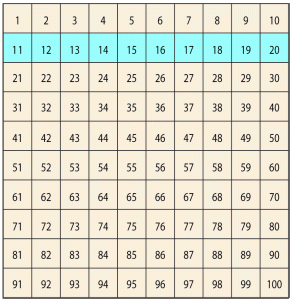
1/10 of 100

Well, you might say that:

\frac{1}{10}  of one hundred chart
+ \frac{1}{10}  of the same chart
= \frac{2}{10}  of that hundred chart

But, you might also say that:

\frac{1}{10}  of one chart
+ \frac{1}{10}  of another chart
= \frac{2}{20}  of the pair of charts

That is, you started off counting on two independent charts. But when you put them together, you ended up with a double chart. Two hundred squares in all. Which made each row in the final set worth \frac{1}{20}  of the whole pair of charts.

So what happens if you see this question on a math test:

\frac{1}{10}  + \frac{1}{10}  = ?

If you write the answer “\frac{2}{20}”, you know the teacher will mark it wrong.

Is that fair? Why, or why not?

CREDITS: Feature photo (above) by Thor/geishaboy500 via Flickr (CC BY 2.0). “One is one … or is it?” video by Christopher Danielson via TED-Ed. This math debate was suggested by Marilyn Burns’s blog post Can 1/3 + 1/3 = 2/6? It seemed so!

2018 Mathematics Game — Join the Fun!

Let’s resolve to have fun with math this year. Ben has posted a preview of 2018’s mathematical holidays. Iva offers plenty of cool ways to think about the number 2018. And Patrick proposes a new mathematical conjecture.

But my favorite way to celebrate any new year is by playing the Year Game. It’s a prime opportunity for players of all ages to fulfill the two most popular New Year’s Resolutions: spending more time with family and friends, and getting more exercise.

So grab a partner, slip into your workout clothes, and pump up those mental muscles!

For many years mathematicians, scientists, engineers and others interested in mathematics have played “year games” via e-mail and in newsgroups. We don’t always know whether it is possible to write expressions for all the numbers from 1 to 100 using only the digits in the current year, but it is fun to try to see how many you can find. This year may prove to be a challenge.

— Math Forum Year Game Site

Rules of the Game

Use the digits in the year 2018 to write mathematical expressions for the counting numbers 1 through 100. The goal is adjustable: Young children can start with looking for 1-10, middle grades with 1-25.

  • You must use all four digits. You may not use any other numbers.
  • Solutions that keep the year digits in 2-0-1-8 order are preferred, but not required.
  • You may use +, -, x, ÷, sqrt (square root), ^ (raise to a power), ! (factorial), and parentheses, brackets, or other grouping symbols.
  • You may use a decimal point to create numbers such as .2, .02, etc., but you cannot write 0.02 because we only have one zero in this year’s number.
  • You may create multi-digit numbers such as 10 or 201 or .01, but we prefer solutions that avoid them.

My Special Variations on the Rules

  • You MAY use the overhead-bar (vinculum), dots, or brackets to mark a repeating decimal. But students and teachers beware: you can’t submit answers with repeating decimals to Math Forum.
  • You MAY use a double factorial, n!! = the product of all integers from 1 to n that have the same parity (odd or even) as n. I’m including these because Math Forum allows them, but I personally try to avoid the beasts. I feel much more creative when I can wrangle a solution without invoking them.

Click here to continue reading.

A Beautiful Puzzle

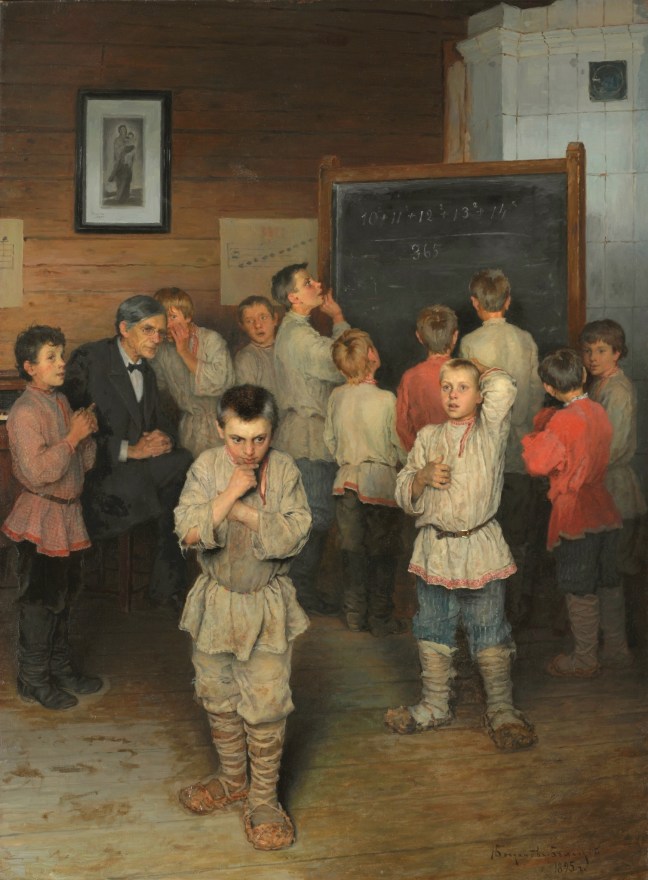
This lovely puzzle (for upper-elementary and beyond) is from Nikolay Bogdanov-Belsky’s 1895 painting “Mental Calculation. In Public School of S. A. Rachinsky.” Pat Ballew posted it on his blog On This Day in Math, in honor of the 365th day of the year.

I love the expressions on the boys’ faces. So many different ways to manifest hard thinking!

Here’s the question:

No calculator allowed. But you can talk it over with a friend, as the boys on the right are doing.

You can even use scratch paper, if you like.

Thinking About Square Numbers

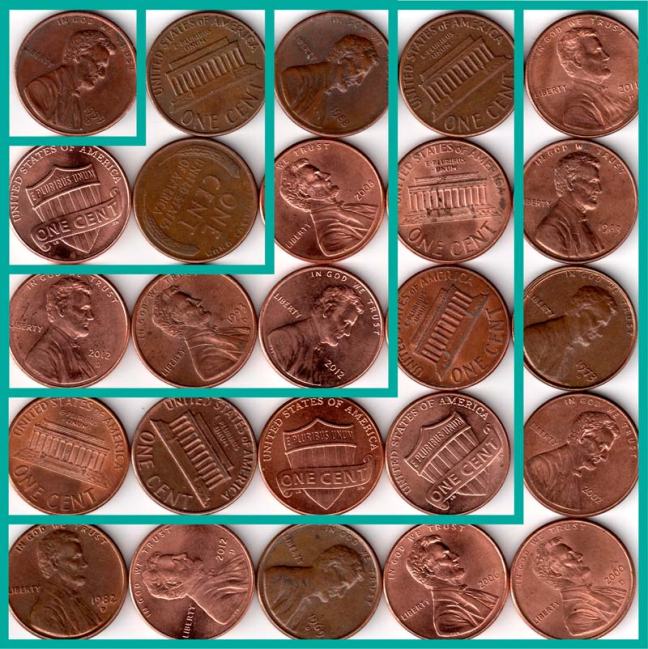
And if you’d like a hint, you can figure out square numbers using this trick. Think of a square number made from rows of pennies.

Can you see how to make the next-bigger square?

Any square number, plus one more row and one more column, plus a penny for the corner, makes the next-bigger square.

So if you know that ten squared is one hundred, then:

… and so onward to your answer. If the Russian schoolboys could figure it out, then you can, too!

Update

Simon Gregg (@Simon_Gregg) added this wonderful related puzzle for the new year:

Even a Math Workbook Can Be a Game

Homeschool Memories…

My youngest daughter wanted to do Singapore math. Miquon Red was her main math text at the time, but we added a bit of Singapore Primary Math 1B whenever she was in the mood.

We turned to the lesson on subtracting with numbers in the 30-somethings.

Continue reading Even a Math Workbook Can Be a Game

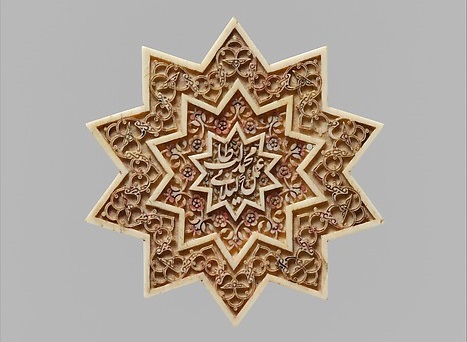
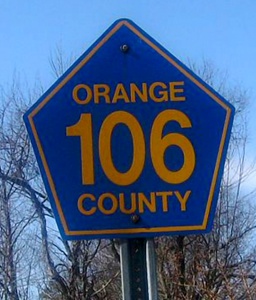
Playful Math Education Carnival 106 with Math Art

Do you enjoy math? I hope so! If not, browsing this post just may change your mind.
Welcome to the 106th edition of the Math Teachers At Play math education blog carnival — a smorgasbord of links to bloggers all around the internet who have great ideas for learning, teaching, and playing around with math from preschool to pre-college. Let the mathematical fun begin!

By tradition, we start the carnival with a puzzle in honor of our 106th edition. But if you would like to jump straight to our featured blog posts, click here to see the Table of Contents.

Try This Puzzle

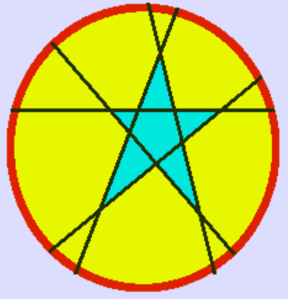
If you slice a pizza with a lightsaber, you’ll make straight cuts all the way across. Slice it once, and you get two pieces.
If you slice it five times, you’ll get a maximum of sixteen pieces. (And if you’re lucky you might get a star!)

  • How many times would you have to slice the pizza to get 106 pieces?

Click here for all the mathy goodness!

New Book: Multiplication & Fraction Games

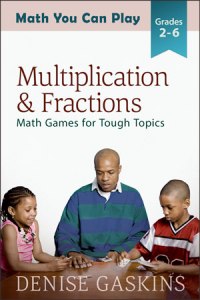
It’s here! My long-awaited upper-elementary Math You Can Play games book has finally hit the online bookstores.

Multiplication & Fractions features 25 kid-tested games, offering a variety of challenges for school-age students. Children master several math models that provide a sturdy foundation for understanding multiplication and fractions. The games feature times table facts and more advanced concepts such as division, fractions, decimals, and multistep mental math.

Click here to find Multiplication & Fractions at your favorite bookstore.

Multiplication & Fraction Games

multfrac-300Maybe you never really understood what multiplication means or what fractions are? As long as you start with an open mind and are willing to engage playfully, the activities in the book can help you as you help your kids.
Anecdotally, these two areas are the first major stumbling point for students in their math studies. The sequencing in the book will help kids develop a strong foundation.
Kids (and parents!) find these games fun. I’ve been field testing math games for the last 18 months and keep seeing how engaged kids get when playing math games.

— Joshua Greene
Multiplication & Fractions Math Games from Denise Gaskins (a review)

Chapters include:

  • Mathematical Models: Learn the basic pictures that help support your child’s comprehension.
  • Conquer the Times Tables: Enjoy practicing the math facts until correct answers become automatic.
  • Mixed Operations: Give mental muscles a workout with games that require number skills and logical thinking.
  • Fractions and Decimals: Master equivalent fractions, work with decimal place value, and multiply fractions and decimal numbers.

If you are a parent, these games provide opportunities to enjoy quality time with your children. If you are a classroom teacher, use the games as warm-ups and learning center activities or for a relaxing review day at the end of a term. If you are a tutor or homeschooler, make games a regular feature in your lesson plans to build your students’ mental math skills.

So what are you waiting for? Clear off a table, grab a deck of cards, and let’s play some math!

Check It Out

It starts with models that are visual explanations of the concepts. Gaskins also breaks learning these concepts into comfortable steps that emphasize patterns and relationships, the real ideas that are behind properly understanding multiplication and fractions (indeed, math generally).
The sequence of games in each section starts by building familiarity and then fluency (speed) to solidify all of that work.

— Joshua Greene
Multiplication & Fractions Math Games from Denise Gaskins (a review)

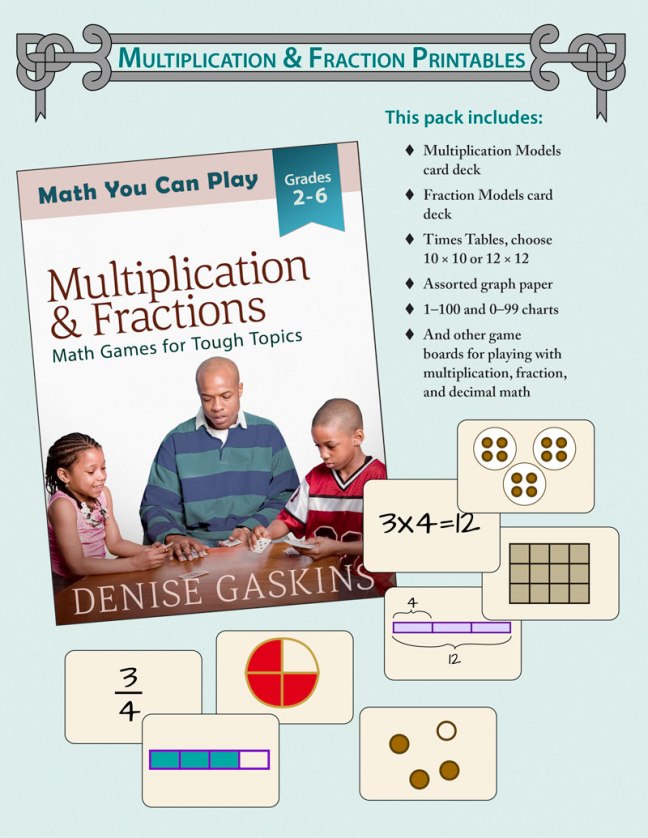
Multiplication & Fraction Printables

Multiplication & Fraction Printables

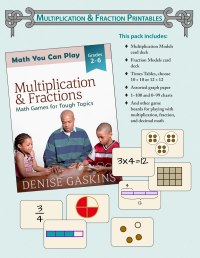
Most of the Math You Can Play games use materials you already have around the house, such as playing cards or dice. But this book introduces multiplication and fractions with several games using two special mathematical model card decks.

Click here to download the Multiplication & Fraction Printables, featuring all the math model cards, hundred charts, and game boards you will need for any game in the book.

Number Game Printables

One step closer to getting my long-awaited Multiplication & Fraction Games book out — I finished the printables file! At least, I hope I’ve finished. Sometimes it seems like whack-a-typo never ends…

Multiplication & Fraction Printables

Multiplication & Fraction Printables

Click here to download the Multiplication & Fraction Printables, featuring mathematical model cards, hundred charts, and game boards to accompany the upcoming Math You Can Play: Multiplication & Fractions book.

The Multiplication & Fractions ebook will come out sometime in November, and the paperback should follow in time for Christmas. If you’re interested, my newsletter subscribers will get a special introductory sale price whenever the book is published. Join now!

You may also want to check out:

Number Game Printables Pack

Number Game Printables Pack

Click here to download the Number Game Printables Pack, featuring hundred charts, graph paper, and game boards from the first two Math You Can Play books.

Also, 0–99 charts, and bottoms-up versions, too. (See my blog post Math Debates with a Hundred Chart.) And a fun cut-and-fold game board for playing Shut the Box.

Permission to Use These Files

You have permission to copy and use these game boards and worksheets in your own local classroom, home school, math circle, co-op class, etc. But you may not post them on your own website (though you can link to this post, if you like) or sell them. If you’re not sure how copyright works on the Internet, check out Daniel Scocco’s Copyright Law: 12 Dos and Don’ts.

FAQ: Trouble with Worksheets

“Worksheet problems make my daughter’s brain freeze. Even simple things such as “2 + ___ = 2″ confuse her. What can I do?”

Can your daughter do math if you put away the worksheet and ask her a real-life problem: “I have a lunch sack. I put two cookies into the sack, and then I give it to you. When you look into the sack, you see two cookies there. Can you tell me what was in the sack at the beginning, before I put my cookies in?”

Or can she solve problems when the answer isn’t zero? Could she figure out how many you started with if she saw four cookies when she looked in the sack?

The idea of having a number for “nothing” can seem strange to young children.

Continue reading FAQ: Trouble with Worksheets