(30) Can you mark ten squares Sudoku-style, so that no two squares share the same row or column? Add up the numbers to get your score. Then try to find a different set of ten Sudoku-style squares. What do you notice? What do you wonder?
[Suggested by David Radcliffe.]
Share Your Ideas
Can you think of anything else we might do with a hundred chart? Add your ideas in the Comments section below, and I’ll add the best ones to our master list.
Many children are confused by decimals. They are convinced 0.48 > 0.6 because 48 is obviously ever so much bigger than 6. Their intuition tells them 0.2 × 0.3 = 0.6 has the clear ring of truth. And they confidently assert that, if you want to multiply a decimal number by 10, all you have to do is add a zero at the end.
What can we do to help our kids understand decimals?
Christopher Danielson (author of Talking Math with Your Kids) will be hosting the Triangleman Decimal Institute, a free, in-depth, online chat for “everyone involved in children’s learning of decimals.” The Institute starts tomorrow, September 30 (sorry for the short notice!), but you can join in the discussion at any time:
Welcome to the Math Teachers At Play blog carnival — which is not just for math teachers! If you like to learn new things and play around with ideas, you are sure to find something of interest.
By tradition, we start the carnival with a couple of puzzles in honor of our 66th edition.
Let the mathematical fun begin!
Puzzle 1
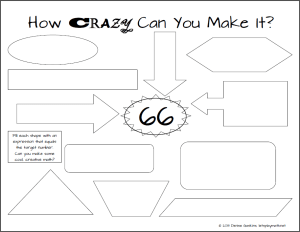
Our first puzzle is based on one of my favorite playsheets from the Miquon Math workbook series. Fill each shape with an expression that equals the target number. Can you make some cool, creative math?
Click the image to download the pdf playsheet set: one page has the target number 66, and a second page is blank so you can set your own target number.
As we were doing Buddy Math (taking turns through the homework exercises) today, my daughter said, “Oooo! I want to do this one. It’s pretty!”
She has always loved seeing patterns in math. I remember once, years ago, when she insisted that we change the problems on a worksheet to make the answers come out symmetrical. 🙂
I had a fight with Euclid on the nature of the primes.
It got a little heated – you know how the tension climbs.
It started out most civil, with a honeyed cup of tea;
we traded tales of scholars, like Descartes and Ptolemy.
But as the tea began to cool, our chatter did as well.
We’d had our fill of gossip. We sat silent for a spell.
That’s when Euclid turned to me, and said, “Hear this, my friend:
did you know the primes go on forever, with no end?” …
During off-times, at a long stoplight or in grocery store line, when the kids are restless and ready to argue for the sake of argument, I invite them to play the numbers game.
“Can you tell me how to get to twelve?”
My five year old begins, “You could take two fives and add a two.”
“Take sixty and divide it into five parts,” my nearly-seven year old says.
“You could do two tens and then take away a five and a three,” my younger son adds.
Eventually we run out of options and they begin naming numbers. It’s a simple game that builds up computational fluency, flexible thinking and number sense. I never say, “Can you tell me the transitive properties of numbers?” However, they are understanding that they can play with numbers.
…
photo by Mike Baird via flickr
I didn’t learn the rules of baseball by filling out a packet on baseball facts. Nobody held out a flash card where, in isolation, I recited someone else’s definition of the Infield Fly Rule. I didn’t memorize the rules of balls, strikes, and how to get someone out through a catechism of recitation.
If you’d like to help fund the blog on an on-going basis, then please join me on Patreon for mathy inspiration, tips, and an ever-growing archive of printable activities.
If you liked this post, and want to show your one-time appreciation, the place to do that is PayPal: paypal.me/DeniseGaskinsMath. If you go that route, please include your email address in the notes section, so I can say thank you.
Do you enjoy math? I hope so! If not, browsing this post just may change your mind. Welcome to the Math Teachers At Play blog carnival — a smorgasbord of ideas for learning, teaching, and playing around with math from preschool to pre-college.
Let the mathematical fun begin!
POLYHEDRON PUZZLE
By tradition, we start the carnival with a puzzle in honor of our 62nd edition:
An Archimedean solid is a polyhedron made of two or more types of regular polygons meeting in identical vertices. A rhombicosidodecahedron (see image above) has 62 sides: triangles, squares, and pentagons.
How many of each shape does it take to make a rhombicosidodecahedron?
Click for template.
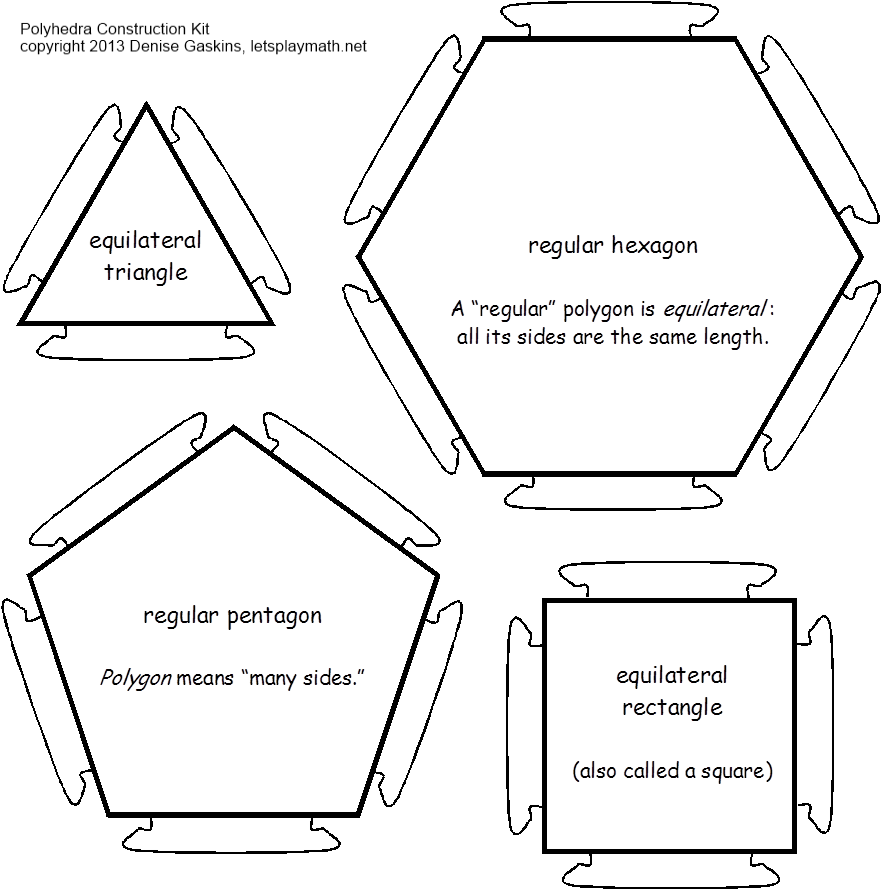
My math club students had fun with a Polyhedra Construction Kit. Here’s how to make your own:
Collect a bunch of empty cereal boxes. Cut the boxes open to make big sheets of cardboard.
Print out the template page (→) and laminate. Cut out each polygon shape, being sure to include the tabs on the sides.
Turn your cardboard brown-side-up and trace around the templates, making several copies of each polygon. I recommend 20 each of the pentagon and hexagon, 40 each of the triangle and square.
Draw the dark outline of each polygon with a ballpoint pen, pressing hard to score the cardboard so the tabs will bend easily.
Cut out the shapes, being careful around the tabs.
Use small rubber bands to connect the tabs. Each rubber band will hold two tabs together, forming one edge of a polyhedron.
So, for instance, it takes six squares and twelve rubber bands to make a cube. How many different polyhedra (plural of polyhedron) will you make?
Can you build a rhombicosidodecahedron?
And now, on to the main attraction: the 62 blog posts. Many of the following articles were submitted by their authors; others were drawn from the immense backlog in my blog reader. If you’d like to skip directly to your area of interest, here’s a quick Table of Contents:
Check out my newest home decor item, a hundred chart. The amount of work I put into it, I consider getting it framed to be proudly displayed in the living room. The thing is monumental in several ways:
1. It is monumentally different from my usual approach to choosing math aids. My rule is if it takes me more than 5 minutes to prepare a math manipulative, I skip it and find another way.
2. It is monumentally time-consuming to create from scratch all by yourself.
It began with a humble list of seven things in the first (now out of print) edition of my book about teaching home school math. Over the years I added new ideas, and online friends contributed, too, so the list grew to become one of the most popular posts on my blog:
Can you think of anything else we might do with a hundred chart? Add your ideas in the Comments section below, and I’ll add the best ones to our master list.
Welcome to the Math Teachers At Play blog carnival — a smorgasbord of ideas for learning, teaching, and playing around with math from preschool to pre-college. If you like to learn new things and play around with ideas, you are sure to find something of interest.
Let the mathematical fun begin…
PUZZLE 1
By tradition, we start the carnival with a pair of puzzles in honor of our 58th edition. Click to download the pdf:
Now is the accepted time to make your regular annual good resolutions. Next week you can begin paving hell with them as usual.
Yesterday, everybody smoked his last cigar, took his last drink, and swore his last oath. Today, we are a pious and exemplary community. Thirty days from now, we shall have cast our reformation to the winds and gone to cutting our ancient shortcomings considerably shorter than ever. We shall also reflect pleasantly upon how we did the same old thing last year about this time.
However, go in, community. New Year’s is a harmless annual institution, of no particular use to anybody save as a scapegoat for promiscuous drunks, and friendly calls, and humbug resolutions, and we wish you to enjoy it with a looseness suited to the greatness of the occasion.
For many homeschoolers, January is the time to assess our progress and make a few New Semester’s Resolutions. This year, we resolve to challenge ourselves to more math puzzles. Would you like to join us? Pump up your mental muscles with the 2013 Mathematics Game!










 Denise Gaskins' Let's Play Math