Quotable: I Do Hate Sums

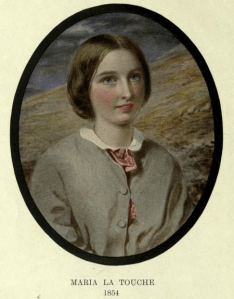
MrsLaTouche

I’ve been looking for quotes to put at the beginning of each chapter in my math games books. I found a delightful one by Mrs. LaTouche on the Mathematical Quotations Server, but when I looked up the original source, it was even better:

I am nearly driven wild with the Dorcas accounts, and by Mrs. Wakefield’s orders they are to be done now.

I do hate sums. There is no greater mistake than to call arithmetic an exact science. There are Permutations and Aberrations discernible to minds entirely noble like mine; subtle variations which ordinary accountants fail to discover; hidden laws of Number which it requires a mind like mine to perceive.

For instance, if you add a sum from the bottom up, and then again from the top down, the result is always different.

Again if you multiply a number by another number before you have had your tea, and then again after, the product will be different. It is also remarkable that the Post-tea product is more likely to agree with other people’s calculations than the Pre-tea result.

Try the experiment, and if you do not find it as I say, you are a mere sciolist*, a poor mechanical thinker, and not gifted as I am, with subtle perceptions.

Of course I find myself not appreciated as an accountant. Mrs. Wakefield made me give up the book to [my daughter] Rose and her governess (who are here), and was quite satisfied with the work of those inferior intellects.

— Maria Price La Touche
The Letters of A Noble Woman
London: George Allen & Sons, 1908

*sciolist: (archaic) A person who pretends to be knowledgeable and well informed. From late Latin sciolus (diminutive of Latin scius ‘knowing’, from scire ‘know’) + -ist.
Math Teachers at Play #76

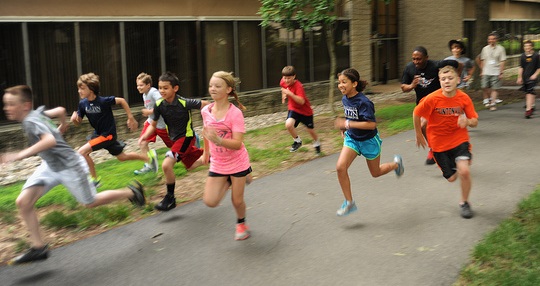
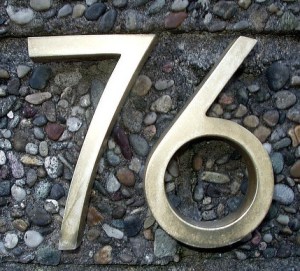
76[Feature photo (above) by U.S. Army RDECOM. Photo (right) by Stephan Mosel. (CC BY 2.0)]

On your mark… Get set… Go play some math!

Welcome to the 76th edition of the Math Teachers At Play math education blog carnival — a smorgasbord of links to bloggers all around the internet who have great ideas for learning, teaching, and playing around with math from preschool to pre-college.

By tradition, we start the carnival with a puzzle in honor of our 76th edition. But if you would like to jump straight to our featured blog posts, click here to see the Table of Contents.

Continue reading Math Teachers at Play #76

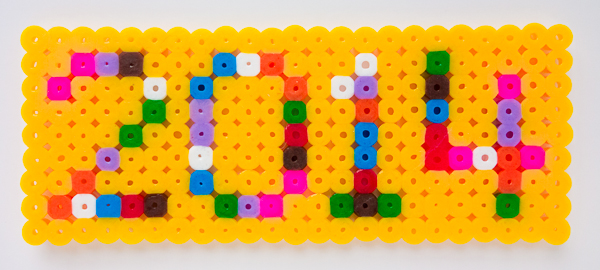
Math Teachers at Play #70

800px-Brauchtum_gesteck_70_1[Feature photo above by David Reimann via Bridges 2013 Gallery. Number 70 (right) from Wikimedia Commons (CC-BY-SA-3.0-2.5-2.0-1.0).]

Do you enjoy math? I hope so! If not, browsing this post just may change your mind.

Welcome to the 70th edition of the Math Teachers At Play math education blog carnival — a smorgasbord of 42+ links to bloggers all around the internet who have great ideas for learning, teaching, and playing around with math from preschool to pre-college. Let the mathematical fun begin!

By tradition, we start the carnival with a puzzle in honor of our 70th edition. But if you would like to jump straight to our featured blog posts, click here to see the Table of Contents.

Click here to continue reading.

2014 Mathematics Game

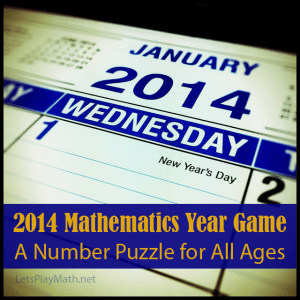
2014-Calendar

[Feature photo above by Artis Rams (CC BY 2.0) via flickr. Title background (right) by Dan Moyle (CC BY 2.0) via flickr]

Have you made a New Year’s resolution to spend more time with your family this year, and to get more exercise? Problem-solvers of all ages can pump up their (mental) muscles with the Annual Mathematics Year Game Extravaganza!

For many years mathematicians, scientists, engineers and others interested in mathematics have played “year games” via e-mail and in newsgroups. We don’t always know whether it is possible to write expressions for all the numbers from 1 to 100 using only the digits in the current year, but it is fun to try to see how many you can find.

— Math Forum Year Game Site

Rules of the Game

Use the digits in the year 2014 to write mathematical expressions for the counting numbers 1 through 100. The goal is adjustable by age: Young children can start with looking for 1-10, or 1-25.

  • You must use all four digits. You may not use any other numbers.
  • Solutions that keep the year digits in 2-0-1-4 order are preferred, but not required.
  • You may use +, -, x, ÷, sqrt (square root), ^ (raise to a power), ! (factorial), and parentheses, brackets, or other grouping symbols.
  • You may use a decimal point to create numbers such as .2, .02, etc., but you cannot write 0.02 because we only have one zero in this year’s number.
  • You may use the overhead-bar (vinculum), dots, or brackets to mark a repeating decimal.
  • You may create multi-digit numbers such as 10 or 201 or .01, but we prefer solutions that avoid them.
  • You may use a double factorial, but we prefer solutions that avoid them. n!! = the product of all integers from 1 to n that have the same parity (odd or even) as n.

[Note to students and teachers: If you want to take part in the Math Forum Year Game, be warned that they do not allow repeating decimals.]

Click here to continue reading.

Things To Do with a Hundred Chart #30

100chartpuzzle

Here’s one more entry for my 20+ Things to Do with a Hundred Chart post, thanks to David Radcliffe in the comments on Monday’s post:

(30) Can you mark ten squares Sudoku-style, so that no two squares share the same row or column? Add up the numbers to get your score. Then try to find a different set of ten Sudoku-style squares. What do you notice? What do you wonder?
[Suggested by David Radcliffe.]

Share Your Ideas

Can you think of anything else we might do with a hundred chart? Add your ideas in the Comments section below, and I’ll add the best ones to our master list.

Parents, Teachers: Learn about Teaching Decimals

Many children are confused by decimals. They are convinced 0.48 > 0.6 because 48 is obviously ever so much bigger than 6. Their intuition tells them 0.2 × 0.3 = 0.6 has the clear ring of truth. And they confidently assert that, if you want to multiply a decimal number by 10, all you have to do is add a zero at the end.

What can we do to help our kids understand decimals?

Christopher Danielson (author of Talking Math with Your Kids) will be hosting the Triangleman Decimal Institute, a free, in-depth, online chat for “everyone involved in children’s learning of decimals.” The Institute starts tomorrow, September 30 (sorry for the short notice!), but you can join in the discussion at any time:

Past discussions stay open, so feel free to jump into the course whenever you can. Here is the schedule of “classes”:

Click here to see the TDI topic list →

Math Teachers at Play #66

[Feature photo above by Franz & P via flickr. Route 66 sign by Sam Howzit via flickr. (CC BY 2.0)]
Route 66 Sign

Welcome to the Math Teachers At Play blog carnival — which is not just for math teachers! If you like to learn new things and play around with ideas, you are sure to find something of interest.

By tradition, we start the carnival with a couple of puzzles in honor of our 66th edition.

Let the mathematical fun begin!

Puzzle 1

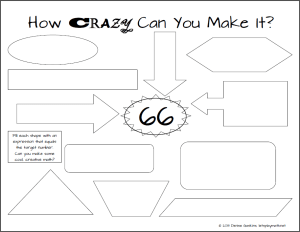
how crazy 66

Our first puzzle is based on one of my favorite playsheets from the Miquon Math workbook series. Fill each shape with an expression that equals the target number. Can you make some cool, creative math?

Click the image to download the pdf playsheet set: one page has the target number 66, and a second page is blank so you can set your own target number.

Continue reading Math Teachers at Play #66

A Pretty Math Problem?

As we were doing Buddy Math (taking turns through the homework exercises) today, my daughter said, “Oooo! I want to do this one. It’s pretty!”

CodeCogsEqn

She has always loved seeing patterns in math. I remember once, years ago, when she insisted that we change the problems on a worksheet to make the answers come out symmetrical. 🙂

Math That Is Fun: Infinite Primes

Oh, my! Ben Orlin over at Math with Bad Drawings just published my new favorite math proof ever:

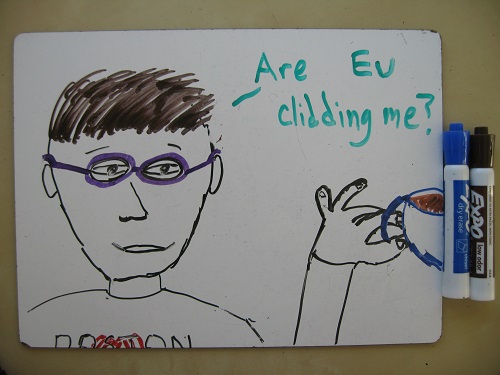
I had a fight with Euclid on the nature of the primes.
It got a little heated – you know how the tension climbs.

It started out most civil, with a honeyed cup of tea;
we traded tales of scholars, like Descartes and Ptolemy.
But as the tea began to cool, our chatter did as well.
We’d had our fill of gossip. We sat silent for a spell.
That’s when Euclid turned to me, and said, “Hear this, my friend:
did you know the primes go on forever, with no end?” …

15-eu-must-be-clidding

Click here to read the whole post at Math with Bad Drawings.

Quotable: Learning the Math Facts

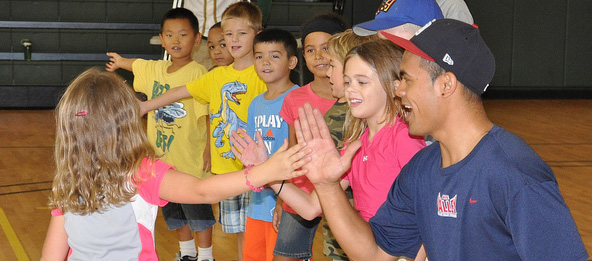
Feature photo above by USAG- Humphreys via Flickr (CC BY 2.0).

During off-times, at a long stoplight or in grocery store line, when the kids are restless and ready to argue for the sake of argument, I invite them to play the numbers game.

“Can you tell me how to get to twelve?”

My five year old begins, “You could take two fives and add a two.”

“Take sixty and divide it into five parts,” my nearly-seven year old says.

“You could do two tens and then take away a five and a three,” my younger son adds.

Eventually we run out of options and they begin naming numbers. It’s a simple game that builds up computational fluency, flexible thinking and number sense. I never say, “Can you tell me the transitive properties of numbers?” However, they are understanding that they can play with numbers.

…

photo by Mike Baird via flickr

I didn’t learn the rules of baseball by filling out a packet on baseball facts. Nobody held out a flash card where, in isolation, I recited someone else’s definition of the Infield Fly Rule. I didn’t memorize the rules of balls, strikes, and how to get someone out through a catechism of recitation.

Instead, I played baseball.

— John Spencer
Memorizing Math Facts

Conversational Math

The best way for children to build mathematical fluency is through conversation. For more ideas on discussion-based math, check out these posts:

Learning the Math Facts

For more help with learning and practicing the basic arithmetic facts, try these tips and math games:

 
* * *

This blog is reader-supported.

If you’d like to help fund the blog on an on-going basis, then please join me on Patreon for mathy inspiration, tips, and an ever-growing archive of printable activities.

If you liked this post, and want to show your one-time appreciation, the place to do that is PayPal: paypal.me/DeniseGaskinsMath. If you go that route, please include your email address in the notes section, so I can say thank you.

Which I am going to say right now. Thank you!

“Quotable: Learning the Math Facts” copyright © 2013 by Denise Gaskins. Image at the top of the post copyright © USAG- Humphreys via Flickr (CC BY 2.0).