Build Mathematical Skills by Delaying Arithmetic, Part 2

To my fellow homeschoolers,

Most young children are not developmentally ready to master abstract, pencil-and-paper rules for manipulating numbers. But they are eager to learn about and explore the world of ideas. Numbers, patterns, and shapes are part of life all around us. As parent-teachers, we have many ways to feed our children’s voracious mental appetites without resorting to workbooks.

To delay formal arithmetic does not mean that we avoid mathematical topics — only that we delay math fact drill and the memorization of procedures. Notice the wide variety of mathematics Benezet’s children explored through books and through their own life experiences:

Grade I

There is no formal instruction in arithmetic. In connection with the use of readers, and as the need for it arises, the children are taught to recognize and read numbers up to 100. This instruction is not concentrated into any particular period or time but comes in incidentally in connection with assignments of the reading lesson or with reference to certain pages of the text.

Meanwhile, the children are given a basic idea of comparison and estimate thru [sic] the understanding of such contrasting words as: more, less; many. few; higher, lower; taller, shorter; earlier, later; narrower, wider; smaller, larger; etc.

As soon as it is practicable the children are taught to keep count of the date upon the calendar. Holidays and birthdays, both of members of the class and their friends and relatives, are noted.

— L. P. Benezet
The Teaching of Arithmetic II: The Story of an experiment

Continue reading Build Mathematical Skills by Delaying Arithmetic, Part 2

Build Mathematical Skills by Delaying Arithmetic, Part 1

To my fellow homeschoolers,

It’s counter-intuitive, but true: Our children will do better in math if we delay teaching them formal arithmetic skills. In the early years, we need to focus on conversation and reasoning — talking to them about numbers, bugs, patterns, cooking, shapes, dinosaurs, logic, science, gardening, knights, princesses, and whatever else they are interested in.

In the fall of 1929 I made up my mind to try the experiment of abandoning all formal instruction in arithmetic below the seventh grade and concentrating on teaching the children to read, to reason, and to recite — my new Three R’s. And by reciting I did not mean giving back, verbatim, the words of the teacher or of the textbook. I meant speaking the English language.

— L. P. Benezet
The Teaching of Arithmetic I: The Story of an experiment

Continue reading Build Mathematical Skills by Delaying Arithmetic, Part 1

PUFM 1.5 Multiplication, Part 1

Photo by Song_sing via flickr. In this Homeschooling Math with Profound Understanding (PUFM) Series, we are studying Elementary Mathematics for Teachers and applying its lessons to home education.

My apologies to those of you who dislike conflict. This week’s topic inevitably draws us into a simmering Internet controversy.

Thinking my way through such disputes helps me to grow as a teacher, to re-think on a deeper level concepts that I thought I understood. This is why I loved Liping Ma’s book when I first read it, and it’s why I thoroughly enjoyed Terezina Nunes and Peter Bryant’s book Children Doing Mathematics.

repeatedaddition

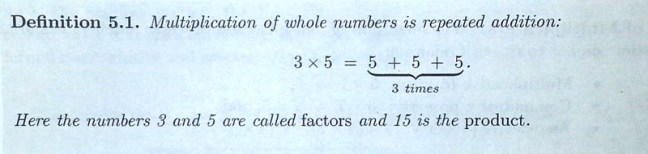
Multiplication of whole numbers is defined as repeated addition…

— Thomas H. Parker & Scott J. Baldridge
Elementary Mathematics for Teachers

Multiplication simply is not repeated addition, and telling young pupils it is inevitably leads to problems when they subsequently learn that it is not… Adding numbers tells you how many things (or parts of things) you have when you combine collections. Multiplication is useful if you want to know the result of scaling some quantity.

— Keith Devlin
It Ain’t No Repeated Addition

Continue reading PUFM 1.5 Multiplication, Part 1

Math Teachers at Play #52

[Photo by bumeister1 via flickr.]

Welcome to the Math Teachers At Play blog carnival — which is not just for math teachers! We have games, lessons, and learning activities from preschool math to calculus. If you like to learn new things and play around with mathematical ideas, you are sure to find something of interest.

Scattered between all the math blog links, I’ve included highlights from the Common Core Standards for Mathematical Practice, which describe the types of expertise that teachers at all levels — whether in traditional, experimental, or home schools — should seek to develop in their math students.

Let the mathematical fun begin…

TRY THESE PUZZLES

By tradition, we start the carnival with a couple of puzzles in honor of our 52nd edition. Since there are 52 playing cards in a standard deck, I chose two card puzzles from the Maths Is Fun Card Puzzles page:

  • A blind-folded man is handed a deck of 52 cards and told that exactly 10 of these cards are facing up. How can he divide the cards into two piles (which may be of different sizes) with each pile having the same number of cards facing up?
  • What is the smallest number of cards you must take from a 52-card deck to be guaranteed at least one four-of-a-kind?

The answers are at Maths Is Fun, but don’t look there. Having someone give you the answer is no fun at all!

Continue reading Math Teachers at Play #52

How Crazy Can You Make It?

And here is yet more fun from Education Unboxed. This type of page was always one of my my favorites in Miquon Math.

Update:

Handmade “How Crazy…?” worksheets are wonderful, but if you want something a tad more polished, I created a printable. The first page has a sample number, and the second is blank so that you can fill in any target:

Add an extra degree of freedom: students can fill in the blanks with equivalent and non-equivalent expressions. Draw lines anchoring the ones that are equivalent to the target number, but leave the non-answers floating in space.

Or don’t draw lines. Let the kids create a worksheet for you to solve. After they finish their expressions, can you figure out which ones connect to the target number?

How CRAZY Can You Make It

PUFM 1.4 Subtraction

Photo by Martin Thomas via flickr. In this Homeschooling Math with Profound Understanding (PUFM) Series, we are studying Elementary Mathematics for Teachers and applying its lessons to home education.

When adding, we combine two addends to get a sum. For subtraction we are given the sum and one addend and must find the “missing addend”.

— Thomas H. Parker & Scott J. Baldridge
Elementary Mathematics for Teachers

Notice that subtraction is not defined independently of addition. It must be taught along with addition, as an inverse (or mirror-image) operation. The basic question of subtraction is, “What would I have to add to this number, to get that number?”

Inverse operations are a very fundamental idea in mathematics. The inverse of any math operation is whatever will get you back to where you started. In order to fully understand a math operation, you must understand its inverse.

Continue reading PUFM 1.4 Subtraction

Multiplication Challenge

Can you explain why the multiplication method in the following video works? How about your upper-elementary or middle school students — can they explain it to you?

Pause the video at 4:30, before he gives the interpretation himself. After you have decided how you would explain it, hit “play” and listen to his explanation.

Continue reading Multiplication Challenge

PUFM 1.2 Place Value

Photo by Chrissy Johnson1 via flickr. In this Homeschooling Math with Profound Understanding (PUFM) Series, we are studying Elementary Mathematics for Teachers and applying its lessons to home education.

Our decimal system of recording numbers is ingenious. Once learned, it is a simple, versatile, and efficient way of writing numbers. … But the system is not obvious nor easily learned. The use of place value is subtle, and mastering it is the single most challenging aspect of elementary school mathematics.

Ironically, these challenges are largely invisible to untrained parents and teachers — place value is so ingrained in adults’ minds that it is difficult to appreciate how important it is and how hard it is to learn.

— Thomas H. Parker & Scott J. Baldridge
Elementary Mathematics for Teachers

In other words, we take place value for granted. I know this was true of me when I started teaching my kids. Every year, their textbooks would start with the obligatory chapters on place value, which seemed to me just busywork. I began to appreciate the vital importance of place value when I read Liping Ma’s book and saw how the American teachers were unable to properly explain subtraction or multi-digit multiplication.

Place value is the heart of our number system, the foundation on which all the rest of arithmetic must be built. Because of place value, “The simplest schoolboy is now familiar with facts for which Archimedes would have sacrificed his life.”

Continue reading PUFM 1.2 Place Value