Lockhart’s Measurement

After watching the video on the Amazon.com page, this book has jumped to the top of my wish list.

You may have read Paul Lockhart’s earlier piece, A Mathematician’s Lament, which explored the ways that traditional schooling distorts mathematics. In this book, he attempts to share the wonder and beauty of math in a way that anyone can understand.

According to the publisher: “Measurement offers a permanent solution to math phobia by introducing us to mathematics as an artful way of thinking and living. Favoring plain English and pictures over jargon and formulas, Lockhart succeeds in making complex ideas about the mathematics of shape and motion intuitive and graspable.”

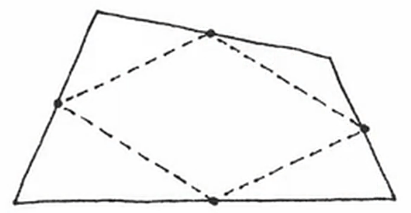
If you take any 4-sided shape at all — make it as awkward and as ridiculous as you want — if you take the middles of the sides and connect them, it always makes a parallelogram. Always! No matter what crazy, kooky thing you started with.

That’s scary to me. That’s a conspiracy.

That’s amazing!

That’s completely unexpected. I would have expected: You make some crazy blob and connect the middles, it’s gonna be another crazy blob. But it isn’t — it’s always a slanted box, beautifully parallel.

WHY is it that?!

The mathematical question is “Why?” It’s always why. And the only way we know how to answer such questions is to come up, from scratch, with these narrative arguments that explain it.

So what I want to do with this book is open up this world of mathematical reality, the creatures that we build there, the questions that we ask there, the ways in which we poke and prod (known as problems), and how we can possibly craft these elegant reason-poems.

— Paul Lockhart
author of Measurement

5 Stars at Home School Book Review

Wayne at Home School Book Review just posted a very kind review of my daughter’s book:

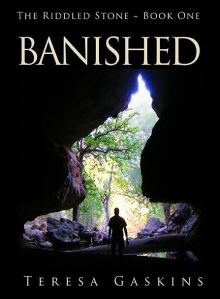
Banished is a captivating fantasy story with a well-thought-out plot that would be a credit to any writer. But it is especially remarkable coming from a thirteen-year-old student who has been homeschooled all her life.

However, be forewarned. When you reach the final page and find the words, “Not the End…,” you will cry, “Oh! No!”

I for one feel as if I simply can’t wait to read the next installment to find out what happens to Chris and his friends. It’s that good!

New Fantasy Fiction Book by 13yo Homeschooler

My 13-year-old daughter just released her first book on Kindle:

  • Banished (The Riddled Stone, Book One)
    Falsely accused of stealing a magic artifact, Chris is forced to leave home, never to return. As he and three friends travel toward the border, however, they are warned of great danger approaching the land. They set out to solve an ancient riddle — but will they be able to save the kingdom, or will the quest cost them their lives?

[Update 7/6/12: The paperback book is now “In Stock” at Amazon (yay!).]

Teresa (also known as Princess Kitten) has done the NaNoWriMo Youth Program as part of her language studies for the past three years and has written many stories on her blog, but this is the first time we’ve followed through and published one of her books.

Of course I’m biased, but I think she did a pretty good job, as first books go. It’s clearly the beginning of a series, so she sets up more plot threads than she resolves — but I did convince her not to wait for this year’s NaNoWriMo to start Book Two. (I want to find out what happens next!)

Anyway, if you or your kids enjoy fantasy fiction and are interested in reading something written by a teenage homeschooler, please check out her book. She would love to get some reviews!

Sample The Moscow Puzzles

Dover Publications is offering a free sample chapter from The Moscow Puzzles.

Cat and Mice
Purrer has decided to take a nap. He dreams he is encircle by 13 mice: 12 gray and 1 white. He hears his owner saying: “Purrer, you are to eat each thirteenth mouse, keeping the same direction. The last mouse you eat must be the white one.”

Download the sample chapter from The Moscow Puzzles.

More Free Math from Dover Publications

PUFM 1.0 Introduction

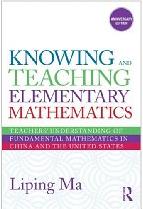
Profound Understanding of Fundamental Mathematics (PUFM) is a phrase coined by Liping Ma in her landmark book, Knowing and Teaching Elementary Mathematics, to describe the deep, broad, and thorough understanding exhibited by several of the Chinese teachers she interviewed.

The Chinese teachers with PUFM didn’t get it automatically. It grew over many years of teaching several levels of elementary math and of studying their textbooks and teaching materials. They met weekly in teaching research groups to learn from each other’s experience, to find multiple ways to solve problems, and to broaden their mathematical understanding.

More than eight years ago, a group of homeschooling friends started a Yahoo “teaching research group” to discuss math in hope of deepening our own understanding and learning to better help our students. We had a good time, but the busy-ness of everyday life eventually won out. The group has mostly disbanded, though the archives remain. Now I’d like to bring that study to my blog, bit by bit, updated with things I’ve learned in the years since.

Continue reading PUFM 1.0 Introduction

Used Book Price Shock

Someone mentioned one of my old books on the Living Math forum, which made me curious how the used copies were doing at Amazon.com. These are simple little books, 100 loose pages comb-bound together. I have seen ridiculous prices before, but this one takes the cake.

Thankfully, there are a few used book dealers with more sense, or at least with more reasonable computer-automated pricing routines.

I am still at work revising (and greatly expanding) the old books so I can publish new editions. If you haven’t voted yet in my “What Do You Want from a Math Book?” survey, I’d love to hear your opinion!

Raymond Smullyan Excerpts at Dover Publications

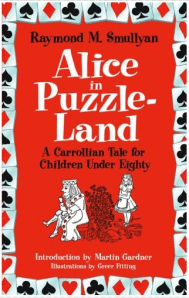
To celebrate their re-release of his classic puzzle books, the Dover Math and Science Newsletter featured an interview with Raymond Smullyan, as well as several extended excerpts from his books. (For my math club students: Professor Smullyan invented the Knights and Knaves puzzles.) Enjoy!

What I’m Reading: Fermat’s Enigma

Homeschooling is much more than just doing school at home — it’s a lifelong lifestyle of learning. And thanks to the modern miracle of inter-library loan, even those of us who live in the middle of nowhere can get just about any book sent directly to our tiny home-town libraries.

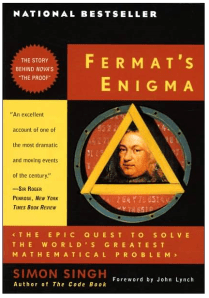
As I mentioned in Math Teachers at Play 46, I’m trying to add more living books about math to our homeschool schedule, including my own self-education reading. So, a copy of Fermat’s Enigma: The Epic Quest to Solve the World’s Greatest Mathematical Problem finally showed up at my library, and I am thoroughly enjoying it.

Continue reading What I’m Reading: Fermat’s Enigma

Do You Teach Math to Young Children?

Sue VanHattum is trying to convince the publishers that this excellent book would reach a wider audience if they made it available at a lower price. What do you think?

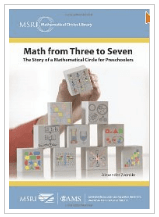
As anyone who has taught or raised young children knows, mathematical education for little kids is a real mystery. What are they capable of? What should they learn first? How hard should they work? Should they even “work” at all? Should we push them, or just let them be?

There are no correct answers to these questions, and Zvonkin deals with them in classic math-circle style: He doesn’t ask and then answer a question, but shows us a problem — be it mathematical or pedagogical — and describes to us what happened. His book is a narrative about what he did, what he tried, what worked, what failed, but most important, what the kids experienced.

This book is not a guidebook. It does not purport to show you how to create precocious high achievers. It is just one person’s story about things he tried with a half-dozen young children. On the other hand, if you are interested in running a math circle, or homeschooling children, you will find this book to be an invaluable, inspiring resource. It’s not a “how to” manual as much as a “this happened” journal. … Just about every page contains a really clever teaching idea, a cool math problem, and an inspiring and funny story.

— Paul Zeitz
Introduction to Math from Three to Seven

Math Teachers at Play #46: Living Books for Math

Welcome to the Math Teachers At Play blog carnival — which is not just for math teachers! Here is a smorgasbord of ideas for learning, teaching, and playing around with math from preschool to pre-college. Some articles were submitted by their authors, others were drawn from the immense backlog in my blog reader. If you like to learn new things, you are sure to find something of interest.

Living Books for Math

A child’s intercourse must always be with good books, the best that we can find… We must put into their hands the sources which we must needs use for ourselves, the best books of the best writers.

For the mind is capable of dealing with only one kind of food; it lives, grows and is nourished upon ideas only; mere information is to it as a meal of sawdust to the body.

Charlotte Mason
Toward A Philosophy of Education

Princess Kitten and I took a longer than usual holiday break from homeschooling, but now I’m in plan-for-the-new-semester mode. I hope to include more living math in our schedule, so I decided to illustrate this edition of the MTaP carnival with a few of my favorite living math books. I’d love to hear more living book suggestions in the comments!

If you click on a book cover, the links take you to Amazon.com, where you can read reviews and other details (and where I earn a small affiliate commission if you actually buy the book), but all of these books should be available through your public library or via inter-library loan.

Let the mathematical fun begin…

Continue reading Math Teachers at Play #46: Living Books for Math