How to Conquer the Times Table, Part 4

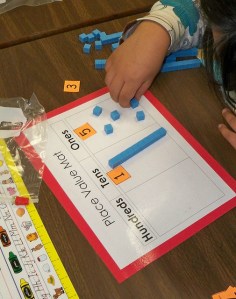
Photo of Miss Karen (and computer) times 3, by Karen, via flickr.

If you remember, we are in the middle of an experiment in mental math. We are using the world’s oldest interactive game — conversation — to explore multiplication patterns while memorizing as little as possible. So far, we have studied the times-1 and times-10 families and the Commutative Property (that you can multiply numbers in any order). Then we memorized the doubles and mastered the facts built on them.

Continue reading How to Conquer the Times Table, Part 4

How to Conquer the Times Table, Part 3

Photo of Javier times 4, by Javier Ignacio Acuña Ditzel, via flickr.

If you remember, we are in the middle of an experiment in mental math. We are using the world’s oldest interactive game — conversation — to explore multiplication patterns while memorizing as little as possible. Talk through these patterns with your student. Work many, many, many oral math problems together. Discuss the different ways you can find each answer, and notice how the number patterns connect to each other.

So far, we have mastered the times-1 and times-10 families and the Commutative Property (that you can multiply numbers in any order).

Continue reading How to Conquer the Times Table, Part 3

How to Conquer the Times Table, Part 2

Photo of Eeva times 6, by Eric Horst, via flickr.

The question is common on parenting forums:

My daughter is in 4th grade. She has been studying multiplication in school for nearly a year, but she still stumbles over the facts and counts on her fingers. How can I help her?

Many people resort to flashcards and worksheets in such situations, and computer games that flash the math facts are quite popular with parents. I recommend a different approach: Challenge your student to a joint experiment in mental math. Over the next two months, without flashcards or memory drill, how many math facts can the two of you learn together?

We will use the world’s oldest interactive game — conversation — to explore multiplication patterns while memorizing as little as possible.

Continue reading How to Conquer the Times Table, Part 2

Square One TV: The Mathematics of Love

The Engineer was away on a business trip, and Kitten and I were in the mood to veg out on YouTube, so I hunted for some golden oldies. We used to watch Square One TV faithfully, back when my eldest was in first grade. I can’t believe they haven’t released this show on DVD!

We found recordings of my two favorite songs (“Nine, Nine, Nine” and “8% of My Love”), but the picture quality was horrible. This video was the runner-up:

How to Conquer the Times Table, Part 1

Photo of Evil Erin times 5 (and dog times 2), via flickr.

Perhaps the biggest challenge for any middle-elementary math student is to master the multiplication facts. It can seem like an unending task to memorize so many facts and be able to pull them out of mental storage in any order on demand. Too often, the rote aspect of such memory work overwhelms students, eclipsing their view of the principles behind the math. Yet rote memory is not enough: A student may be able to recite the times tables perfectly and still be reduced to counting on fingers in the middle of a long division problem.

We will use the world’s oldest interactive game — conversation — to learn the multiplication facts one bite at a time. But first, let’s take some time to think about what multiplication really means.

Continue reading How to Conquer the Times Table, Part 1

Game: Times Tac Toe

Photo by jma.work via flickr.

I’ve been working on a book of math games for homeschoolers and other teachers. I hope to get it published later this year, but the editing drags on. Would anybody like to draw the illustrations?

Meanwhile, here’s a 2-player game your students may enjoy…

Set Up

Print out a blank times table chart and place it between the players. Each player will need a colored marker, and the colors must be different enough to be easily distinguished.

Remove the jokers and kings from a deck of poker-style playing cards, but leave the jacks (= 11) and queens (= 12). Shuffle the deck, and place the stack face down as a draw pile.

Continue reading Game: Times Tac Toe

Quotable: Times Tables Are Not Math

Important note: times tables are not math. Math doesn’t need to be made fun; it already is fun. Memorizing your times tables is a rote activity, it requires a fair bit of repetition for most, and it may need to be made fun. Just saying.

Dan Finkel
A game to end all times tables drills: Damult Dice

It’s a great game! Do click over to Dan’s blog and check it out:

And while we’re on the topic of times tables, Maria posted an article, too:

Hobbit Math: Elementary Problem Solving 5th Grade

[Photo by OliBac. Visit OliBac’s photostream for more.]

The elementary grades 1-4 laid the foundations, the basics of arithmetic: addition, subtraction, multiplication, division, and fractions. In grade 5, students are expected to master most aspects of fraction math and begin working with the rest of the Math Monsters: decimals, ratios, and percents (all of which are specialized fractions).

Word problems grow ever more complex as well, and learning to explain (justify) multi-step solutions becomes a first step toward writing proofs.

This installment of my elementary problem solving series is based on the Singapore Primary Mathematics, Level 5A. For your reading pleasure, I have translated the problems into the world of J.R.R. Tolkien’s classic, The Hobbit.

UPDATE: Problems have been genericized to avoid copyright issues.

Continue reading Hobbit Math: Elementary Problem Solving 5th Grade

Word Problems from Literature

[Photo by Passion of Bilwa.]

I’ve put the word problems from my elementary problem solving series into printable worksheets:

Continue reading Word Problems from Literature