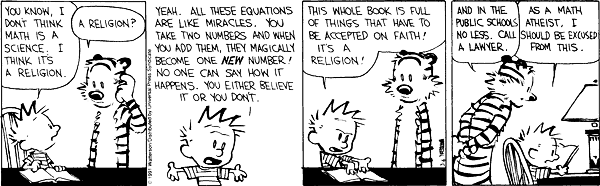
How to Conquer the Times Table, Part 1

Photo of Evil Erin times 5 (and dog times 2), via flickr.

Perhaps the biggest challenge for any middle-elementary math student is to master the multiplication facts. It can seem like an unending task to memorize so many facts and be able to pull them out of mental storage in any order on demand. Too often, the rote aspect of such memory work overwhelms students, eclipsing their view of the principles behind the math. Yet rote memory is not enough: A student may be able to recite the times tables perfectly and still be reduced to counting on fingers in the middle of a long division problem.

We will use the world’s oldest interactive game — conversation — to learn the multiplication facts one bite at a time. But first, let’s take some time to think about what multiplication really means.

Continue reading How to Conquer the Times Table, Part 1

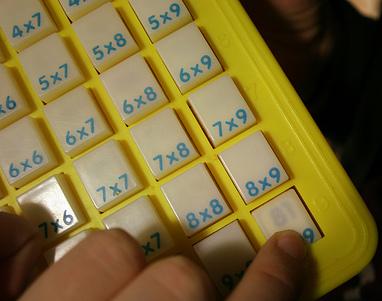
Game: Times Tac Toe

Photo by jma.work via flickr.

I’ve been working on a book of math games for homeschoolers and other teachers. I hope to get it published later this year, but the editing drags on. Would anybody like to draw the illustrations?

Meanwhile, here’s a 2-player game your students may enjoy…

Set Up

Print out a blank times table chart and place it between the players. Each player will need a colored marker, and the colors must be different enough to be easily distinguished.

Remove the jokers and kings from a deck of poker-style playing cards, but leave the jacks (= 11) and queens (= 12). Shuffle the deck, and place the stack face down as a draw pile.

Continue reading Game: Times Tac Toe

Quotable: Times Tables Are Not Math

Important note: times tables are not math. Math doesn’t need to be made fun; it already is fun. Memorizing your times tables is a rote activity, it requires a fair bit of repetition for most, and it may need to be made fun. Just saying.

— Dan Finkel
A game to end all times tables drills: Damult Dice

It’s a great game! Do click over to Dan’s blog and check it out:

And while we’re on the topic of times tables, Maria posted an article, too:

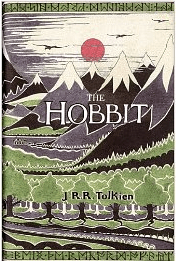
Hobbit Math: Elementary Problem Solving 5th Grade

[Photo by OliBac. Visit OliBac’s photostream for more.]

The elementary grades 1-4 laid the foundations, the basics of arithmetic: addition, subtraction, multiplication, division, and fractions. In grade 5, students are expected to master most aspects of fraction math and begin working with the rest of the Math Monsters: decimals, ratios, and percents (all of which are specialized fractions).

Word problems grow ever more complex as well, and learning to explain (justify) multi-step solutions becomes a first step toward writing proofs.

This installment of my elementary problem solving series is based on the Singapore Primary Mathematics, Level 5A. For your reading pleasure, I have translated the problems into the world of J.R.R. Tolkien’s classic, The Hobbit.

UPDATE: Problems have been genericized to avoid copyright issues.

Continue reading Hobbit Math: Elementary Problem Solving 5th Grade

Word Problems from Literature

[Photo by Passion of Bilwa.]

I’ve put the word problems from my elementary problem solving series into printable worksheets:

Continue reading Word Problems from Literature

The Cookie Factory Guide to Long Division

[Photo by scubadive67.]

Help! My son was doing fine in math until he started long division, but now he’s completely lost! I always got confused with all those steps myself. How can I explain it to him?

Long division. It’s one of the scariest of the Math Monsters, those tough topics of upper-elementary and middle school mathematics. Of all the topics that come up on homeschool math forums, perhaps only one (“How can I get my child to learn the math facts?”) causes parents more anxiety.

Most of the “helpful advice” I’ve seen focuses on mnemonics (“Dad/Mother/Sister/Brother” to remember the steps: Divide, Multiply, Subtract, Bring down) or drafting (turn your notebook paper sideways and use the lines to keep your columns straight).

I worry that parents are too focused on their child mastering the algorithm, learning to follow the procedure, rather than on truly understanding what is happening in long division.

An algorithm is simply a step-by-step recipe for doing a mathematical calculation. But WHY does the algorithm work? If our students could understand the reason for the steps, they wouldn’t have to work so hard on memory tricks.

Continue reading The Cookie Factory Guide to Long Division

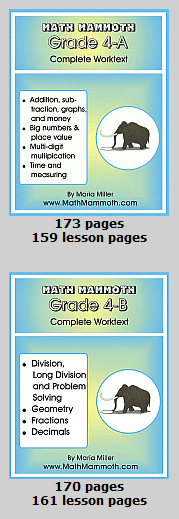
Review: Math Mammoth

When Maria of Homeschool Math Blog asked if I would review her Math Mammoth curriculum, I jumped at the chance. I’ve always enjoyed her blog posts, and I liked the worksheets I had seen on her website. (Maria gives away more than 300 pages absolutely free!)

She sent me her then-new 4th grade worktexts, and Kitten and I dug in.
Well, that was longer ago than I care to admit. But of course, it takes quite a bit of daily use before one can be absolutely sure of one’s opinion about a homeschool program — or at least, it does for me. Too many times a homeschool resource will look great in the catalog, and we’ll start it with high hopes only to bog down in the day-to-day grind and abandon it after a few weeks or months. So I wanted to give Math Mammoth a thorough workout before I wrote this review.

And all excuses aside, I really am a pro at crastinating…

My aim is to help parents and teachers teach math so our children and students can really understand what is going on. I’ve strived to explain the concepts so that both the teacher and the student can “get it” by reading the explanations in the books.

— Maria Miller
author of Math Mammoth worktexts
and Homeschool Math Blog

Continue reading Review: Math Mammoth

New Edition of Must-Read Math Book

I thought I knew math fairly well.

I thought arithmetic was boring.

I thought the reason other nations beat America in international math tests was that their students worked harder than ours.

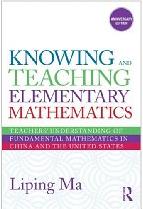
I thought all sorts of silly things before I read Liping Ma’s Knowing and Teaching Elementary Mathematics. Now this must-read book is coming out in a new edition, due in bookstores next week.

I can hardly wait!

In American elementary mathematics education, arithmetic is viewed as negligible, sometimes even with pity and disdain—like Cinderella in her stepmother’s house. Many people seem to believe that arithmetic is only composed of a multitude of “math facts” and a handful of algorithms. . . Who would expect that the intellectual demand for learning such a subject actually is challenging and exciting?

— Liping Ma
Arithmetic in American Mathematics Education: An Abandoned Arena?

Continue reading New Edition of Must-Read Math Book

Narnia Math: Elementary Problem Solving 4th Grade

[Photo by armigeress.]

In 4th grade, math problems take a large step up on the difficulty scale. Students are more mature and can read and follow more complex stories. Multi-step word problems become the new norm, and proportional relationships (like “three times as many”) show up frequently. As the year progresses, fractions grow to be a dominant theme.

As a math teacher, one of my top goals is that my students learn to solve word problems. Arithmetic is (relatively) easy, but many children struggle in applying it to “real world” situations.

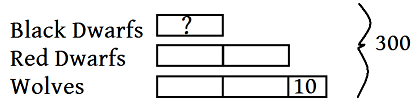
In previous posts, I introduced the problem-solving tools of word algebra and bar diagrams, either of which can help students organize the information in a word problem and translate it into a mathematical calculation. The earlier posts in this series are:

In this installment, I will continue to demonstrate the problem-solving tool of bar diagrams through a series of ten 4th grade problems based on the Singapore Primary Math series, level 4A. For your reading pleasure, I have translated the problems into the universe of a family-favorite story by C. S. Lewis, The Lion, the Witch and the Wardrobe.

UPDATE: Problems have been genericized to avoid copyright issues.

Continue reading Narnia Math: Elementary Problem Solving 4th Grade