Math Game: Number Train

Math Concepts: number symbols, numerical order, thinking ahead.
Players: two or more.
Equipment: one math deck of playing cards (remove face cards and jokers), or a double deck for more than four players; additional cards to use as train cars.

Set-Up

Give each player four to six miscellaneous cards (such as the face cards and jokers you removed from the card deck) to serve as the cars of their number trains.

Lay these cards face down in a horizontal row, as shown. Shuffle the math card deck and spread it on the table as a fishing pond.

Line up the cars of your train.

How to Play

On your turn, draw one card and play it face up on one of your train cars. The numbers on your train must increase from left to right, but they do not need to be in consecutive order. If you do not have an appropriate blank place for your card, you have two choices:

• Mix the new card back into the fishing pond.

• Use the new number to replace one of your other cards, and then discard the old one.

The first player to complete a train of numbers that increases from left to right wins the game.

Two of the train cars have passengers. Which numbers could you put on the other cars?

Variations

House Rule: Decide how strict you will be about the “increases from left to right” rule and repeated numbers. Does “1, 3, 3, 7, 8” count as a valid number train? Or will the player have to keep trying for a card to replace one of the threes?

For older players: You can adapt Number Train to play with more advanced students:

Deal Alert!

One of my favorite stores, Rainbow Resource Center, is offering several of my books at a great discount.

Check them out!

 
* * *

CountingGames-300“Math Game: Number Train” is an excerpt from my book Counting & Number Bonds: Math Games for Early Learners, available now at your favorite online book dealer.

This blog is reader-supported.

If you’d like to help fund the blog on an on-going basis, then please join me on Patreon for mathy inspiration, tips, and an ever-growing archive of printable activities.

If you liked this post, and want to show your one-time appreciation, the place to do that is PayPal: paypal.me/DeniseGaskinsMath. If you go that route, please include your email address in the notes section, so I can say thank you.

Which I am going to say right now. Thank you!

“Math Game: Number Train” copyright © 2018 by Denise Gaskins.

Playing Complex Fractions with Your Kids

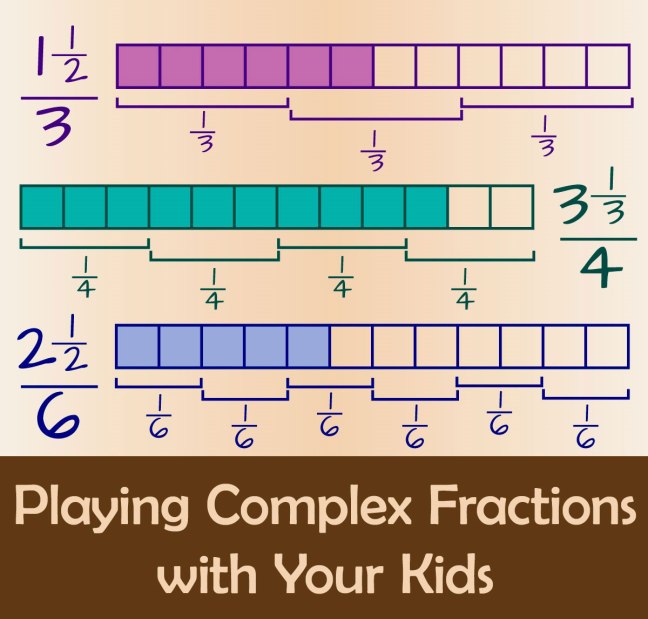
This week, I’m working on graphics for my upcoming book 70+ Things to Do with a Hundred Chart. I had fun with this complex fraction image.

It looks a bit cluttered. Possible tweak: Remove the brackets and instead use a thicker dividing line to show the thirds.

While I’m thinking about that, would you like a sneak peek at an activity from the book?

Make Your Own Math

You don’t need a set of worksheets or lesson plans to learn math. All you need is an inquiring mind and something interesting to think about.

Play. Discuss. Notice. Wonder.

Enjoy.

Here’s how you can play complex fractions with your kids…

Start with Fraction Strips
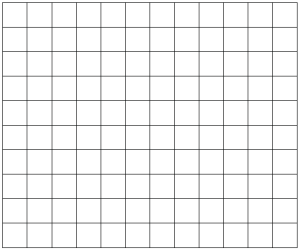
Print a few blank 120 charts and turn them sideways, so each chart has ten rows with twelve squares in each row.

Cut out the rows to make fraction strips with twelve squares on each strip.

Color a different set of squares on each strip. On some strips, arrange the colored squares all together at one end. On other strips, mix them around.

If we count each strip as one whole thing, what fraction of its squares are colored?

Match the strips that represent the same fraction.

On some of the strips, there will be more than one way to name the fraction. For example, if six squares are colored, we can call that 6/12 or 2/4 or 1/2 of the strip. These alternate names are easiest to see when the colored squares are all at one end of the strip, because you can fold the strip to show the halves or fourths.

How many different fraction names can you find for each set of colored squares?

Look for Complex Fractions

We could also call the strip with six colored squares “1 1/2 thirds” of the whole strip. Can you show by folding why that name makes sense?

Or we could call the strip with five colored squares “2 1/2 sixths.”

When we have a fraction within a fraction like this, we call it a complex fraction, because it is more complicated than a common (or simple) fraction.

Another way to say it: Complex fractions have other fractions inside them.

A complex fraction is like a puzzle, challenging us to find its secret identity — the common fraction that names the same amount of stuff.

For example, how much is 3 1/3 fourths? One fourth would be three of the twelve squares on a fraction strip. So three fourths would be three sets of those three squares, or nine squares. Then we need to add one-third of the final fourth, which is one of the remaining three squares. So 3 1/3 fourths must be ten squares in all.

3 1/3 fourths = 10/12 = 5/6

How many complex fractions can you find in your set of fraction strips?
Challenge Puzzles

Can you figure out how much a one-and-a-halfth would be?

That is one piece, of such a size that it takes one and one-half pieces to make a complete fraction strip.

A one-and-a-halfth is a very useful fraction and was a favorite of the ancient Egyptian scribes, who used it to solve all sorts of practical math problems.

How about a one-and-a-thirdth? How many of those pieces make a whole strip? What common fraction names the same amount of stuff?

Or how much would a two-thirdth be? In that case, it only takes two-thirds of a piece to make a complete strip. So the whole piece must be greater than one. A two-thirdth’s secret identity is a mixed number. Can you unmask it?

Make up some challenge fraction mysteries of your own.

Complex2

Update…

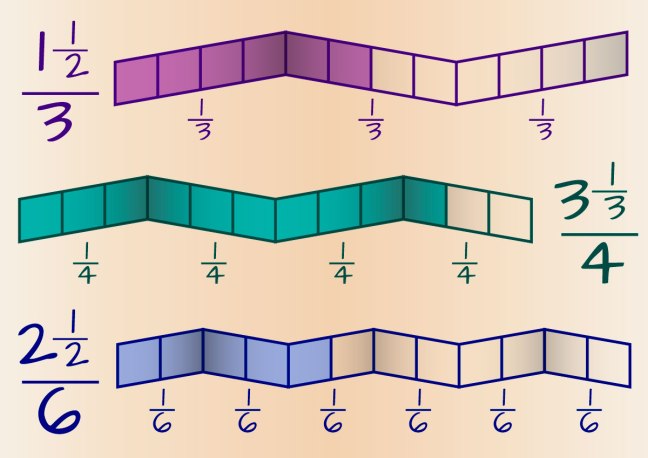
I’m still working on the graphics for my hundred chart book. Here’s the latest version of the complex fraction strips.

I like this one much better.

What do you think?
CREDITS: The slogan “Make Math Your Own” comes from Maria Droujkova, founder and director of the Natural Math website. Maria likes to say: “Make math your own, to make your own math!”

70+ Things to Do with a Hundred Chart is now available from Tabletop Academy Press.

Math Journals for Elementary and Middle School

This fall, my homeschool co-op math class will play with math journaling.

But my earlier dot-grid notebooks were designed for adults. Too thick, too many pages. And the half-cm dot grid made lines too narrow for young writers.

So I created a new series of paperback dot-grid journals for my elementary and middle school students.

I hope you enjoy them, too!

Click here for more information

Math Journaling Prompts

So, what can your kids do with a math journal?

Here are a few ideas: 

I’m sure we’ll use several of these activities in my homeschool co-op math class this fall.

Noticing and Wondering

Learning math requires more than mastering number facts and memorizing rules. At its heart, math is a way of thinking.

So more than anything else, we need to teach our kids to think mathematically — to make sense of math problems and persevere in figuring them out.

Help your children learn to see with mathematical eyes, noticing and wondering about math problems.

Whenever your children need to learn a new idea in math, or whenever they get stuck on a tough homework problem, that’s a good time to step back and make sense of the math.

Kids can write their noticings and wonderings in the math journal. Or you can act as the scribe, writing down (without comment) everything child says.

For more tips on teaching students to brainstorm about math, check out these online resources from The Math Forum:

Problem-solving is a habit of mind that you and your children can learn and grow in. Help your kids practice slowing down and taking the time to fully understand a problem situation.

Puzzles Are Math Experiments

Almost anything your child notices or wonders can lead to a math experiment.

For example, one day my daughter played an online math game…

a math experiment
Click the image to read about my daughter’s math experiment.

A math journal can be like a science lab book. Not the pre-digested, fill-in-the-blank lab books that some curricula provide. But the real lab books that scientists write to keep track of their data, and what they’ve tried so far, and what went wrong, and what finally worked.

Here are a few open-ended math experiments you might try:

Explore Shapes
  • Pick out a 3×3 set of dots. How many different shapes can you make by connecting those dots? Which shapes have symmetry? Which ones do you like the best?
  • What if you make shapes on isometric grid paper? How many different ways can you connect those dots?
  • Limit your investigation to a specific type of shape. How many different triangles can you make on a 3×3 set of dots? How many different quadrilaterals? What if you used a bigger set of dots?
Explore Angles

  • On your grid paper, let one dot “hold hands” with two others. How many different angles can you make? Can you figure out their degree without measuring?
  • Are there any angles you can’t make on your dot grid? If your paper extended forever, would there be any angles you couldn’t make?
  • Does it make a difference whether you try the angle experiments on square or isometric grid paper?
Explore Squares
  • How many different squares can you draw on your grid paper? (Don’t forget the squares that sit on a slant!) How can you be sure that they are perfectly square?
  • Number the rows and columns of dots. Can you find a pattern in the corner positions for your squares? If someone drew a secret square, what’s the minimum information you would need to duplicate it?
  • Does it make a difference whether you try the square experiments on square or isometric grid paper?

Or Try Some Math Doodles

Create math art. Check out my math doodling collection on Pinterest and my Dot Grid Doodling blog post. Can you draw an impossible shape?

How Would YOU Use a Math Journal?

I’d love to hear your favorite math explorations or journaling tips!

Please share in the comments section below.

 
* * *

P.S.: Do you have a blog? If you’d like to feature a math journal review and giveaway, I’ll provide the prize. Send a message through my contact form or leave a comment below, and we’ll work out the details.

This blog is reader-supported.

If you’d like to help fund the blog on an on-going basis, then please head to my Patreon page.

If you liked this post, and want to show your one-time appreciation, the place to do that is PayPal: paypal.me/DeniseGaskinsMath. If you go that route, please include your email address in the notes section, so I can say thank you.

Which I am going to say right now. Thank you!

“Math Journals for Elementary and Middle School” copyright © 2018 by Denise Gaskins. Photos of children © original artists / Pixabay.

FAQ: Struggling with Arithmetic

My son can’t stand long division or fractions. We had a lesson on geometry, and he enjoyed that — especially the 3-D shapes. If we can just get past the basics, then we’ll have time for the things he finds interesting. But one workbook page takes so long, and I’m sick of the drama. Should we keep pushing through?

Those upper-elementary arithmetic topics are important. Foundational concepts. Your son needs to master them.

Eventually.

But the daily slog through page after page of workbook arithmetic can wear anyone down.

Many children find it easier to focus on math when it’s built into a game.

Take a look at Colleen King’s Math Playground website. Or try one of the ideas on John Golden’s Math Hombre Games blog page.

Or sometimes a story helps, like my Cookie Factory Guide to Long Division.

Continue reading FAQ: Struggling with Arithmetic

FAQ: Forgetting What They Learned

“As we go through each lesson, it seems like my daughter has a good handle on the concepts, but when we get to the test she forgets everything. When I ask her about it, she shrugs and says, ‘I don’t know.’ What do you do when your child completely loses what she has learned?”

Forgetting is the human brain’s natural defense mechanism. It keeps us from being overwhelmed by the abundance of sensory data that bombards us each moment of every day.

Our children’s minds will never work like a computer that can store a program and recall it flawlessly months later.

Sometimes, for my children, a gentle reminder is enough to drag the forgotten concept back out of the dust-bunnies of memory.

Other times, I find that they answer “I don’t know” out of habit, because it’s easier than thinking about the question. And because they’d prefer to be doing something else.

Continue reading FAQ: Forgetting What They Learned

Math Debate: Adding Fractions

Cover image by Thor/ geishaboy500 via Flickr (CC BY 2.0)

I’ve been working on my next Playful Math Singles book, based on the popular Things to Do with a Hundred Chart post.

My hundred chart list began many years ago as seven ideas for playing with numbers. Over the years, it grew to its current 30+ activities.

Now, in preparing the new book, my list has become a monster. I’ve collected almost 70 ways to play with numbers, shapes, and logic from preschool to middle school. Just yesterday I added activities for fraction and decimal multiplication, and also tips for naming complex fractions. Wow!

Gonna have to edit that cover file…

In the “Advanced Patterns” chapter, I have a section on math debates. The point of a math debate isn’t that one answer is “right” while the other is “wrong.” You can choose either side of the question — the important thing is how well you support your argument.

Here’s activity #69 in the current book draft.

Have a Math Debate: Adding Fractions

When you add fractions, you face a problem that most people never consider. Namely, you have to decide exactly what you are talking about.

For instance, what is one-tenth plus one-tenth?

1/10 of 100

Well, you might say that:

\frac{1}{10}  of one hundred chart
+ \frac{1}{10}  of the same chart
= \frac{2}{10}  of that hundred chart

But, you might also say that:

\frac{1}{10}  of one chart
+ \frac{1}{10}  of another chart
= \frac{2}{20}  of the pair of charts

That is, you started off counting on two independent charts. But when you put them together, you ended up with a double chart. Two hundred squares in all. Which made each row in the final set worth \frac{1}{20}  of the whole pair of charts.

So what happens if you see this question on a math test:

\frac{1}{10}  + \frac{1}{10}  = ?

If you write the answer “\frac{2}{20}”, you know the teacher will mark it wrong.

Is that fair? Why, or why not?

CREDITS: Feature photo (above) by Thor/geishaboy500 via Flickr (CC BY 2.0). “One is one … or is it?” video by Christopher Danielson via TED-Ed. This math debate was suggested by Marilyn Burns’s blog post Can 1/3 + 1/3 = 2/6? It seemed so!

Funville Adventures: Blake’s Story

Today we have a guest post — an exclusive tale by Sasha Fradkin and Allison Bishop, authors of the new math storybook Funville Adventures. Enjoy!

Funville Adventures is a math-inspired fantasy that introduces children to the concept of functions, which are personified as magical beings with powers.

Each power corresponds to a transformation such as doubling in size, rotating, copying, or changing color. Some Funvillians have siblings with opposite powers that can reverse the effects and return an object to its original state, but other powers cannot be reversed.

In this way, kids are introduced to the mathematical concepts of invertible and non-invertible functions, domains, ranges, and even functionals, all without mathematical terminology.

We know about Funville because two siblings, Emmy and Leo, were magically transported there after they went down an abandoned slide.

When they came back, Emmy and Leo shared their adventures with their friends and also brought back the following manuscript written by their new friend Blake.

Continue reading Funville Adventures: Blake’s Story

Check Out These Cool Math Sales

I’ve been following Sonya’s Arithmophobia No More blog for a couple of years, and I love the work she is doing. But this month, she’s teamed up with Lacy at Play, Discover, Learn (another great blog to follow!) to offer a humongous bundle of playful math.

You get math journaling pages, games, creative task cards, thought-provoking worksheets, and video training resources to help you build your child’s understanding of math from arithmetic to early algebra. Wow!

These activities are perfect for homeschooling families or anyone looking to supplement their child’s current math curriculum with effective discovery-based activities. If you’ve ever wondered what to do with those Cuisenaire rods you picked up on sale way back when, this bundle is for you.

I’m so looking forward to using some of these ideas with my elementary homeschool co-op kids next year!

Sale price is $30 from December 2-15.

Cuisenaire Rod Activities Blowout Bundle

But Wait, There’s More

If you’ve been reading my blog for very long, you’ve probably seen how much I love the blog, books, and classes available from the Natural Math folks.

Their newest book is just off the presses — Funville Adventures, a math adventure chapter book.

And until December 20, they’re having a holiday sale. Make your own bundle of any Natural Math books. Playful algebra, calculus for 5-year-olds, inquiry problems and more: Great deal!

Natural Math Book Sale

Stock Up on My Playful Math Books

Finally, if you’ve been wanting to pick up a paperback copy of Let’s Play Math or some of my game books, or maybe a set of dot-grid math journals, I’m currently offering a discount on bulk orders.

Bundle ANY assortment of titles. Stock up on books for your family, friends, or homeschool group.

  • 2–4 books: 15% discount off retail prices
  • 5–9 books: 25% discount
  • 10–19 books: 35% discount
  • 20+ books: 35% discount, and free Continental U.S. standard shipping or the equivalent discount off other shipping options

Bulk Order Playful Math Paperbacks

(US customers only: We’re sorry we can’t offer bulk discounts for our international readers, but the complexities of international duties and tax laws are too much for this very small family business.)

Do You Know of Any Math Deals?

Apollonian greetings from my homeschool co-op kids, and best wishes for a grace-filled holiday season.

If you’ve seen a great deal or holiday price on a math resource you love, please share!

Add your deal to the comment section below, so we can all take advantage of the math joy this season.

How to Talk Math With Your Kids

A friend shared this video, and I loved it! From Kent Haines, a father who happens to also be a math teacher…

“I hope that this video helps parents find new ways of interacting with their kids on math topics.”

Kent Haines

More from Kent Haines

Advice and Examples of Talking Math with Kids

Danielson-Talking Math

If you enjoyed Kent’s video, you’ll love Christopher Danielson’s book and blog.

It’s a short book with plenty of great stories, advice, and conversation-starters. While Danielson writes directly to parents, the book will also interest grandparents, aunts & uncles, teachers, and anyone else who wants to help children notice and think about math in daily life.

“You don’t need special skills to do this. If you can read with your kids, then you can talk math with them. You can support and encourage their developing mathematical minds.
 
“You don’t need to love math. You don’t need to have been particularly successful in school mathematics. You just need to notice when your children are being curious about math, and you need some ideas for turning that curiosity into a conversation.
 
“In nearly all circumstances, our conversations grow organically out of our everyday activity. We have not scheduled “talking math time” in our household. Instead, we talk about these things when it seems natural to do so, when the things we are doing (reading books, making lunch, riding in the car, etc) bump up against important mathematical ideas.
 
“The dialogues in this book are intended to open your eyes to these opportunities in your own family’s life.”

— Christopher Danielson
Talking Math with Your Kids

 
* * *

This blog is reader-supported.

If you’d like to help fund the blog on an on-going basis, then please join me on Patreon for mathy inspiration, tips, and an ever-growing archive of printable activities.

If you liked this post, and want to show your one-time appreciation, the place to do that is PayPal: paypal.me/DeniseGaskinsMath. If you go that route, please include your email address in the notes section, so I can say thank you.

Which I am going to say right now. Thank you!

“How to Talk Math With Your Kids” copyright © 2017 by Denise Gaskins. “Kids Talk” photo (top) by Victoria Harjadi via Flickr (CC BY 2.0). “Parent Rules” by Kent Haines.

10 Ways to Play Math with Play-Doh

Today we have a guest post from Lucy Ravitch, author of the new Kickstarter picture book Trouble with Monkeys: A math concept story of place value. She’s sharing a few ideas from her Math Activity Thursday (M.a.Th.) video series. Enjoy!


Hello, math fans and enthusiasts! Each week I try to give you and your family a fun math activity to try. Two months ago I posted this video with ten ways to turn play dough into an engaging activity for lower and upper elementary math.

If you want to make your own dough from scratch here are a few simple recipes. I encourage you to let your children play freely at first, before trying these activities.

Below I have identified some of the math concepts that your kids will experience as they play.

1. Toss It

Practice counting. With older children, record your results and make a graph of the data.

  • How many times can you catch it in a row? What’s your average number of tosses?
  • Talk about attributes. Does the size or color of the play dough balls make a difference?
  • How high are you tossing it? Talk about measuring systems. Do you use feet and inches, or meters and centimeters?
  • If you know how to juggle, time how long you can keep the balls going.

2. Smash It

Make several small balls or pieces. Then play as you smash them.

  • Play a NIM game: Make 10-15 small play dough balls. Take turns. On your turn, you can smash one ball or two. Whoever smashes the last ball wins the game.
  • Or smash your math facts: Choose several equations for your children to practice. Write each answer on a 3×5 card. Lay out each card next to a play dough piece. As you call out the equations, kids smash the play dough next to the correct card.

3. Shape It

Have fun molding your play dough. Roll it out to cut shapes.

  • Try making 3D shapes while practicing your math vocabulary. MathisFun.com has a great section about solid geometry. Can you find three math terms that are new for you?
  • Roll out the dough and cut 2D shapes. Discuss their attributes. Can you cut your shape in half to be symmetrical?

4. Hide Things in It

Find small objects around the house and enclose them inside play dough.

  • Take turns hiding small objects in play dough. Optional: Give a one-minute time limit to guess before opening it. This gives you and your kids a chance to talk about size, shape, or other attributes.
  • Have challenges to use the least amount of dough to hide identical objects. Two players have two minutes to hide an object in as little play dough as possible. The object must be completely concealed within the dough. What methods will you use?

5. Make Imprints on It

Show off your design skills and observe textures.

  • You can practice counting as you poke and press your fingers or objects into the dough. Older children can discuss the distance between impressions and/or the pressure applied.
  • As you and your kids make designs, talk about what you notice: Is your design symmetrical? What tools did you use (toothpicks, pencils, marbles, fingers, toy cars)? Which objects make interesting textures?

6. Cut It

Use a butter knife or the edge of a ruler to cut your play dough. Discuss findings as you play and explore.

  • In the video, I posed the question: how many sections do you get if you make only three cuts? Try it and see.
  • Does the number of pieces change if you use a shape other than a flat circle?
  • Discuss making straight cuts that will intersect or be parallel. Bring in more geometry terms.
  • Experiment with a different number of cuts.

7. Weigh It

Pull out a kitchen scale or balancing scales to use with dough.

  • Older children can make conversions between ounces to grams. They can make calculations about doubling or multiplying the measured weight. With younger kids, try using balancing scales. Compare the weights between pieces.
  • Try making two pieces that weigh exactly the same. This is harder than it sounds! For small children, this gives them the opportunity to see that the mass (weight) of an object can come in different shapes.

8. Measure It

Use a ruler or measuring tape while you play. There are several ways you can measure your dough — height, width, and length.

  • How long can you extend one ounce of dough? Pick your own size/weight of play dough and see who can get the longest. What fraction of a yard or meter is it?
  • Discuss height and what it takes to make dough stand vertically. How tall can you get three ounces to stand? Can anything help make it taller?

9. Roll It

Make sure you have plenty of room for this activity. Playing outside or on smooth floors works best.

  • With one push how far does your play dough roll? Is there an ideal size for a piece? Is there an ideal weight for rolling?
  • Is the ground sloped? What effects does the rolling surface have?
  • Why do some shapes roll easily while others don’t? Can you create a not-round shape that will roll?

10. Compare It

Compare similarities and differences between dough colors and types. Consider comparing the previously listed activities

  • If you made your own dough, compare consistency between batches. Is homemade dough denser or lighter than store-bought dough?
  • What are differences between the dough you played with and the dough that has not been touched?
  • Which of these activities do you think will take the shortest amount of time? The longest? Or put the activities in order based on how much dough you will need — least to greatest.

May you and your students have fun as you play with dough!


About the Author

Lucy blogs at kidsmathteacher.com and is the author/creator of Kids Menu Books. The first book in that series is The Pancake Menu, an interactive book that lets kids practice math as they play restaurant.

And be sure to visit Lucy’s Kickstarter project! She’s teamed up with artist Trav Hanson to create the delightful picture book Trouble with Monkeys: A math concept story of place value.