Fraction Game: My Closest Neighbor

[Feature photo above by Jim Larrison, and antique playing cards below by Marcee Duggar, via Flickr (CC BY 2.0).]

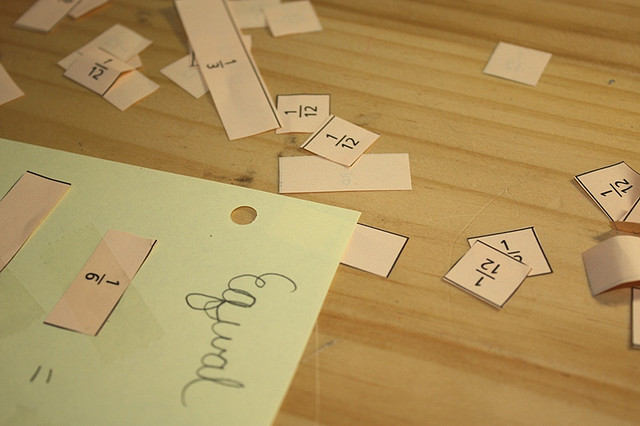
I missed out on the adventures at Twitter Math Camp, but I’m having a great time working through the blog posts about it. I prefer it this way — slow reading is more my speed. Chris at A Sea of Math posted a wonderful game based on one of the TMC workshops. Here is my variation.

Math concepts: comparing fractions, equivalent fractions, benchmark numbers, strategic thinking.

Players: two to four.

Equipment: two players need one deck of playing cards, three or four players need a double deck.

Continue reading Fraction Game: My Closest Neighbor

Reblog: A Mathematical Trauma

Feature photo (above) by Jimmie via flickr.

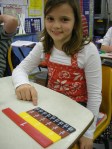
My 8-year-old daughter’s first encounter with improper fractions was a bit more intense than she knew how to handle.

I hope you enjoy this “Throw-back Thursday” blast from the Let’s Play Math! blog archives:


Photo (right) by Old Shoe Woman via Flickr.

Nearing the end of Miquon Blue today, my youngest daughter encountered fractions greater than one. She collapsed on the floor of my bedroom in tears.

The worksheet started innocently enough:

\frac{1}{2} \times 8=\left[ \quad \right]

[Click here to go read the original post.]

Playing with Pinterest: New Math Boards

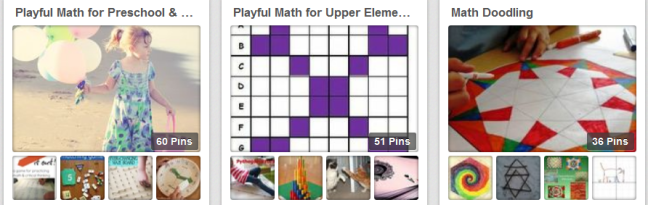
Do you like Pinterest? I’ve enjoyed exploring the site lately, so I set up a few boards where I can pin the goodies I find. It may take awhile before I get all the old games and posts from this blog loaded up, so save the links and come back often…

Playful Math Games & Activities
Middle-High School

As our children (and their parents!) play around with mathematical ideas and the relationships between them, we develop deep understanding that is strong enough to support future learning. Playful math links include math games, activities, and interesting lesson plans.

Math Doodling
Math Doodling

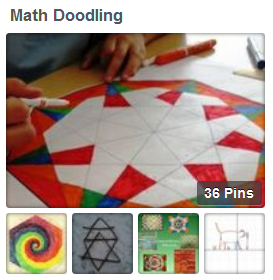
Making abstract math visual: Math doodles let us see and experiment with a wide range of mathematical structures — and even to feel them, if we include hands-on 3D doodles in clay or other media. Links include art projects, geometry constructions, and physical models to explore.

Math Teaching Tips & Resources

Math Teaching Tips

A variety of math teaching ideas for homeschool families or classroom teachers. Learning mathematics is more than just answer-getting: help your students make conceptual connections. These links are more “schooly” than on the other boards, and they include conceptual lessons that build your own understanding of mathematics as well as that of your students. And math notebooking resources, too.

MTaP Math Education Blog Carnival Archive

MTaP archive

Since early 2009, the Math Teachers at Play (MTaP) blog carnival has offered tips, tidbits, games, and activities for students and teachers of preschool through pre-college mathematics. Now published once a month, the carnival welcomes entries from parents, students, teachers, homeschoolers, and just plain folks. If you like to learn new things and play around with ideas, you are sure to find something of interest.

Math-Ed Quotes
Math-Ed Quotes

Inspiration for homeschooling parents and classroom teachers. This is where I’m posting my Wednesday Wisdom quotes.

And that’s the end of my Pinterest boards (so far).

What are some of your favorite Pinterest sites? Please share a link in the comments!
Quotable: Focus on Being Silent

Children Reading Pratham Books and Akshara[Photo by Pratham Books via Flickr (CC BY 2.0).]

I discovered this gem in my blog reading today. One of the secrets of great teaching:

Audrey seemed, for once, at a loss for words. She was thinking about the question.

I try to stay focused on being silent after I ask young children questions, even semi-serious accidental ones. Unlike most adults, they actually take time to think about their answers and that often means waiting for a response, at least if you want an honest answer.

If you’re only looking for the “right” answer, it’s fairly easy to gently badger a child into it, but I’m not interested in doing that.

Thomas Hobson
Thank You For Teaching Me

Learn Math by Asking Questions

The best way for children to build mathematical fluency is through conversation. For more ideas on discussion-based math, check out these posts:

And be sure to follow Christopher Danielson’s Talking Math with Your Kids blog!

 
* * *

This blog is reader-supported.

If you’d like to help fund the blog on an on-going basis, then please join me on Patreon for mathy inspiration, tips, and an ever-growing archive of printable activities.

If you liked this post, and want to show your one-time appreciation, the place to do that is PayPal: paypal.me/DeniseGaskinsMath. If you go that route, please include your email address in the notes section, so I can say thank you.

Which I am going to say right now. Thank you!

“Quotable: Focus on Being Silent” copyright © 2013 by Denise Gaskins. Image at the top of the post copyright © Pratham Books via Flickr (CC BY 2.0).

Multiplication Models Card Game

multfrac-300Update: An expanded version of this post is featured in my book Multiplication & Fractions: Math Games for Tough Topics, available now at your favorite online book dealer.

Homeschooling parents know that one of the biggest challenges for any middle-elementary math student is to master the multiplication facts. It can seem like an unending task to memorize so many facts and be able to pull them out of mental storage in any order on demand.

Too often, we are tempted to stress the rote aspect of such memory work, which makes our children lose their focus on what multiplication really means. Before practicing the times table facts, make sure your student gets plenty of practice recognizing and using the common models for multiplication.

To help your children see what multiplication looks like in real life, explore the multitude of Multiplication Models collected at the Natural Math website. Or sign up for their Multiplication Explorers Online Course.

You may want to pick up this poster and use it for ideas as you play the Tell Me a (Math) Story game. Word problems are important for children learning any new topic in math, because they give children a mental “hook” on which to hang the abstract number concepts.

And for extra practice, you can play my free card game…

Click here to continue reading.

Every Day Is Math Day

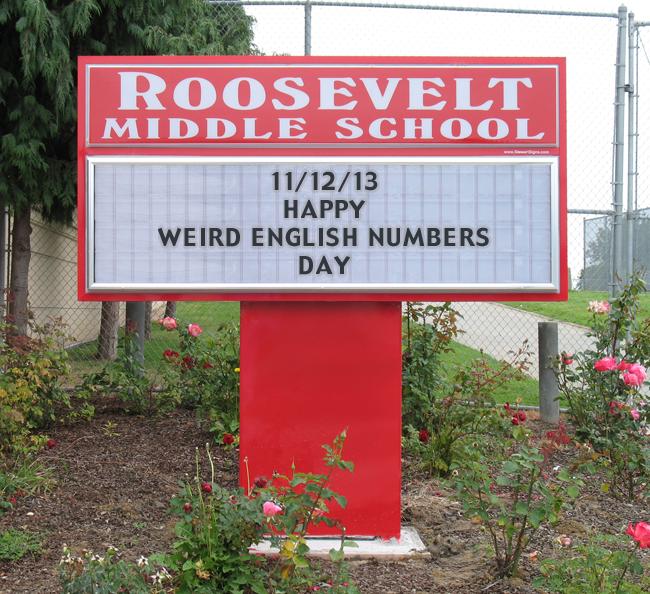
Happy 11-12-13

Happy 11/12/13, otherwise known as “tenty-one, tenty-two, tenty-three.”

Do your young children have trouble counting in the teens? Try making up Funny Numbers to help them! It’s a great habit to develop, because Funny Numbers will come in handy as mental math tools throughout their school math career.

If you’d like to make your own Happy Math Day post, check out the instructions here: Every Day Is Mathematics Day. And please share a link in the comments section below — I’d love to see what math holiday you invent!

Update: The numbers 11, 12, and 13 form an arithmetic progression. If that sounds too scary for your kids, check out Patrick’s bedtime math discussion Making Progress, Arithmetically.

Things To Do with a Hundred Chart #30

100chartpuzzle

Here’s one more entry for my 20+ Things to Do with a Hundred Chart post, thanks to David Radcliffe in the comments on Monday’s post:

(30) Can you mark ten squares Sudoku-style, so that no two squares share the same row or column? Add up the numbers to get your score. Then try to find a different set of ten Sudoku-style squares. What do you notice? What do you wonder?
[Suggested by David Radcliffe.]

Share Your Ideas

Can you think of anything else we might do with a hundred chart? Add your ideas in the Comments section below, and I’ll add the best ones to our master list.

Things To Do with a Hundred Chart #29

100chart puzzle

Here’s a new entry for my 20+ Things to Do with a Hundred Chart post:

(29) Blank 100 Grid Number Investigations: Challenge your students to deduce the secret behind each pattern of shaded squares. Then have them make up pattern puzzles of their own.
[Created by Stuart Kay. Free registration required to download pdf printable.]

Share Your Ideas

Can you think of anything else we might do with a hundred chart? Add your ideas in the Comments section below, and I’ll add the best ones to our master list.

Maze Game: Land or Water?

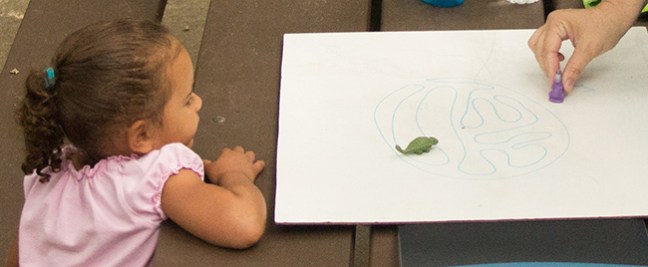
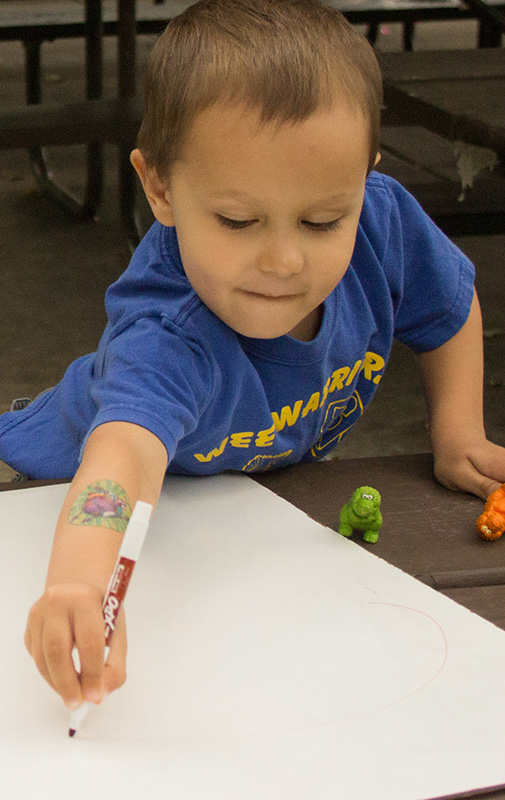
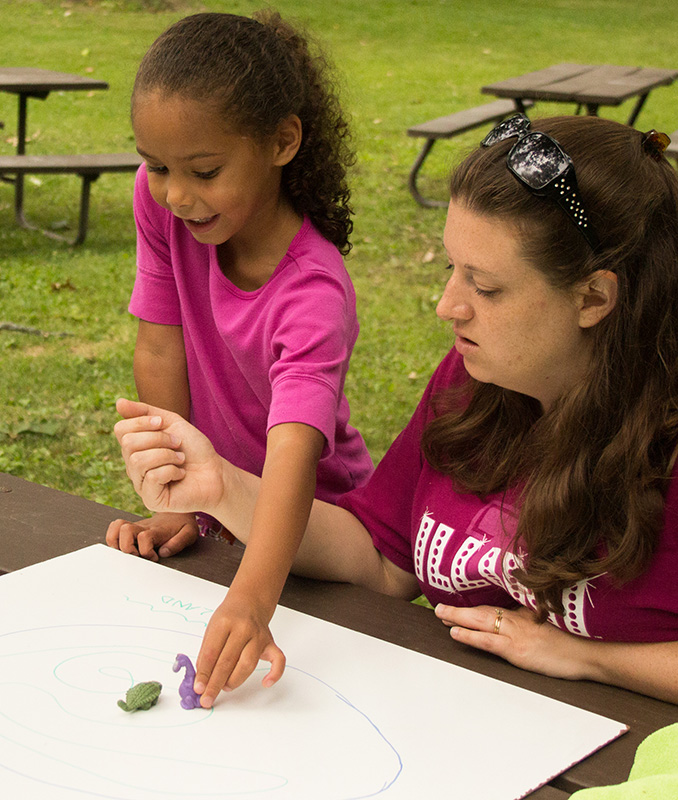
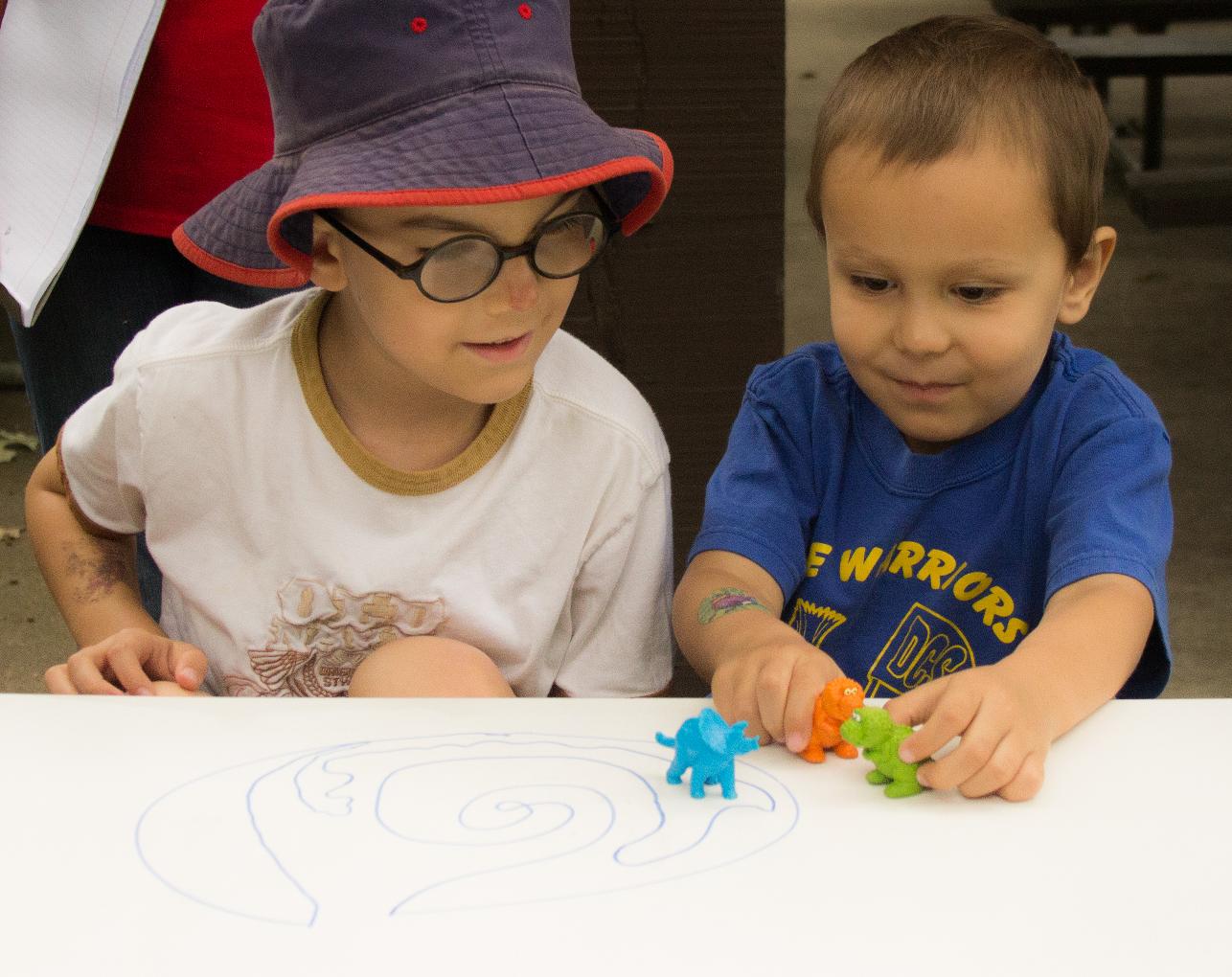
This was a fun activity from Moebius Noodles for our PK-1st grade Homeschool Math in the Park group. The children take turns making a maze and setting a dinosaur inside. Then the other dinosaurs (parents or siblings) try to guess whether their friend is on the land or in the water.

Draw the maze

Player #1

(1) First, draw a big circle on the white board. This is your lake.

(2) With a finger or a bit of cloth, erase a small section of the circle to create the opening for your maze.

(3) Starting at one edge of the opening, draw a random squiggle inside the circle. Make your squiggle end at the other edge of the opening.

Looks like Land

(4) Set your dinosaur anywhere inside the maze.

Player #2

(1) Now it’s your turn to guess. Is the dinosaur standing on the land? Is it swimming in the water?

(2) How will you figure out if you guessed right?

(3) Check by jumping across the lines of the maze. Each jump takes you across a boundary: Splash! (Into the water.) Thump! (Back on the land.) Splash! Thump! … Until you reach the dinosaur inside.

(4) Or go to the maze entrance and walk your dinosaur along the path. Can you find your way?

land or water

 
* * *

This blog is reader-supported.

If you’d like to help fund the blog on an on-going basis, then please join me on Patreon for mathy inspiration, tips, and an ever-growing archive of printable activities.

If you liked this post, and want to show your one-time appreciation, the place to do that is PayPal: paypal.me/DeniseGaskinsMath. If you go that route, please include your email address in the notes section, so I can say thank you.

Which I am going to say right now. Thank you!

“Maze Game: Land or Water?” copyright © 2013 by Denise Gaskins. All photos copyright © Denise Gaskins.

Parents, Teachers: Learn about Teaching Decimals

Many children are confused by decimals. They are convinced 0.48 > 0.6 because 48 is obviously ever so much bigger than 6. Their intuition tells them 0.2 × 0.3 = 0.6 has the clear ring of truth. And they confidently assert that, if you want to multiply a decimal number by 10, all you have to do is add a zero at the end.

What can we do to help our kids understand decimals?

Christopher Danielson (author of Talking Math with Your Kids) will be hosting the Triangleman Decimal Institute, a free, in-depth, online chat for “everyone involved in children’s learning of decimals.” The Institute starts tomorrow, September 30 (sorry for the short notice!), but you can join in the discussion at any time:

Past discussions stay open, so feel free to jump into the course whenever you can. Here is the schedule of “classes”:

Click here to see the TDI topic list →