2015 Mathematics Game

[Feature photo above by Scott Lewis and title background (right) by Carol VanHook, both via Flickr (CC BY 2.0, text added).]

2015YearGame

Did you know that playing games is one of the Top 10 Ways To Improve Your Brain Fitness? So slip into your workout clothes and pump up those mental muscles with the Annual Mathematics Year Game Extravaganza!

For many years mathematicians, scientists, engineers and others interested in math have played “year games” via e-mail. We don’t always know whether it’s possible to write all the numbers from 1 to 100 using only the digits in the current year, but it’s fun to see how many you can find.

Math Forum Year Game Site

Rules of the Game

Use the digits in the year 2015 to write mathematical expressions for the counting numbers 1 through 100. The goal is adjustable: Young children can start with looking for 1-10, middle grades with 1-25.

  • You must use all four digits. You may not use any other numbers.
  • Solutions that keep the year digits in 2-0-1-5 order are preferred, but not required.
  • You may use +, -, x, ÷, sqrt (square root), ^ (raise to a power), ! (factorial), and parentheses, brackets, or other grouping symbols.
  • You may use a decimal point to create numbers such as .2, .02, etc., but you cannot write 0.02 because we only have one zero in this year’s number.
  • You may create multi-digit numbers such as 10 or 201 or .01, but we prefer solutions that avoid them.

My Special Variations on the Rules

  • You MAY use the overhead-bar (vinculum), dots, or brackets to mark a repeating decimal. But students and teachers beware: you can’t submit answers with repeating decimals to Math Forum.
  • You MAY NOT use a double factorial, n!! = the product of all integers from 1 to n that have the same parity (odd or even) as n. Math Forum allows these, but I’ve decided I prefer my arithmetic straight.

Click here to continue reading.

Math Debates with a Hundred Chart

Euclid game
Wow! My all-time most popular post continues to grow. Thanks to an entry from this week’s blog carnival, there are now more than thirty great ideas for mathematical play:

The latest tips:

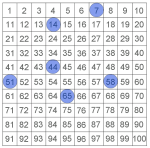
(31) Have a math debate: Should the hundred chart count 1-100 or 0-99? Give evidence for your opinion and critique each other’s reasoning.
[Hat tip: Tricia Stohr-Hunt, Instructional Conundrum: 100 Board or 0-99 Chart?]

(32) Rearrange the chart (either 0-99 or 1-100) so that as you count to greater numbers, you climb higher on the board. Have another math debate: Which way makes more intuitive sense?
[Hat tip: Graham Fletcher, Bottoms Up to Conceptually Understanding Numbers.]

(33) Cut the chart into rows and paste them into a long number line. Try a counting pattern, or Race to 100 game, or the Sieve of Eratosthenes on the number line. Have a new math debate: Grid chart or number line — which do you prefer?
[Hat tip: Joe Schwartz, Number Grids and Number Lines: Can They Live Together in Peace? ]

Roadmap to Mathematics: 3rd Grade

roadmap3

A frequently-asked question on homeschooling forums is, “Are my children working at grade level? What do they need to know?”

The Council of the Great City Schools has published a handy 6-page pdf summary of third grade math concepts, with suggestions for how parents can support their children’s learning:

Whether you are a radical unschooler or passionately devoted to your textbook — or, like me, somewhere in between — you can help your children toward these grade-level goals by encouraging them to view mathematics as mental play. Don’t think of the standards as a “to do” list, but as your guide to an adventure of exploration. The key to learning math is to see it the mathematician’s way, as a game of playing with ideas.

The following are excerpts from the roadmap document (along with a few extra tips) and links to related posts from the past eight years of playing with math on this blog…

Continue reading Roadmap to Mathematics: 3rd Grade

Roadmap to Mathematics: 2nd Grade

roadmap2

A frequently-asked question on homeschooling forums is, “Are my children working at grade level? What do they need to know?”

The Council of the Great City Schools has published a handy 6-page pdf summary of second grade math concepts, with suggestions for how parents can support their children’s learning:

Whether you are a radical unschooler or passionately devoted to your textbook — or, like me, somewhere in between — you can help your children toward these grade-level goals by encouraging them to view mathematics as mental play. Don’t think of the standards as a “to do” list, but as your guide to an adventure of exploration. The key to learning math is to see it the mathematician’s way, as a game of playing with ideas.

The following are excerpts from the roadmap document (along with a couple of extra tips) and links to related posts from the past eight years of playing with math on this blog…

Continue reading Roadmap to Mathematics: 2nd Grade

Roadmap to Mathematics: 1st Grade

[Feature photo (above) by woodleywonderworks. (CC BY 2.0 via Flickr)]

roadmap1

A frequently-asked question on homeschooling forums is, “Are my children working at grade level? What do they need to know?”

The Council of the Great City Schools has published a handy 6-page pdf summary of first grade math concepts, with suggestions for how parents can support their children’s learning:

Whether you are a radical unschooler or passionately devoted to your textbook — or, like me, somewhere in between — you can help your children toward these grade-level goals by encouraging them to view mathematics as mental play. Don’t think of the standards as a “to do” list, but as your guide to an adventure of exploration. The key to learning math is to see it the mathematician’s way, as a game of playing with ideas.

The following are excerpts from the roadmap document, along with links to related posts from the past eight years of playing with math on this blog…

Continue reading Roadmap to Mathematics: 1st Grade

Roadmap to Mathematics: Kindergarten

[Feature photo (above) by MIKI Yoshihito. (CC BY 2.0 via Flickr)]

RoadmapK

A frequently-asked question on homeschooling forums is, “Are my children working at grade level? What do they need to know?”

The Council of the Great City Schools has published a handy 6-page pdf summary of kindergarten math concepts, with suggestions for how parents can support their children’s learning:

Whether you are a radical unschooler or passionately devoted to your textbook — or, like me, somewhere in between — you can help your children toward these grade-level goals by encouraging them to view mathematics as mental play. Don’t think of the standards as a “to do” list, but as your guide to an adventure of exploration. The key to learning math is to see it the mathematician’s way, as a game of playing with ideas.

The following are excerpts from the roadmap document, along with links to related posts from the past eight years of playing with math on this blog…

Continue reading Roadmap to Mathematics: Kindergarten

Math Teachers at Play #79: Puzzles and Games

79

[Feature photo above by Jimmie, and “79” image (right) by Steve Bowbrick via flickr (CC BY 2.0).]

Do you enjoy math? I hope so! If not, browsing this post just may change your mind.

Welcome to the 79th edition of the Math Teachers At Play (MTaP) math education blog carnival — a smorgasbord of links to bloggers all around the internet who have great ideas for learning, teaching, and playing around with math from preschool to pre-college.

Let the mathematical fun begin!

By tradition, we start the carnival with a puzzle, game, or trivia tidbits. If you would like to jump straight to our featured blog posts, click here to see the Table of Contents.

Since I’ve been spending all my free time working on my upcoming Math You Can Play book series, I’m in the mood for games. So I found a few games featuring prime and nonprime numbers [which category is #79 — do you know?], and I’ll sprinkle some of my best-loved math game books throughout the carnival.

Continue reading Math Teachers at Play #79: Puzzles and Games

Horseshoes: A Place Value Game

[Feature photo above by Johnmack161 via Wikimedia Commons (CC BY 2.5).]

I first saw place value games on the old PBS Square One TV show (video below). Many teachers have posted versions of the game online, but Snugglenumber by Anna Weltman is by far the cutest variation. Anna kindly gave me permission to use the game in my upcoming Math You Can Play book series, and I added the following variation:

Horseshoes

snugglenumber

Math Concepts: place value, strategic thinking.
Players: two or more.
Equipment: one deck of playing cards, or a double deck for more than three players.

Separate out the cards numbered ace (one) through nine, plus cards to represent the digit zero. We use the queens (Q is round enough for pretend), but you could also use the tens and just count them as zero.

Shuffle well and deal eleven cards to each player. Arrange your cards in the snugglenumber pattern shown here, one card per blank line, to form numbers that come as close to each target number as you can get it.

Continue reading Horseshoes: A Place Value Game

Fraction Game: My Closest Neighbor

[Feature photo above by Jim Larrison, and antique playing cards below by Marcee Duggar, via Flickr (CC BY 2.0).]

I missed out on the adventures at Twitter Math Camp, but I’m having a great time working through the blog posts about it. I prefer it this way — slow reading is more my speed. Chris at A Sea of Math posted a wonderful game based on one of the TMC workshops. Here is my variation.

Math concepts: comparing fractions, equivalent fractions, benchmark numbers, strategic thinking.

Players: two to four.

Equipment: two players need one deck of playing cards, three or four players need a double deck.

Continue reading Fraction Game: My Closest Neighbor

Reblog: A Mathematical Trauma

Feature photo (above) by Jimmie via flickr.

My 8-year-old daughter’s first encounter with improper fractions was a bit more intense than she knew how to handle.

I hope you enjoy this “Throw-back Thursday” blast from the Let’s Play Math! blog archives:


Photo (right) by Old Shoe Woman via Flickr.

Nearing the end of Miquon Blue today, my youngest daughter encountered fractions greater than one. She collapsed on the floor of my bedroom in tears.

The worksheet started innocently enough:

\frac{1}{2} \times 8=\left[ \quad \right]

[Click here to go read the original post.]