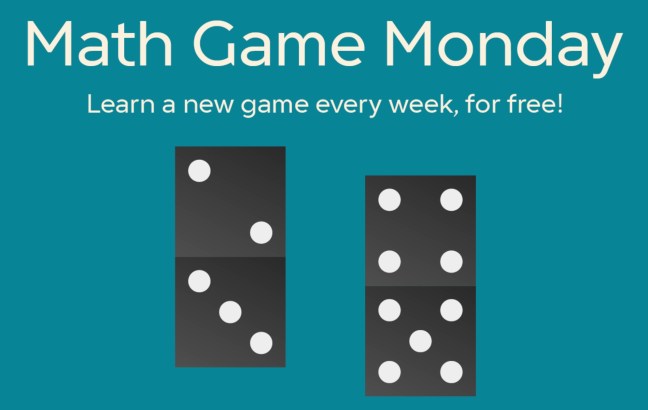
Math Game Monday: Domino Fraction War

Learn a new math game every week, for free

This game offers upper-elementary and middle school students plenty of practice doing estimation and mental math with fractions.

Many parents remember struggling to learn math. We hope to provide a better experience for our children.

And one of the best ways for children to enjoy learning is through hands-on play.

Domino Fraction War

Math Concepts: proper fractions, comparing fractions.

Players: two or more.

Equipment: one set of double-six or double-nine dominoes.

Continue reading Math Game Monday: Domino Fraction War

Memories: Improper Fractions

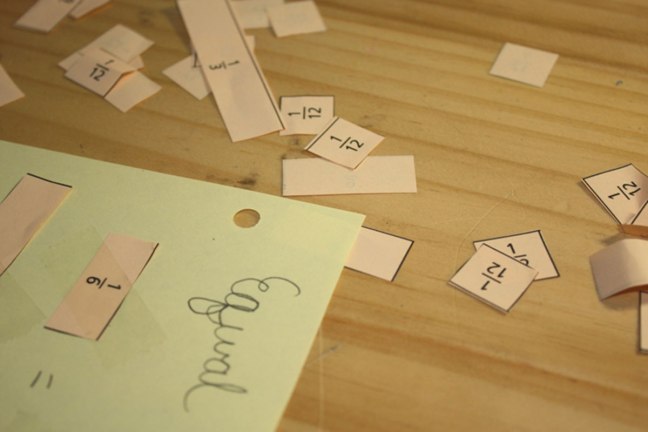
notebooking math with fraction pieces - photo

Homeschool Memories…

My eight-year-old daughter’s first encounter with improper fractions was a bit more intense than she knew how to handle. And I hadn’t learned yet how to use the Notice-Wonder-Create cycle to help kids think about tough problems.

Sometimes I wonder how our children survive their parents’ learning curve. It’s a good thing God made them resilient enough to thrive despite our mistakes!

Continue reading Memories: Improper Fractions

If Not Methods: Fraction Multiplication

Father and son doing math homework together

This is the last post (for now, at least) in our If Not Methods series about how to help children figure out tough calculations.

By the time students reach the topic of multiplying fractions, they have become well-practiced at following rules. After some of the complex procedures they’ve learned, a simple rule like “tops times tops, and bottoms times bottoms” comes as a relief.

But we know that relying on rules like that weakens understanding, just as relying on crutches weakens physical muscles.

If we want our students to think, to make sense of math, to figure things out, what can we do with a problem like 5/6 × 21 ?

Continue reading If Not Methods: Fraction Multiplication

If Not Methods: Mixed Numbers

A family doing math homework together

Continuing our series on teaching the tough topics of arithmetic

Our own school math experiences led many of us to think that math is all about memorizing and following specific procedures to get right answers. But that kind of math is obsolete in our modern world.

The math that matters today is our ability to recognize and reason about numbers, shapes, and patterns, and to use the relationships we know to figure out something new.

But what if our children get stumped on a mixed-number calculation like 2 5/12 + 1 3/4?

Continue reading If Not Methods: Mixed Numbers

If Not Methods – Subtracting Fractions

Father and daughter doing math homework

We’re continuing our series of posts on how to build robust thinking skills instead of forcing our children to walk with crutches.

When we say, “Use this method, follow these steps,” we teach kids to be mathematical cripples.

If your student’s reasoning is, “I followed the teacher’s or textbook’s steps and out popped this answer,” then they’re not doing real math. Real mathematical thinking says, “I know this and that are both true, and when I put them together, I can figure out the answer.”

But what if our kids get stumped on a fraction calculation like 7/8 − 1/6?

Continue reading If Not Methods – Subtracting Fractions

If Not Methods: Dividing Fractions

Mother and daughter working together on math homewrok

As I said in an earlier post, we don’t want to give our children a method because that acts as a crutch to keep them from making sense of math.

But what if our children get stumped on a tough fraction calculation like 1 1/2 ÷ 3/8?

Continue reading If Not Methods: Dividing Fractions

What Are Mixed Numbers?

I just discovered a fascinating fact: In some places in the world, mixed numbers apparently don’t exist.

So that made me curious about my blog readers:

  • Did you learn about mixed numbers in school?
  • Do you ever use mixed numbers in daily life?
  • Are your children learning to work with them?

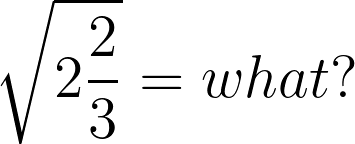
And if you DO know mixed numbers, can you simplify this mess:

[If you enjoy dry math humor, the answer is worth the work.]

Continue reading What Are Mixed Numbers?

Math Game: War with Special Decks

The all-time most-visited page on this site is my post about Math War: The Game That Is Worth 1,000 Worksheets. It’s easy to adapt to almost any math topic, simple to learn, and quick to play. My homeschool co-op students love it.

But Math War isn’t just for elementary kids. Several teachers have shared special card decks to help middle and high school students practice math by playing games.

Take a look at the links below for games from prealgebra to high school trig. And try the Math War Trumps variation at the end of the post to boost your children’s strategic-thinking potential.

Have fun playing math with your kids!

Continue reading Math Game: War with Special Decks

Playing Complex Fractions with Your Kids

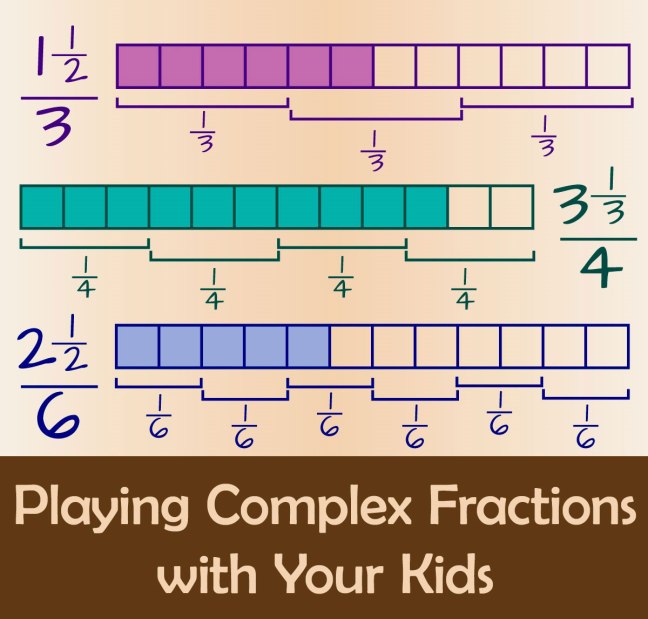
This week, I’m working on graphics for my upcoming book 70+ Things to Do with a Hundred Chart. I had fun with this complex fraction image.

It looks a bit cluttered. Possible tweak: Remove the brackets and instead use a thicker dividing line to show the thirds.

While I’m thinking about that, would you like a sneak peek at an activity from the book?

Make Your Own Math

You don’t need a set of worksheets or lesson plans to learn math. All you need is an inquiring mind and something interesting to think about.

Play. Discuss. Notice. Wonder.

Enjoy.

Here’s how you can play complex fractions with your kids…

Start with Fraction Strips
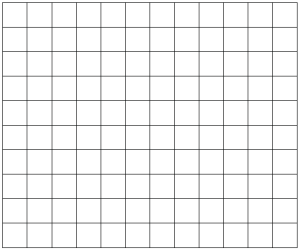
Print a few blank 120 charts and turn them sideways, so each chart has ten rows with twelve squares in each row.

Cut out the rows to make fraction strips with twelve squares on each strip.

Color a different set of squares on each strip. On some strips, arrange the colored squares all together at one end. On other strips, mix them around.

If we count each strip as one whole thing, what fraction of its squares are colored?

Match the strips that represent the same fraction.

On some of the strips, there will be more than one way to name the fraction. For example, if six squares are colored, we can call that 6/12 or 2/4 or 1/2 of the strip. These alternate names are easiest to see when the colored squares are all at one end of the strip, because you can fold the strip to show the halves or fourths.

How many different fraction names can you find for each set of colored squares?

Look for Complex Fractions

We could also call the strip with six colored squares “1 1/2 thirds” of the whole strip. Can you show by folding why that name makes sense?

Or we could call the strip with five colored squares “2 1/2 sixths.”

When we have a fraction within a fraction like this, we call it a complex fraction, because it is more complicated than a common (or simple) fraction.

Another way to say it: Complex fractions have other fractions inside them.

A complex fraction is like a puzzle, challenging us to find its secret identity — the common fraction that names the same amount of stuff.

For example, how much is 3 1/3 fourths? One fourth would be three of the twelve squares on a fraction strip. So three fourths would be three sets of those three squares, or nine squares. Then we need to add one-third of the final fourth, which is one of the remaining three squares. So 3 1/3 fourths must be ten squares in all.

3 1/3 fourths = 10/12 = 5/6

How many complex fractions can you find in your set of fraction strips?
Challenge Puzzles

Can you figure out how much a one-and-a-halfth would be?

That is one piece, of such a size that it takes one and one-half pieces to make a complete fraction strip.

A one-and-a-halfth is a very useful fraction and was a favorite of the ancient Egyptian scribes, who used it to solve all sorts of practical math problems.

How about a one-and-a-thirdth? How many of those pieces make a whole strip? What common fraction names the same amount of stuff?

Or how much would a two-thirdth be? In that case, it only takes two-thirds of a piece to make a complete strip. So the whole piece must be greater than one. A two-thirdth’s secret identity is a mixed number. Can you unmask it?

Make up some challenge fraction mysteries of your own.

Complex2

Update…

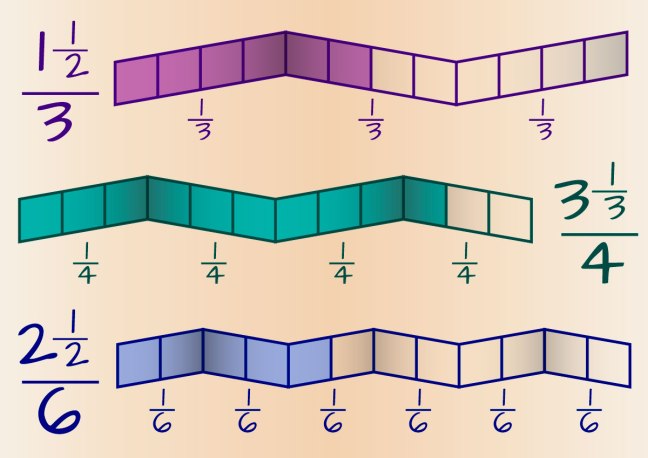
I’m still working on the graphics for my hundred chart book. Here’s the latest version of the complex fraction strips.

I like this one much better.

What do you think?
CREDITS: The slogan “Make Math Your Own” comes from Maria Droujkova, founder and director of the Natural Math website. Maria likes to say: “Make math your own, to make your own math!”

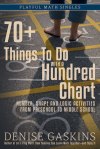
70+ Things to Do with a Hundred Chart is now available from Tabletop Academy Press.
Math Debate: Adding Fractions

Cover image by Thor/ geishaboy500 via Flickr (CC BY 2.0)

I’ve been working on my next Playful Math Singles book, based on the popular Things to Do with a Hundred Chart post.

My hundred chart list began many years ago as seven ideas for playing with numbers. Over the years, it grew to its current 30+ activities.

Now, in preparing the new book, my list has become a monster. I’ve collected almost 70 ways to play with numbers, shapes, and logic from preschool to middle school. Just yesterday I added activities for fraction and decimal multiplication, and also tips for naming complex fractions. Wow!

Gonna have to edit that cover file…

In the “Advanced Patterns” chapter, I have a section on math debates. The point of a math debate isn’t that one answer is “right” while the other is “wrong.” You can choose either side of the question — the important thing is how well you support your argument.

Here’s activity #69 in the current book draft.

Have a Math Debate: Adding Fractions

When you add fractions, you face a problem that most people never consider. Namely, you have to decide exactly what you are talking about.

For instance, what is one-tenth plus one-tenth?

1/10 of 100

Well, you might say that:

\frac{1}{10}  of one hundred chart
+ \frac{1}{10}  of the same chart
= \frac{2}{10}  of that hundred chart

But, you might also say that:

\frac{1}{10}  of one chart
+ \frac{1}{10}  of another chart
= \frac{2}{20}  of the pair of charts

That is, you started off counting on two independent charts. But when you put them together, you ended up with a double chart. Two hundred squares in all. Which made each row in the final set worth \frac{1}{20}  of the whole pair of charts.

So what happens if you see this question on a math test:

\frac{1}{10}  + \frac{1}{10}  = ?

If you write the answer “\frac{2}{20}”, you know the teacher will mark it wrong.

Is that fair? Why, or why not?

CREDITS: Feature photo (above) by Thor/geishaboy500 via Flickr (CC BY 2.0). “One is one … or is it?” video by Christopher Danielson via TED-Ed. This math debate was suggested by Marilyn Burns’s blog post Can 1/3 + 1/3 = 2/6? It seemed so!