Game: Avoid Three, or Tic-Tac-No!

Math concepts: slope, logical strategy
Number of players: 2 or more
Equipment: 4×4 or larger grid, pebbles or other tokens to mark squares

Set Up

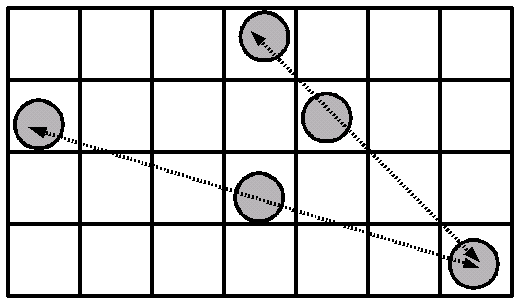
Alexandria Jones and her brother Leon played Avoid Three with pebbles on a grid scratched in the sand, but you can also use pencils or markers on graph paper. You need a rectangular playing area at least 4×4 squares large. The bigger your grid, the longer your game.

Continue reading Game: Avoid Three, or Tic-Tac-No!

Math Games by Kids

Photo by Mike Licht, NotionsCapital.com.

The cold came back and knocked me flat, but there are compensations. The downtime gave me a chance to browse my overflowing bookmarks folder, and I found something to add to my resource page. Princess Kitten and I enjoyed exploring these games and quizzes from Ambleweb.

Continue reading Math Games by Kids

More Free Math and Logic Resources

File library
Photo by Drab Makyo.

I have a huge, long-neglected bookmarks folder labeled “To add to resource page.” I am never going to find time to sort and review all of those links. But if I post a few at random now and then, perhaps you will find something useful.

So here are five new links I am adding to my Free (mostly) math resources on the Internet page.

Continue reading More Free Math and Logic Resources

Math Links for Fun and Charity

Numbers
Photo by James Cridland.

Aargh! My computer died again. So I borrowed my daughter’s laptop and ran off to the coffee shop to write blog articles — and discovered that all the outlets on the wall here are fake. Why would they do that? Anyway, before the laptop battery dies, I want to share a couple of math links with you…

Continue reading Math Links for Fun and Charity

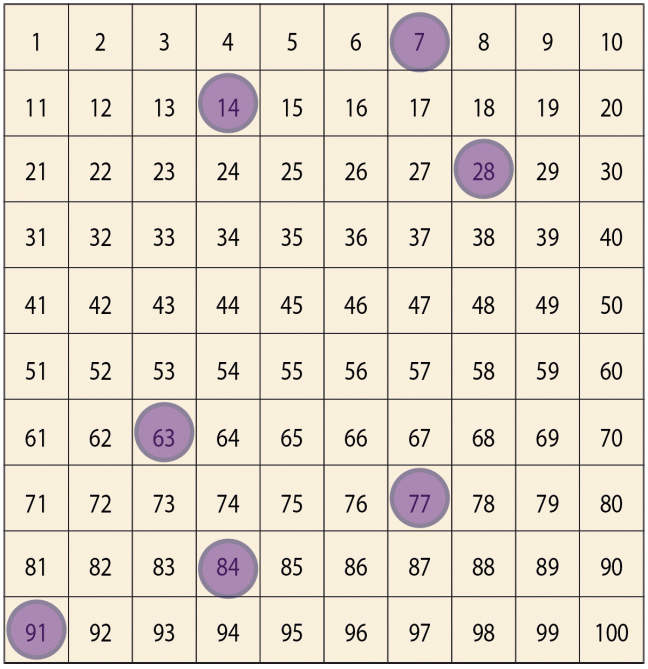
Euclid’s Game on a Hundred Chart

Math concepts: subtraction within 100, number patterns, mental math
Number of players: 2 or 3
Equipment: printed hundred chart (also called a hundred board), and highlighter or translucent disks to mark numbers — or use this online hundred chart

Set Up

Place the hundred chart and highlighter where all players can reach them.

How to Play

  • Allow the youngest player choice of moving first or second; in future games, allow the loser of the last game to choose.
  • The first player chooses a number from 1 to 100 and marks that square on the hundred chart.
  • The second player chooses and marks any other number.
  • On each succeeding turn, the player subtracts any two marked numbers to find and mark a difference that has not yet been taken.
  • Play alternates until no more numbers can be marked.

Continue reading Euclid’s Game on a Hundred Chart

Fraction Models, and a Card Game

Fraction cards

Models give us a way to form and manipulate a mental image of an abstract concept, such as a fraction. There are three basic ways we can imagine a fraction: as partially-filled area or volume, as linear measurement, or as some part of a given set. Teach all three to give your students a well-rounded understanding.

When teaching young students, we use physical models — actual food or cut-up pieces of construction paper. Older students and adults can firm up the foundation of their understanding by drawing many, many pictures. As we move into abstract, numbers-only work, these pictures remain in our minds, an always-ready tool to help us think our way through fraction problems.

Continue reading Fraction Models, and a Card Game
Game: Hundred Chart Nim

Photo by Håkan Dahlström via flickr.

Math concepts: addition and subtraction within 100, logical strategy
Number of players: 2 or 3
Equipment: printed hundred chart (also called a hundred board) and beans, pennies, or other tokens with which to mark numbers — or use this online hundred chart

Set Up

Place the hundred chart and a small pile of tokens where both players can reach them.

Continue reading Game: Hundred Chart Nim

7 Things to Do with a Hundred Chart


This post has been revised to incorporate all the suggestions in the comments below, plus many more activities. Please update your bookmarks:

Or continue reading the original article…


Continue reading 7 Things to Do with a Hundred Chart

Game: Tens Concentration

Math concepts: addition, number bonds for 10, visual memory
Number of players: any number, mixed ages
Equipment: math cards, one deck

Set Up

Each player draws a card, and whoever choses the highest number will go first. Then shuffle the cards and lay them all face down on the table, spread out so no card covers any other card. There are 40 cards in a deck, so you can make a neat array with five rows of eight cards each, or you may scatter them at random.

Continue reading Game: Tens Concentration