This game encourages players to reason about the relationships between length dimensions and volume in a 3-D shape.
Many parents remember struggling to learn math. We hope to provide a better experience for our children. And one of the best ways for children to enjoy learning is through hands-on play.
So what are you waiting for? Let’s play some math!
Prism Power
Math Concepts: rectangular volume, cubic units.
Players: two or more.
Equipment: printed gameboard or plain paper, pencils or markers, one six-sided die, 40–50 cubic blocks per player.
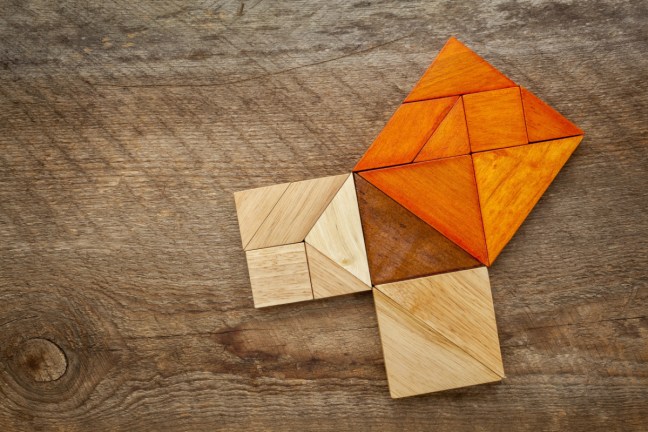
No peeking! This post is for those of you who have given the trisection proof a good workout on your own.
If you have a question about the proof or a solution you would like to share, please post a comment here.
But if you haven’t yet worked at the puzzle, go back and give it a try.
When someone just tells you the answer, you miss out on the fun. Figure it out for yourself — and then check the answer just to prove that you got it right.
One of the great unsolved problems of antiquity was to trisect any angle, to cut it into thirds with only the basic tools of Euclidean geometry: an unmarked straight-edge and a compass.
Like the alchemist’s dream of turning lead into gold, this proved to be an impossible task. If you want to trisect an angle, you have to “cheat.” A straight-edge and compass can’t do it. You have to use some sort of crutch, just as an alchemist would have to use a particle accelerator.
One “cheat” that works is to fold your paper.
I will show you how it works, and your job is to show why.
We were eclectic homeschoolers back in the Dark Ages before there was an internet. Our primary curriculum was the public library.
As we went along, I noticed how many of our homeschooling friends felt uncomfortable with math, and even hated or feared the subject.
Math anxiety runs rampant in Western culture. By one researcher’s estimate, more than 90% of adults experience some level of math anxiety — that is, discomfort, avoidance, and even emotional pain when faced with a math calculation.
So I became a sort of “math evangelist” in the homeschooling community, spreading the news that we can find beauty and fun even in math.
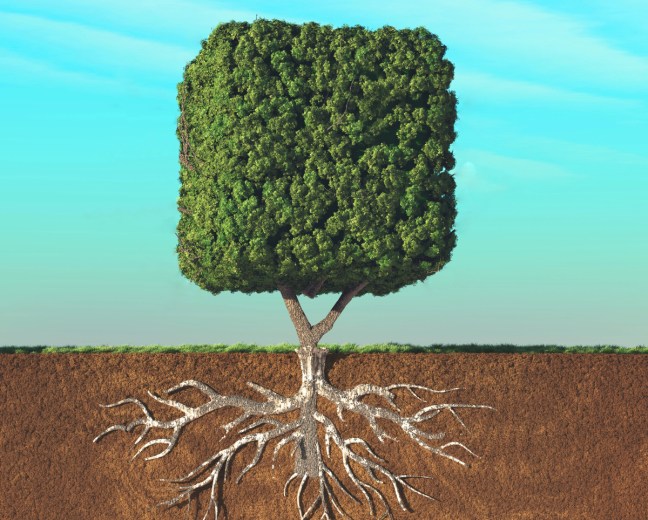
On May 5, we celebrate one of the rarest math holidays: Square Root Day, 5/5/25.
Here are a few ideas for playing math with squares and roots.
What is a Square Root?
Five is the square root of twenty-five, which means it is the number we can “square” (multiply times itself) to get 25.
The root is the base number from which the square grows. In physical terms, it is the side of the square.
Imagine a straight segment of length 5, perhaps a stick or a piece of chalk. Now lay that segment down and slide it sideways for a distance equal to its length. Drag the stick across sand, or pull the chalk across paper or a slate.
Notice how this sideways motion transforms the one-dimensional length into a two-dimensional shape, a square.
The area of this shape is the square of its root: 5 × 5 = 25.
What do you think would happen if you could drag the square through a third dimension, or drag that resulting shape through a fourth dimension?
How many shapes do you suppose might grow from that original root of 5?
Are your students doing anything special for Pi Day?
Back when we were homeschooling, my kids and I always felt stir-crazy after two months with no significant break. We needed a day off — and what better way could we spend it than to play math all afternoon?
I love any excuse to celebrate math!
Pi Day is March 14. If you write dates in the month/date format, then 3/14 at 1:59 is about as close as the calendar can get to 3.14159etc.
(Otherwise, you can celebrate Pi Approximation Day on July 22, or 22/7.)
Unfortunately, most of the activities on teacher blogs and Pinterest focus on the pi/pie wordplay or on memorizing the digits. With a bit of digging, however, I found a few puzzles that let us sink our metaphorical teeth into real mathematical meat.
What’s the Big Deal? Why Pi?
In math, symmetry is beautiful, and the most completely symmetric object in the (Euclidean) mathematical plane is the circle. No matter how you turn it, expand it, or shrink it, the circle remains essentially the same.
Every circle you can imagine is the exact image of every other circle there is.
This is not true of other shapes. A rectangle may be short or tall. An ellipse may be fat or slim. A triangle may be squat, or stand upright, or lean off at a drunken angle. But circles are all the same, except for magnification. A circle three inches across is a perfect, point-for-point copy of a circle three miles across, or three millimeters.
What makes a circle so special and beautiful? Any child will tell you, what makes a circle is its roundness. Perfectly smooth and plump, but not too fat.
The definition of a circle is “all the points at a certain distance from the center.” Can you see why this definition forces absolute symmetry, with no pointy sides or bumped-out curves?
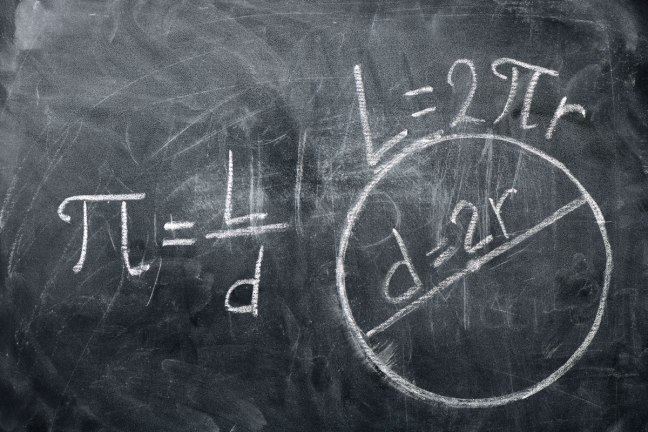
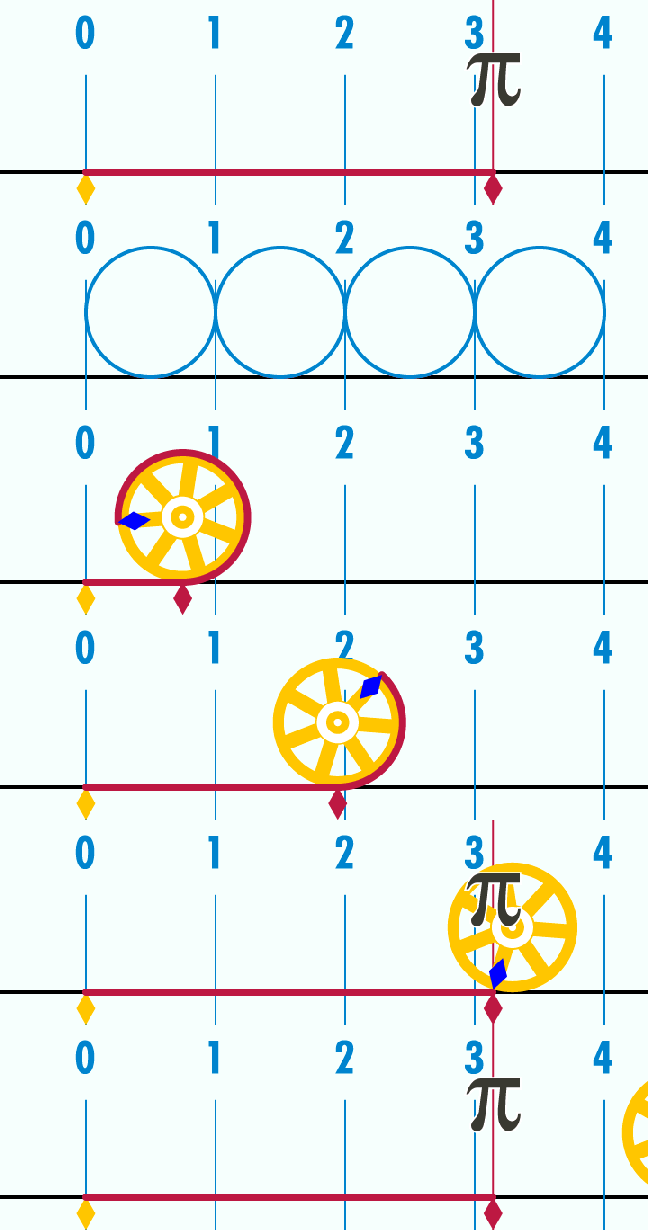
One way to express that perfect roundness in numbers is to compare it to the distance across. How many times would you have to walk back and forth across the middle of the circle to make the same distance as one trip around?
The ratio is the same for every circle, no matter which direction you walk.
That’s pi!
Puzzles with Pi
For all ages:
Sarah Carter created this fun variation on the classic Four 4s puzzle for Pi Day:
Using only the digits 3, 1, 4 once in each calculation, how many numbers can you make?
You can use any math you know: add, subtract, multiply, square roots, factorials, etc. You can concatenate the digits, putting them together to make a two-digit or three-digit number.
1. Imagine the Earth as a perfect sphere with a long rope tightly wrapped around the equator. Then increase the length of the rope by 10 feet, and magically lift it off the Earth to float above the equator. Will an ant be able to squeeze under the rope without touching it? What about a cat? A person?
2. If you ride a bicycle over a puddle of water, the wheels will leave wet marks on the road. Obviously, each wheel leaves a periodic pattern. How the two patterns are related? Do they overlap? Does their relative position depend on the length of the puddle? The bicycle? The size of the wheels?
3. Draw a semicircle. Along its diameter draw smaller semicircles (not necessarily the same size) that touch each other. Because there are no spaces in between, the sum of the diameters of the small semicircles must equal the diameter of the large one. What about their perimeter, the sum of their arc lengths?
4. Choose any smallish number N. How can you cut a circular shape into N parts of equal area with lines of equal lengths, using only a straight-edge and compass? Hint: The lines don’t have to be straight.
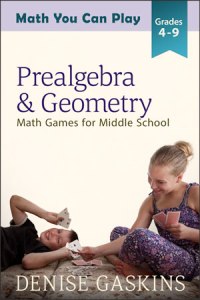
You can prepare your children for high school math by playing with positive and negative integers, number properties, mixed operations, algebraic functions, coordinate geometry, and more. Prealgebra & Geometry features 41 kid-tested games, offering a variety of challenges for students in 4–9th grades and beyond.
A true understanding of mathematics requires more than the ability to memorize procedures. This book helps your children learn to think mathematically, giving them a strong foundation for future learning.
And don’t worry if you’ve forgotten all the math you learned in school. I’ve included plenty of definitions and explanations throughout the book. It’s like having a painless math refresher course as you play.
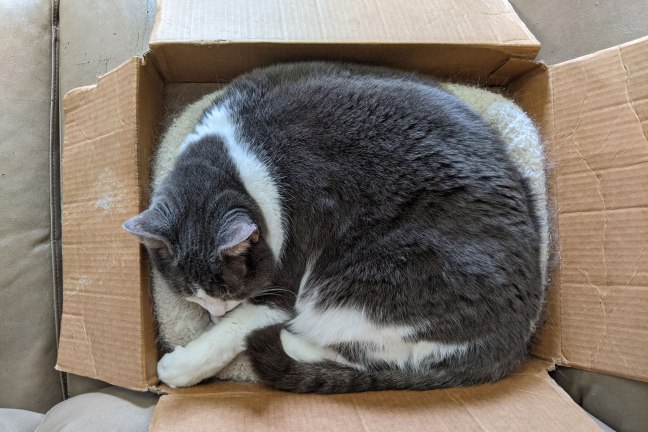
It may look like Cimorene has lain down on the job, but don’t be fooled! She’s hard at work, creating a math investigation for your students to explore.
Cats know how important it can be for students to experiment with math and try new things. Playing with ideas is how kittens (and humans!) learn.
Cimorene wants you to know that the Make 100 Math Rebels Kickstarter offers a great way for human children to learn math through play. She encourages you to go watch the video and read all about the project.
Too often, school math can seem stiff and rigid. To children, it can feel like “Do what I say, whether it makes sense or not.” But cats know that kids are like kittens — they can make sense of ideas just fine if we give them time to play around.
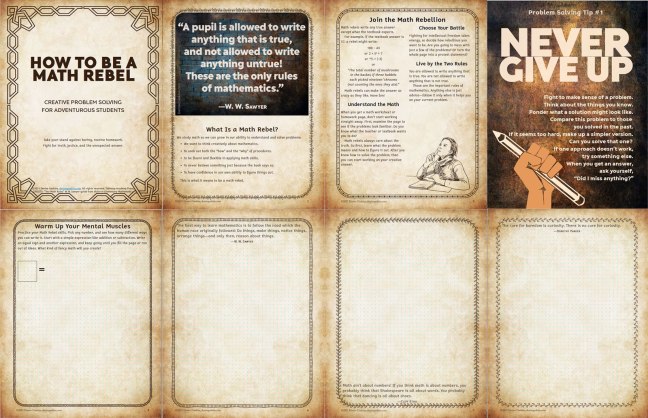
So Cimorene says you should download the free sample journaling pages from the Math Rebels Kickstarter page. The beautiful parchment design makes doing math an adventure.
Cimorene’s math puzzle is a classic geometry problem from the ancient Kingdom of Cats: Squaring the Circle.
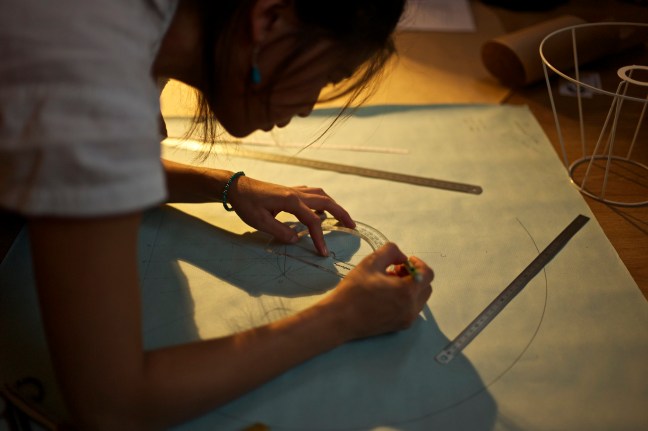
Draw a circle on your journal page. Can you draw a square (or rectangle) that has the same area?
How would you even begin such a task?
Notice Cimorene’s hint in the photo above: Try drawing the square that just touches the edges of your circle. (We call those just-touching lines “tangents” to the circle.)
What do you notice? Do the square and the circle have the same area? How close are they?
The tangent square sets an upper limit on the area of the circle. You can see that any square that exactly matches the circle would have to be smaller than the tangent square.
Can you find a square that sets a lower limit on the area of the circle? That is, a square that must have less area than the circle?
What’s the biggest square you can draw inside your circle? Can you find a square that has all four corners on the circle?
We call that biggest-inside square “inscribed” in the circle. Any polygon whose corners all sit on the circle is an inscribed polygon.
Play around with circles and squares. How close can you get to matching their size?
Further Exploration
After you have explored for awhile on your own, Cimorene has one more twist in her puzzle.
Divide the width of the circle in thirds, and then in thirds again. (That is, cut the diameter into nine parts.) Draw a square with sides measured by eight such parts.
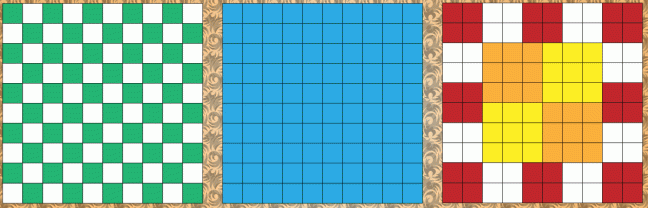
You can try this on your journaling page by drawing a circle that is nine squares wide. Then draw a square overlapping it, with sides that are eight squares in length.
How closely do the areas match?
Playing with Pi
Here’s a surprise: Cimorene’s puzzle isn’t really about squares, but about calculus.
The problem of Squaring the Circle is really a much bigger question: Finding the area of a square, rectangle, or other polygon is relatively easy, but how can we discover the area of a curved shape?
For a circle, the area is related to the number pi, which is the number of times you would have to walk across the circle to equal the distance of one time walking around it.
graphic by John Reid (cc by-sa 3.0)So the problem of Squaring the Circle is really the same as asking, “What is the value of pi?”
Can you figure out what approximate value for pi matches the 8/9 square used in the ancient Kingdom of Cats?
If you’d like to learn more about pi, get ready for a celebration: Pi Day is coming soon! Every year, millions of children celebrate math on March 14th, because if you write the date as 3/14, it’s the same as the first three digits of pi.
Find out more about playing with pi in my Pi Day Round-Up post.
Cimorene would love to hear about your children’s experiences playing with math! Please share your story in the comments below.
* * *
This blog is reader-supported.
If you’d like to help fund the blog on an on-going basis, then please head to my Patreon page.
If you liked this post, and want to show your one-time appreciation, the place to do that is PayPal: paypal.me/DeniseGaskinsMath. If you go that route, please include your email address in the notes section, so I can say thank you.





 Denise Gaskins' Let's Play Math