Math Storytelling Day: The Hospital Floor

[Feature photo above by Christiaan Triebert via flickr (CC BY 2.0).]
Have you ever heard of Math Storytelling Day? On September 25, people around the world celebrate mathematics by telling stories together. The stories can be real — like my story below — or fictional like the tale of Wizard Mathys from Fantasia and his crystal ball communication system.
Check out these posts for more information:
- Happy Math Storytelling Day
- Math Storytelling Day resources
- Moebius Noodles: Math Storytelling Day archive
My Math Story
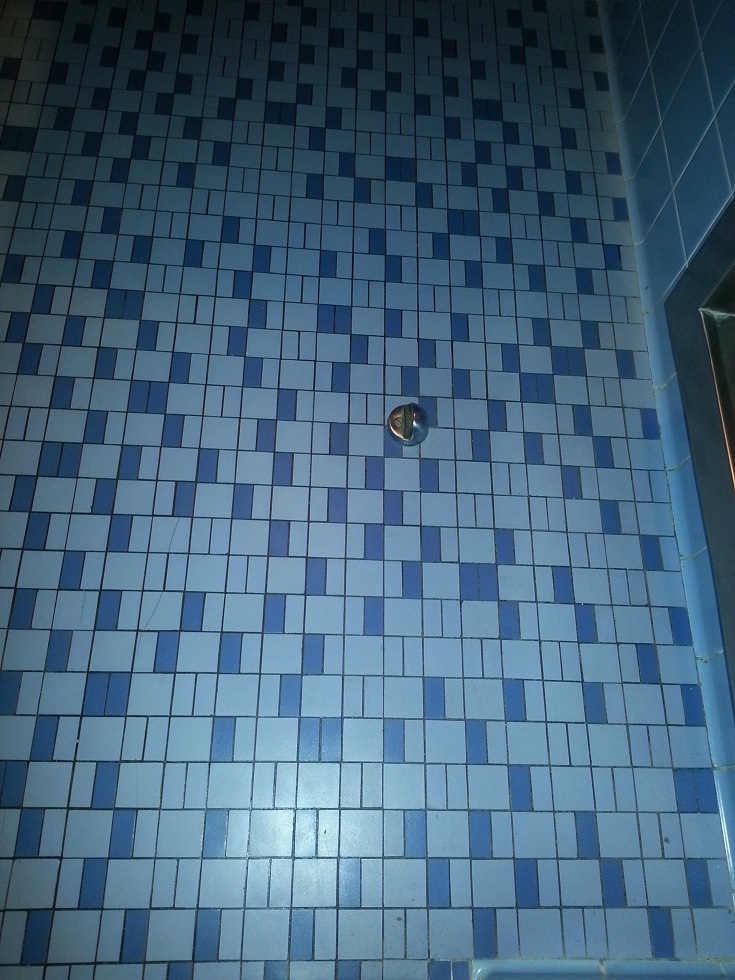
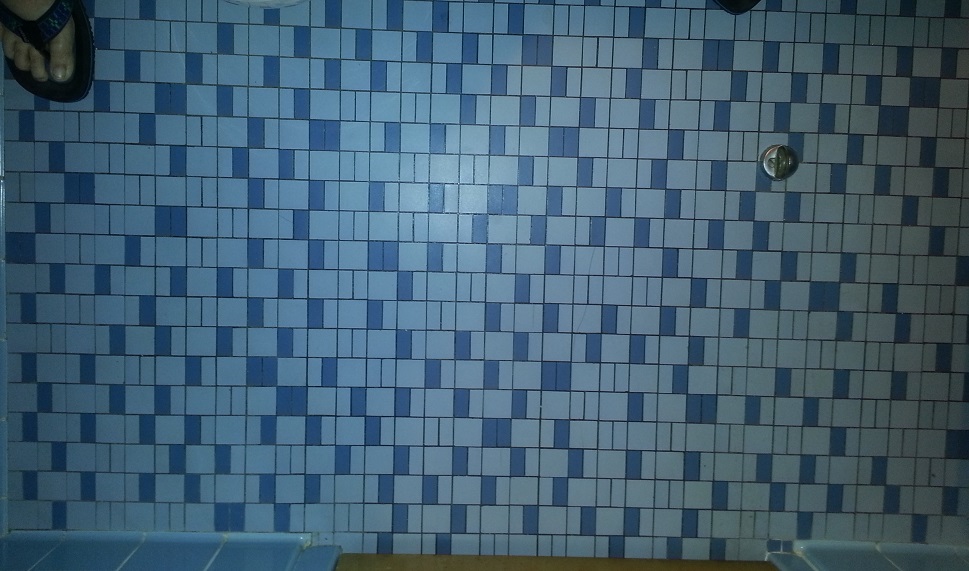
My story begins with an unexpected adventure in pain. Appendicitis sidewhacked my life last week, but that’s not the story. It’s just the setting. During my recovery, I spent a lot of time in the smaller room of my hospital suite. I noticed this semi-random pattern in the floor tile, which made me wonder:
- Did they choose the pattern to keep their customers from getting bored while they were … occupied?
- Is the randomness real? Or can I find a line of symmetry or a set of tiles that repeat?
- If I take pictures from enough different angles, could I transfer the whole floor to graph paper for further study?
- And if the nurse finds me doing this, will she send me to a different ward of the hospital? Do hospitals have psychiatric wards, or is that only in the movies?
- What is the biggest chunk of squares I could “break out” from this pattern that would create the illusion of a regular, repeating tessellation?
I gave up on the graph paper idea (for now) and printed the pictures to play with. By my definition, “broken” pattern chunks need to be contiguous along the sides of the tiles, like pentominoes. Also, the edge of the chunk must be a clean break along the mortar lines. The piece can zigzag all over the place, but it isn’t allowed to come back and touch itself anywhere, even at a corner. No holes allowed.
I’m counting the plain squares as the unit and each of the smaller rectangles as a half square. So far, the biggest chunk of repeating tiles I’ve managed to break out is 283 squares.
What Math Stories Will You Tell?
Have you and your children created any mathematical stories this year? I’d love to hear them! Please share your links in the comments section below.
* * *
This blog is reader-supported.
If you’d like to help fund the blog on an on-going basis, then please head to my Patreon page.
If you liked this post, and want to show your one-time appreciation, the place to do that is PayPal: paypal.me/DeniseGaskinsMath. If you go that route, please include your email address in the notes section, so I can say thank you.
Which I am going to say right now. Thank you!
“Math Storytelling Day: The Hospital Floor” copyright © 2014 by Denise Gaskins.
Math Teachers at Play #76

 [Feature photo (above) by U.S. Army RDECOM. Photo (right) by Stephan Mosel. (CC BY 2.0)]
On your mark… Get set… Go play some math!
Welcome to the 76th edition of the Math Teachers At Play math education blog carnival — a smorgasbord of links to bloggers all around the internet who have great ideas for learning, teaching, and playing around with math from preschool to pre-college.
By tradition, we start the carnival with a puzzle in honor of our 76th edition. But if you would like to jump straight to our featured blog posts, click here to see the Table of Contents.
Reblog: Patty Paper Trisection
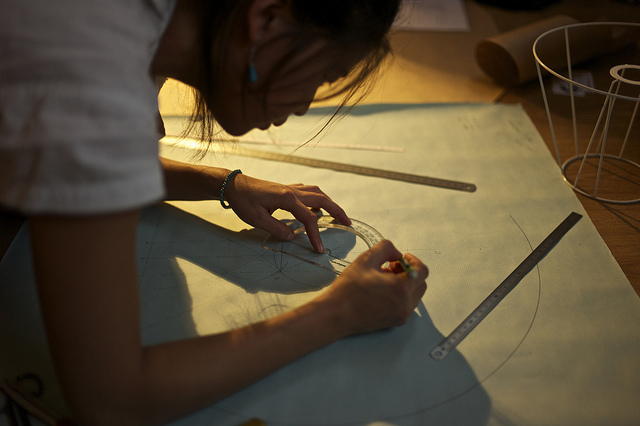
[Feature photo above by Michael Cory via Flickr (CC BY 2.0).]

I hear so many people say they hated geometry because of the proofs, but I’ve always loved a challenging puzzle. I found the following puzzle at a blog carnival during my first year of blogging. Don’t worry about the arbitrary two-column format you learned in high school — just think about what is true and how you know it must be so.
I hope you enjoy this “Throw-back Thursday” blast from the Let’s Play Math! blog archives:
One of the great unsolved problems of antiquity was to trisect any angle using only the basic tools of Euclidean geometry: an unmarked straight-edge and a compass. Like the alchemist’s dream of turning lead into gold, this proved to be an impossible task. If you want to trisect an angle, you have to “cheat.” A straight-edge and compass can’t do it. You have to use some sort of crutch, just as an alchemist would have to use a particle accelerator or something.
One “cheat” that works is to fold your paper. I will show you how it works, and your job is to show why …

More Than One Way To Find the Center of a Circle

[Feature photo above by hom26 via Flickr.]
My free time lately has gone to local events and to book editing. I hope to put up a series of blog posts sometime soon, based on the Homeschool Math FAQs chapter I’m adding to the paperback version of Let’s Play Math. [And of course, I’ll update the ebook whenever I finally publish the paperback, so those of you who already bought a copy should be able to get the new version without paying extra.]
But in the meantime, as I was browsing my blog archives for an interesting “Throw-Back Thursday” post, I stumbled across this old geometry puzzle from Dave Marain over at MathNotations blog:

Jake shows Jack a piece of wood he cut out in the machine shop: a circular arc bounded by a chord. Jake claimed that the arc was not a semicircle. In fact, he claimed it was shorter than a semicircle, i.e., segment AB was not a diameter and arc ACB was less than 180 degrees.
Jack knew this was impossible and argued: “Don’t you see, Jake, that O must be the center of the circle and that OA, OB and OC are radii.”
Jake wasn’t buying this, since he had measured everything precisely. He argued that just because they could be radii didn’t prove they had to be.
Which boy do you agree with?
- Pick one side of the debate, and try to find at least three different ways to prove your point.
If you have a student in geometry or higher math, print out the original post (but not the comments — it’s no fun when someone gives you the answer!) and see what he or she can do with it.
Dave offers many other puzzles to challenge your math students. While you are at his blog, do take some time to browse past articles.
The Linear Inequality Adventures of Ohio Jones

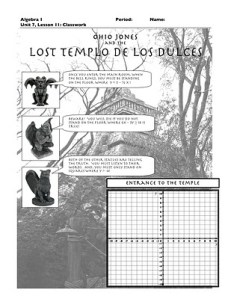
Last week, Kitten and I reached her textbook’s chapter on graphing linear equations, and a minor mistake with negative numbers threw her into an “I can’t do it!” funk. It’s not easy teaching a perfectionist kid.
Usually her mood improves if we switch to a slightly more advanced topic, and luckily I had saved these worksheets on my desktop, waiting for just such an opportunity. Today’s lesson:
- Some fun(ish) worksheets
“For tomorrow, students will be graphing systems of inequalities, so I decided to create a little Ohio Jones adventure (Indiana’s lesser known brother)…”
I offered to give her a hint, but she wanted to try it totally on her own. It took her about 40 minutes to work through the first few rooms of the Lost Templo de los Dulces and explain her solutions to me. I’m sure she’ll speed up with experience.
So far, she’s enjoying it much more than the textbook lesson. It’s fascinating to me how the mere hint of fantasy adventure can change graphing equations from boring to cool. Thanks, Dan!
Math Teachers at Play #70
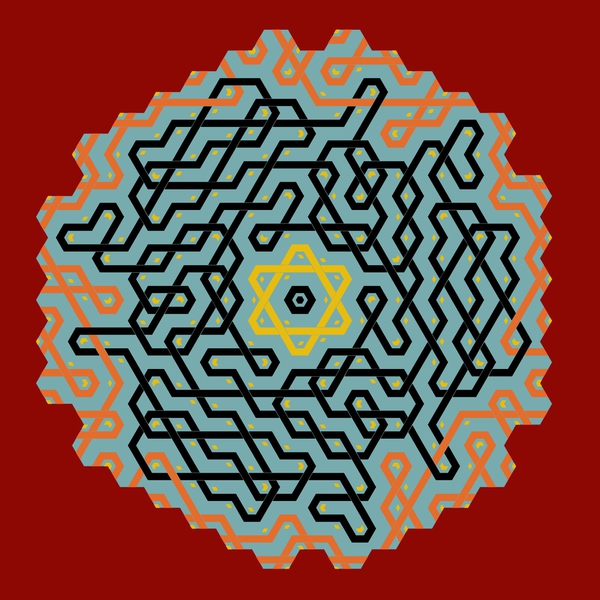
 [Feature photo above by David Reimann via Bridges 2013 Gallery. Number 70 (right) from Wikimedia Commons (CC-BY-SA-3.0-2.5-2.0-1.0).]
Do you enjoy math? I hope so! If not, browsing this post just may change your mind.
Welcome to the 70th edition of the Math Teachers At Play math education blog carnival — a smorgasbord of 42+ links to bloggers all around the internet who have great ideas for learning, teaching, and playing around with math from preschool to pre-college. Let the mathematical fun begin!
By tradition, we start the carnival with a puzzle in honor of our 70th edition. But if you would like to jump straight to our featured blog posts, click here to see the Table of Contents.
Math Playtime With Blocks
Feature video by Stuart Jeckel via youtube.
DO Try This at Home
And ask questions!
- What do you notice?
- What do you wonder?
- Will the pattern continue?
- How can we know for sure?
Math Teachers at Play #66

[Feature photo above by Franz & P via flickr. Route 66 sign by Sam Howzit via flickr. (CC BY 2.0)]

Welcome to the Math Teachers At Play blog carnival — which is not just for math teachers! If you like to learn new things and play around with ideas, you are sure to find something of interest.
By tradition, we start the carnival with a couple of puzzles in honor of our 66th edition.
Let the mathematical fun begin!
Puzzle 1
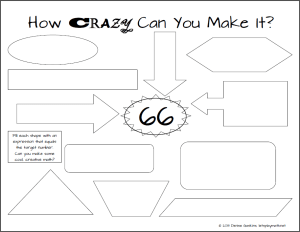
Our first puzzle is based on one of my favorite playsheets from the Miquon Math workbook series. Fill each shape with an expression that equals the target number. Can you make some cool, creative math?
Click the image to download the pdf playsheet set: one page has the target number 66, and a second page is blank so you can set your own target number.
What Do You Notice? What Do You Wonder?

If you want your children to understand and enjoy math, you need to let them play around with beautiful things and encourage them to ask questions.
Here is a simple yet beautiful thing I stumbled across online today, which your children may enjoy:
It reminds me of string art designs, but the app makes it easy to vary the pattern and see what happens.
- What do your students notice about the patterns?
- What questions can they ask?
I liked the way the app uses “minutes” as the unit that describes the star you want the program to draw. That makes it easier (for me, at least) to notice and understand the patterns, since minutes are a more familiar and intuitive unit than degrees, let alone radians.
 Denise Gaskins' Let's Play Math