Graph-It Game

[Photo by Scott Schram via Flickr.]

For Leon’s Christmas gift, Alex made the Graph-It game. She wrapped a pad of graph paper and wrote up the instructions:

To play Graph-It, one person designs a picture made by connecting points on a coordinate graph. He reads the points to the other player, who tries to reproduce the picture.

Continue reading Graph-It Game

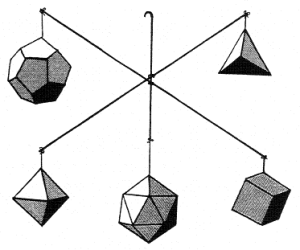
Renée’s Platonic Mobile

Alexandria Jones struggled to think of a Christmas gift that a one-month-old baby could enjoy, but finally she got an idea.

She cut empty cereal boxes to make regular polygons: 6 squares, 12 regular pentagons, and 32 equilateral triangles. Using small pieces of masking tape, she carefully formed the five Platonic solids. Then she mixed flour and water into a runny paste. She tore an old newspaper into small strips and soaked them in the paste. She covered each solid with a thin layer of paper.

Continue reading Renée’s Platonic Mobile

Math Project: Measure the Earth

Tomorrow, September 23, is the equinox — when night and day are equally balanced (or would be, if the sun appeared as a point, rather than a disc). If we lived on the equator, the sun would appear directly overhead at noon and would cast no shadow. Therefore, it’s a great day to perform Eratosthenes’ experiment of measuring the earth:

Continue reading Math Project: Measure the Earth

Sept-Oct 2010 Math Calendars

As I was preparing for Wednesday’s Homeschool Math Club Games & Activities meeting, I remembered my old math calendars and thought, that would be a fun activity to offer. So I pulled up the files and discovered that the days of the week matched perfectly. What a cool coincidence!

So in case you missed the math calendars last year, or in case it’s been long enough that your children have forgotten, here are the “new” versions:

Addendum

Umm Ahmad created an easier version for young students:

Continue reading Sept-Oct 2010 Math Calendars

Math Teachers at Play #24

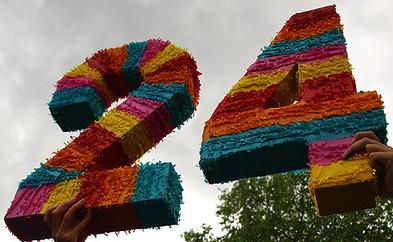
[Photo by internets_dairy.]

Welcome to the Math Teachers At Play blog carnival — which is not just for math teachers! If you like to learn new things and play around with ideas, you are sure to find something of interest. Let’s start the mathematical fun with an arithmetic card game in honor of our 24th edition and a few number puzzles:

Continue reading Math Teachers at Play #24

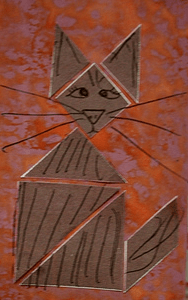
Cardstock Geometry Puzzle

While browsing the Kim Komando website for ideas I could use in my blogging class, I followed a rabbit trail through Kim’s video archive. I think we will try this in Math Club next semester:

If the embedded video doesn’t work on your computer, you can find the original here: Unbelievable Paper Transformer.

Update

Simon posted a template for the puzzle at his MathsClass blog.

Math Teachers at Play #20

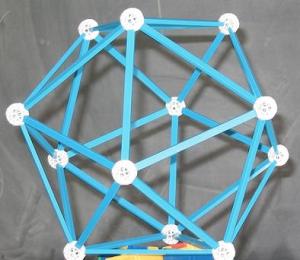
blue icosahedron, by shonk[Photo by shonk.]

Welcome to the Math Teachers At Play blog carnival — which is not just for math teachers! If you like to learn new things and play around with ideas, you are sure to find something of interest.

Let’s start the mathematical fun with a couple of puzzles in honor of our 20th edition: First, the shape to our right is an icosahedron, one of the Platonic solids. Each face is an equilateral triangle — can you count them? For more fun, make your own model.

Continue reading Math Teachers at Play #20

Math Teachers at Play #8

party-child-by-jaaron

[Photo by jaaron.]

Welcome to the Math Teachers At Play blog carnival — which is not just for math teachers! We accept entries from anyone who enjoys playing around with math, as long as the topic is relevant to students or teachers of preK-12th grade mathematics.

Some articles were submitted by their authors, other were drawn from the back-log in my blog reader, and I’ve spiced it all up with a few math jokes courtesy of the Mathematical humor collection of Andrej and Elena Cherkaev.

Let the mathematical fun begin…

Continue reading Math Teachers at Play #8

Quilt: What Can You Do with This?


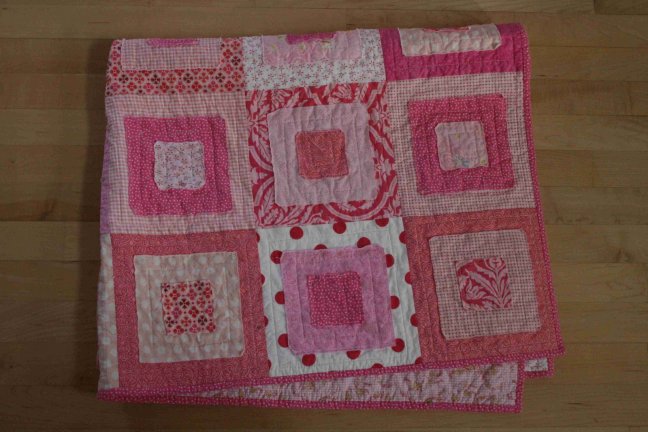
[Ragged Squares Quilt photos used with permission from Crazy Mom Quilts.]

I know other teachers have done math quilts, but I’ve never gotten around to trying it in any of my classes. Still, this image caught my eye and practically begged me to make it into a math lesson for my elementary math club.

I thought of at least two ways I could go with this, but I bet that if we put our brains together, we can come up with even more creative ideas. So here’s the question, ala Dan Meyer:

  • What can you do with this?

How could you use this image as a springboard to doing math? What questions would you ask? What concepts would you try to get across? What would you follow it with? Please comment!

Other photos are available…

Continue reading Quilt: What Can You Do with This?