The Christmas Present Quandary

Alexandria Jones hated using store-bought wrapping paper at Christmas. She tried to wrap each present as a hand-crafted work of art.

Last year, she did mini-scenes with plastic figures building cotton snowmen or skating on aluminum-foil ponds — and, for her brother Leonhard’s gift, her favorite creation: toy dinosaurs having a snowball fight. But those 3-D scenes got knocked about under the Christmas tree.

This year, she decided, she would wrap the packages flat. But then, how could she make them special?

Continue reading The Christmas Present Quandary

Rewriting the History of Math

Here are a couple of quick links to math in the news:

Quotations XVI: Back to the Blackboard

Classes are back in session at our homeschool co-op, so I am again collecting short quotes for the blackboard. Here are the ones I used in September:

Any fool can know. The point is to understand.

Albert Einstein

Life without geometry is pointless.

Anonymous

You don’t understand anything until you learn it more than one way.

Marvin Minsky

Egyptian Geometry and Other Challenges

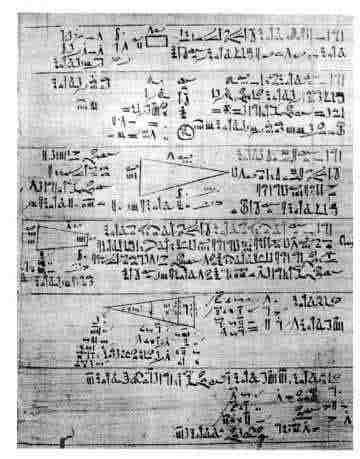
Rhind papyrus

Would you like to study “the knowledge of all existing things and all obscure secrets”? That is how Scribe Ahmose (also translated Ahmes) described his mathematical papyrus. Ahmose’s masterpiece is now called the Rhind Papyrus, after Alexander Henry Rhind, a Scotsman who was one of the first archaeologists to make meticulous records of his excavations (rather than simply hunting for treasures). Rhind purchased the papyrus from an antiquities dealer in Luxor, Egypt, in 1858.

Ahmose’s writing included a huge table of fractions as well as story problems, geometry, algebra, and accounting. Can you solve any of Scribe Ahmose’s problems?

Continue reading Egyptian Geometry and Other Challenges

Hints and Solutions: Patty Paper Trisection

No peeking! This post is for those of you who have given the trisection proof a good workout on your own. If you have a question about the proof or a solution you would like to share, please post a comment here.

But if you haven’t yet worked at the puzzle, go back and give it a try. When someone just tells you the answer, you miss out on the fun. Figure it out for yourself — and then check the answer just to prove that you got it right.

Continue reading Hints and Solutions: Patty Paper Trisection

Puzzle: Patty Paper Trisection

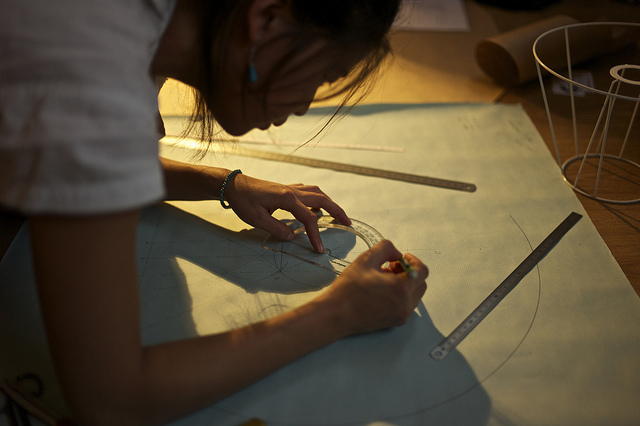
[Feature photo above by Michael Cory via Flickr (CC BY 2.0).]

trisection

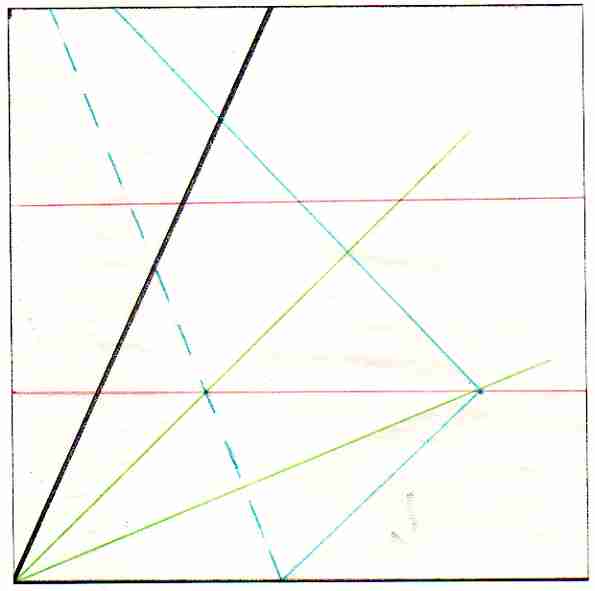
One of the great unsolved problems of antiquity was to trisect any angle using only the basic tools of Euclidean geometry: an unmarked straight-edge and a compass. Like the alchemist’s dream of turning lead into gold, this proved to be an impossible task. If you want to trisect an angle, you have to “cheat.” A straight-edge and compass can’t do it. You have to use some sort of crutch, just as an alchemist would have to use a particle accelerator or something.

One “cheat” that works is to fold your paper. I will show you how it works, and your job is to show why.

Continue reading Puzzle: Patty Paper Trisection

Historical Tidbits: Alexandria Jones

[Read the story of the pharaoh’s treasure: Part 1, Part 2, and Part 3.]

Here are a few more tidbits from math history, along with links to relevant Internet sites or books, and three more math puzzles for you to try. I hope you find them interesting.

Next time, a new adventure (sort of)…

Continue reading Historical Tidbits: Alexandria Jones

Answers and Other Tidbits: The Pharaoh’s Treasure

[Read the story of the pharaoh’s treasure here: Part 1, Part 2, and Part 3.]

I confess: I lied — or rather, I helped to propagate a legend. Scholars tell us that the Egyptian rope stretchers did not use a 3-4-5 triangle for right-angled corners. They say it is a myth, like the corny old story of George Washington and the cherry tree, which bounces from one storyteller to the next — as I got it from a book I bought as a library discard.

None of the Egyptian papyri that have been found show any indication that the Egyptians knew of the Pythagorean Theorem, one of the great theorems of mathematics, which is the basis for the 3-4-5 triangle. Unless a real archaeologist finds a rope like Alexandria Jones discovered in my story, or a papyrus describing how to use one, we must assume the 3-4-5 rope triangle is an unfounded rumor.

Continue reading Answers and Other Tidbits: The Pharaoh’s Treasure

The Secret of the Pharaoh’s Treasure, Part 3

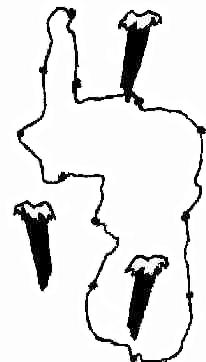
[In the last episode, Alexandria Jones discovered a mysterious treasure: three wooden sticks, like tent pegs, and a long loop of rope with 12 evenly spaced knots. Her father explained that it was an ancient Egyptian surveyor’s tool, used to mark right angles.]

Back at the camp, Fibonacci Jones stacked multi-layer sandwiches while Alexandria poured milk and set the table for supper.

“Geometry,” Fibonacci said.

“What?”

Geo means earth, and metry means to measure. So geometry means to measure the earth. That is what the Egyptian rope stretches did.”

Alex thought for a moment. “So in the beginning, math was just surveying?”

“And taxes…”

Continue reading The Secret of the Pharaoh’s Treasure, Part 3

Geometry: Can You Find the Center of a Circle?

Is it possible that AB is a chord but NOT a diameter? That is, could circle ABC have a center that is NOT point O?

For the last couple of days, I have been playing around with this geometry puzzle. If you have a student in geometry or higher math, I recommend you print out the original post (but not the comments — it’s no fun when someone gives you the answer!) and see what he or she can do with it.

[MathNotations offers many other puzzles for 7-12th grade math students. While you are at his blog, take some time to browse past articles.]