Euclid’s Geometric Algebra

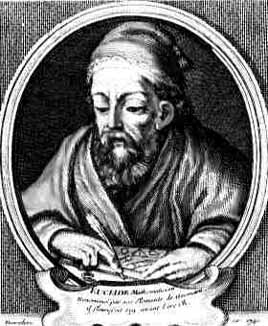
Picture from MacTutor Archives.

After the Pythagorean crisis with the square root of two, Greek mathematicians tried to avoid working with numbers. Instead, the Greeks used geometry to demonstrate mathematical concepts. A line can be drawn any length, so straight lines became a sort of non-algebraic variable.

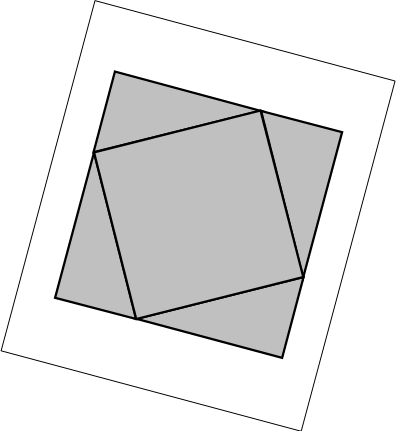
You can see an example of this in The Pythagorean Proof, where Alexandria Jones represented the sides of her triangle by the letters a and b. These sides may be any length. The sizes of the squares will change with the triangle sides, but the relationship a^2 + b^2 = c^2 is always true for every right triangle.
Continue reading Euclid’s Geometric Algebra

The Mosaic Tile Mystery

Dear Alexandria Jones,

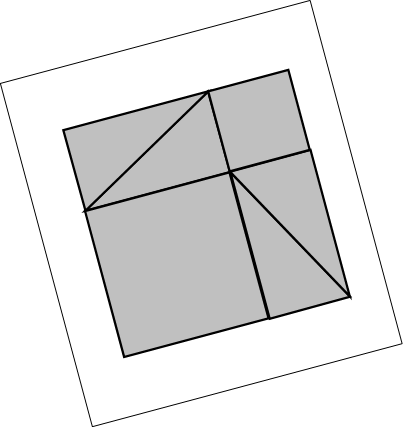
We continue to excavate the ancient building complex, which I believe may have been Pythagoras’s school. Yesterday, one of our digging crews uncovered a mosaic tile floor in the courtyard. The pattern of the tiles alternates between two square designs. (See enclosed sketches.)

During your family’s recent visit, you expressed an interest in the mathematical ideas of Pythagoras. Could you or your father offer us any insight into what these tile designs may represent?

I look forward to your response.

Sincerely,
Sofia Theano, Ph.D.
Crotone, Italy

Continue reading The Mosaic Tile Mystery

Answers to Leon’s Figurate Number Puzzles

Remember the Math Adventurer’s Rule: Figure it out for yourself! Whenever I give a problem in an Alexandria Jones story, I will try to post the answer soon afterward. But don’t peek! If I tell you the answer, you miss out on the fun of solving the puzzle. So if you haven’t worked these problems yet, go back to the original post. Figure them out for yourself — and then check the answers just to prove that you got them right.

Continue reading Answers to Leon’s Figurate Number Puzzles

Puzzle: Figuring Out Figurate Numbers


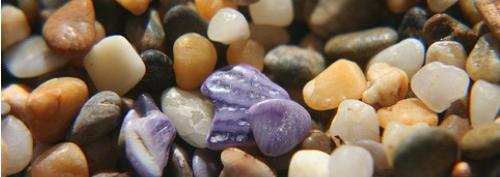
Photo by frumbert.

Alexandria Jones‘s parents decided that the family needed to relax after the excitement of tracking Simon Skulk, so they spent the next day at a beach on the Mediterranean coast. Leon collected pebbles and tried to build up figurate numbers — numbers that make a figure, or shape — the way Dr. Theano had shown them.

Continue reading Puzzle: Figuring Out Figurate Numbers

April Fool’s Day: Fun with Math Fallacies

Photo by RBerteig. Take a break from “serious” math and have a little fun today with some classics of recreational mathematics. Do you have a favorite math or logic fallacy? Please share it in the Comments below. Continue reading April Fool’s Day: Fun with Math Fallacies

Answers to Alex’s and Leon’s Puzzles

Remember the Math Adventurer’s Rule: Figure it out for yourself! Whenever I give a problem in an Alexandria Jones story, I will try to post the answer soon afterward. But don’t peek! If I tell you the answer, you miss out on the fun of solving the puzzle. So if you haven’t worked these problems yet, go back to the original posts. Figure them out for yourself — and then check the answers just to prove that you got them right.

Leonhard’s block puzzles

Alex’s & Leon’s homeschool puzzle

Continue reading Answers to Alex’s and Leon’s Puzzles

Leonhard’s Block Puzzles

Leon’s wooden block puzzle Leonhard Jones is Alexandria Jones’s younger brother. He enjoys woodworking, and he cut a wooden cube into 8 smaller blocks to make himself a puzzle.

Puzzle #1

Leon painted the 8 blocks with his two favorite colors: red and forest green. When he was finished, Leon could put the blocks together into a red cube, or he could switch them around to make a green cube.

How did Leon paint his blocks?

Continue reading Leonhard’s Block Puzzles

Happy Pi Day II

[Feature photo above by pauladamsmith.]

Now there is an ancient Greek letter,
And I think no other is better.
It isn’t too tall,
It might look very small,
But its digits, they go on forever.

— Scott
Mrs. Mitchell’s Virtual School

Time to Celebrate

Are your students doing anything special for \pi Day? After two months with no significant break, we are going stir crazy. We need a day off — and what better way could we spend it than to play math all afternoon?

If you need ideas, here are some great \pi pages:

Continue reading Happy Pi Day II