Playful Math Carnival #142: Math Art Edition

Welcome to the 142nd edition of the Playful Math Education Blog Carnival — a smorgasbord of delectable tidbits of mathy fun. It’s like a free online magazine devoted to learning, teaching, and playing around with math from preschool to high school.

Bookmark this post, so you can take your time browsing.

Seriously, plan on coming back to this post several times. There’s so much playful math to enjoy!

By tradition, we start the carnival with a puzzle/activity in honor of our 142nd edition. But if you’d rather jump straight to our featured blog posts, click here to see the Table of Contents.

Activity: Planar Graphs

According to the OEIS Wiki, 142 is “the number of planar graphs with six vertices.”

What does that mean?

And how can our students play with it?

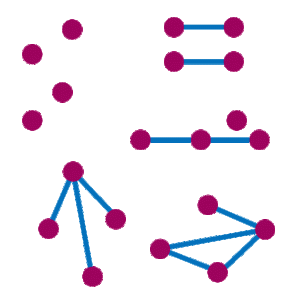
A planar graph is a set of vertices connected (or not) by edges. Each edge links two vertices, and the edges cannot intersect each other. The graph doesn’t have to be fully connected, and individual vertices may float free.

Children can model planar graphs with three-dimensional constructions using small balls of playdough (vertices) connected by toothpicks (edges).

Let’s start with something smaller than 142. If you roll four balls of playdough, how many different ways can you connect them? The picture shows five possibilities. How many more can you find?

Sort your planar graphs into categories. How are they similar? How are they different?

A wise mathematician once said, “Learning is having new questions to ask.” How many different questions can you think of to ask about planar graphs?

Play the Planarity game to untangle connected planar graphs (or check your phone store for a similar app).

Or play Sprouts, a pencil-and-paper planar-graph game.

For deeper study, elementary and middle-school students will enjoy Joel David Hamkins’s Graph coloring & chromatic numbers and Graph theory for kids. Older students can dive into Oscar Levin’s Discrete Mathematics: An Open Introduction. Here’s the section on planar graphs.

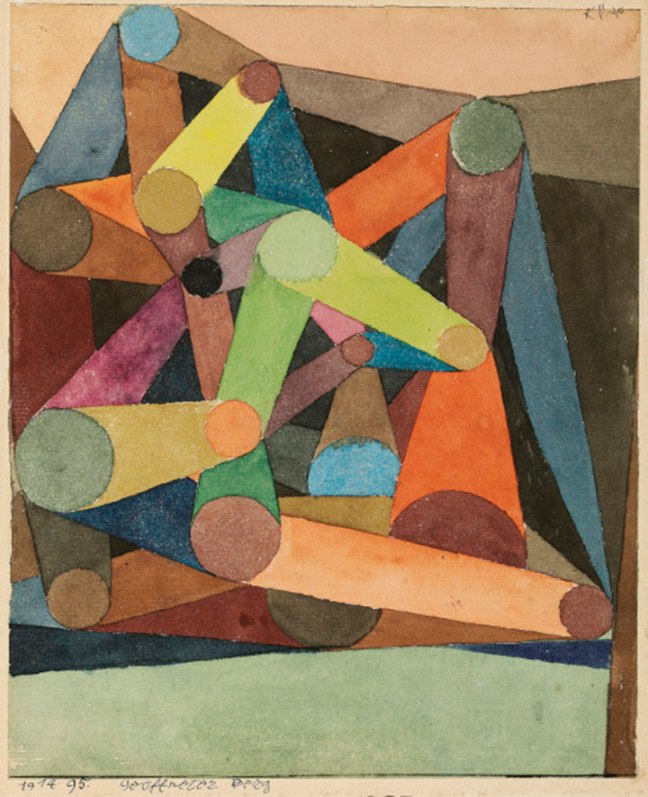
[“Geöffneter Berg” by Paul Klee, 1914.]

Click here for all the mathy goodness!

The Gerrymander Math Project

With a big election on the horizon, now is a great time to talk about the math of politics.

Does “One person, one vote” make a fair democracy?

Or does it give the majority license to trample a minority?

How can planners arrange voting districts to give everyone the best representation? And is that really what politicians would do, if they had the choice?

Try the Gerrymander Project with your students to investigate these questions and spark real-world mathematical discussion.

First, Create a Map
[Or buy a copy of my printable activity guide, The Gerrymander Project: Math in the World of Politics, which includes a prepared city map with more detailed instructions, answers, and journaling prompts. My publisher has extended the 10% discount code TBLTOP10 through to Election Day, 3 November 2020.]

  • Print a blank hundred chart or outline a 10×10 square on grid paper. This represents your city. Give it a name.
  • Pull out your colored pencils. Choose one color for your city’s Majority Party and another for the Minority Party.
  • Color 10 squares in a neutral color for non-voting areas. These might be malls or parks or the downtown business district — your choice.
  • Color the remaining 90 blocks in a random distribution so that 60% are the Majority color and 40% the Minority. How will you choose which squares to make which colors? Can you think of a way to use dice or playing cards to make your choices random, yet still get the right proportion?

Slip your finished map into a clear page protector, so you can mark on it with dry-erase markers. Or make several copies, so you can write on them without destroying the original.

Then Gerrymander Your City

“Gerrymandering” is the American political tradition of adjusting the voting district boundaries to favor one’s own party at the expense of one’s opponents.

The city has hired you to mark out 10 new voting districts of 9 squares each (not counting the neutral squares, which can go in any district). The squares in each district must touch side-to-side, not just meet at a corner.

So now you get to play “political hack.”

First, see how fair you can make the map:

  • What happens if you ignore the party colors and make your districts as compact as possible, so the people living nearest to each other vote together? Will the Majority Party always win?
  • Can you give all your voters a proportional representation? Both parties should win the number of districts that most closely matches their percentage of the voting population.

Next, try your hand at gerrymandering, but make sure all the squares in each district stay connected. Can you create ten voting districts that will guarantee:

  • A come-from-behind triumph for the Minority Party? They need to carry at least six districts to wrest control of the City Council from their opponents.
  • The greatest possible margin of victory for the Majority Party? Can you keep the Minority from winning any districts at all?

Share Your Thoughts

I’d love to hear your students’ reaction to this project. Please share in the comments section below.

For myself, the more I play with this project, the more I admire the work done by the framers of the U.S. Constitution. Our Electoral College divides the country into “districts” based on state boundaries, giving each a vote roughly proportional to its population — but in a way that slightly strengthens the Minority Party. The system may not be perfect, but it’s done an amazing job through the centuries of maintaining a balance of power, making sure that neither major political party can destroy the other.

Which is NOT to say that our country always protects the rights of true minorities. Clearly, that’s an ongoing struggle.

But overall, the political parties stay relatively balanced, making for a stable government. After more than two centuries, we still have, as Ben Franklin said, “a republic, if you can keep it.”

 
* * *

This blog is reader-supported.

If you’d like to help fund the blog on an on-going basis, then please head to my Patreon page.

If you liked this post, and want to show your one-time appreciation, the place to do that is PayPal: paypal.me/DeniseGaskinsMath. If you go that route, please include your email address in the notes section, so I can say thank you.

Which I am going to say right now. Thank you!

“The Gerrymander Math Project” copyright © 2020 by Denise Gaskins.
Prealgebra & Geometry Preorders

Math You Can Play series by Denise Gaskins

My book Prealgebra & Geometry: Math Games for Middle School is scheduled for release to regular bookstores in February, 2021. Because no publisher wants to send a new book into the world during such hectic, unsettled times as a big election, the winter holidays, or during inauguration season.

But preorder links are beginning to appear at several of the major online booksellers. And more stores will join them, as the information filters through their website systems.

The paperback will also be up for preorder, whenever the sites catch that update.

And remember: If you don’t favor a particular bookstore, you can buy the early-release ebook right now at my publisher’s webstore — and get a 10% discount if you order before 15 October.

FAQ: I’ve Ruined My Daughter

My daughter is only eleven, but I’m afraid I’ve ruined her chance of getting into college because she is so far behind in math. We’ve tried tutors, but she still has trouble, and standardized testing puts her three years below grade level. She was a late reader, too, so maybe school just isn’t her thing. What else can I do?

Standardized tests are not placement tests. They cannot tell you at what level your daughter should be studying. They aren’t designed that way. The “placement” they give is vague and general, not indicative of her grade level but rather a way of comparing her performance on that particular test with the performance of other students.

There can be many different reasons for a low score. I’ve listed a few of them in my post In Honor of the Standardized Testing Season.

Continue reading FAQ: I’ve Ruined My Daughter

To Badger a Child

Here’s the full quote:

Audrey seemed, for once, at a loss for words. She was thinking about the question.

I try to stay focused on being silent after I ask young children questions, even semi-serious accidental ones. Unlike most adults, they actually take time to think about their answers and that often means waiting for a response, at least if you want an honest answer.

If you’re only looking for the “right” answer, it’s fairly easy to gently badger a child into it, but I’m not interested in doing that.

—Thomas Hobson
Thank You For Teaching Me

CREDITS: “Pismo Beach, United States” photo by Tim Mossholder on Unsplash.

Playing Math with Michael and Nash

Michael and Nash have been creating and posting new math games with astonishing regularity throughout the pandemic. Their YouTube channel is a great resource for parents who want to play math with elementary-age children.

Today’s entry: Closest to Ten, a quick game for addition and subtraction fluency with a tiny bit of multiplication potential.

And here’s one of my favorites for older players: Factor Triangles, a card game for 2-digit multiplication.

Check out their channel, and have fun playing math with your kids!

Visit Michael and Nash on YouTube

How to Build Math Literacy

Here’s the full quote:

We all know reading a book each day to our child develops their love of literacy… well, playing games is the equivalent in maths.

Through playing card games and board games (just short and sweet ones) children develop problem solving, counting and so many other skills.

Imagine if every time you play a game you say, “Let’s do some maths.” What a positive association your child will develop with maths!

—Ange Rogers
Instagram post

Discover more creative ways to play math with young children at the Number Doctors blog.

CREDITS: “Falling dice” photo by Riho Kroll on Unsplash.

Kenken is Mathematical Play

It’s back-to-school time here in the States. And that means it’s time for the Kenken Classroom Newsletter. Yay for math puzzles!

KenKen arithmetic puzzles build mental math skills, logical reasoning, persistence, and mathematical confidence.

Free via email every Friday during the school year.

What a great way to prepare your children for success in math!

Sign up anytime:

Click Here for KenKen Classroom Newsletter

Continue reading Kenken is Mathematical Play

Journaling Pages

This afternoon, I’ve been working on the printable pdf math activity booklets I’ll be sending out as stretch goals to the backers of my Math You Can Play Kickstarter campaign.

Some of the booklets include dot grid pages for student journaling.

I love dot grid pages for writing because I can start a line anywhere on the page, and the dots help me keep things in line. (They’re also great for doodling.)

As students wrestle their thoughts into shape and create explanations, they do the same sort of work that mathematicians do every day. It’s difficult for children (or anyone) to pin down a thought and put it into words. But it’s great practice for life.

Journaling is a great practice for adult learners, too — and don’t we all want to be lifelong learners?

So I thought I’d share the journaling pages with you all, in case you’d like to get your children writing about math. There are three styles, ranging from plain to ornate parchment. Enjoy!

Download the Journaling Pages

UPDATE: The Kickstarter deals have ended, but my playful math books are still available through your favorite online store or by special order at your local bookshop. (Except for the Prealgebra & Geometry Games book, scheduled for publication in early 2021. Sign up for my email list to get the latest news.)