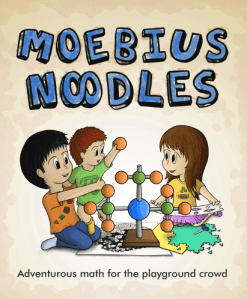
Moebius Noodles: New Must-Read Math Book

MoebiusNoodles2DCover

Homeschoolers, after-schoolers, unschoolers, or anyone else: if you’re a parent with kids at home, you need this book. If you work with children in any way (grandparent, aunt/uncle, teacher, child care, baby sitter, etc.) you need this book. Or if you hated math in school and never understood how anyone could enjoy it, you need this book!

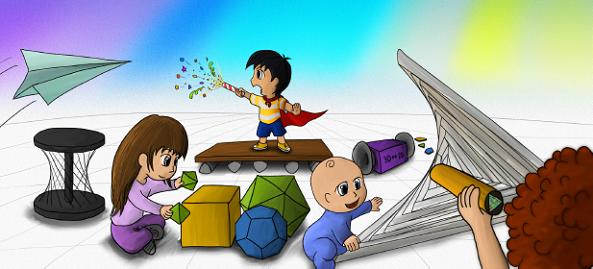
Moebius Noodles is a travel guide to the Math Universe for adventurous families (and it has lots of beautiful pictures, too!) featuring games and activities that draw out the rich, mathematical properties of everyday objects in ways accessible to parents and children:

  • A snowflake is an example of a fractal and an invitation to explore symmetry.
  • Cookies offer combinatorics and calculus games.
  • Paint chips come in beautiful gradients, and floor tiles form tessellations.
Continue reading Moebius Noodles: New Must-Read Math Book

How to Recognize a Successful Homeschool Math Program

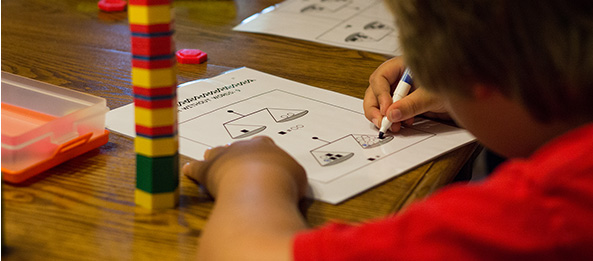
photo by danielrmccarthy
photo by Dan McCarthy (cc-by)

After teaching co-op math classes for several years, I’ve become known as the local math maven. Upon meeting one of my children, fellow homeschoolers often say, “Oh, you’re Denise’s son/daughter? You must be really good at math.”

The kids do their best to smile politely — and not to roll their eyes until the other person has turned away.

I hear similar comments after teaching a math workshop: “Wow, your kids must love math!” But my children are individuals, each with his or her own interests. A couple of them enjoy an occasional geometry or logic puzzle, but they never voluntarily sit down to slog through a math workbook page.

In fact, one daughter expressed the depth of her youthful perfectionist angst by scribbling all over the cover of her Miquon math workbook:

  • “I hate math! Hate, hate, hate-hate-HATE MATH!!!”

Translation: “If I can’t do it flawlessly the first time, then I don’t want to do it at all.”

photo by Jason Bolonski (cc-by)

Continue reading How to Recognize a Successful Homeschool Math Program

Hundred Chart Idea #28: Hang It on the Wall

Math is beautiful when it communicates an abstract idea clearly and provides new insight. Yelena’s hundred chart poster does just that:

[From the Moebius Noodles blog]

Check out my newest home decor item, a hundred chart. The amount of work I put into it, I consider getting it framed to be proudly displayed in the living room. The thing is monumental in several ways:

1. It is monumentally different from my usual approach to choosing math aids. My rule is if it takes me more than 5 minutes to prepare a math manipulative, I skip it and find another way.

2. It is monumentally time-consuming to create from scratch all by yourself.

3. It is monumentally fun to show to a child.

— Yelena McManaman
Moebius Noodles

Now she’s provided a fantastic set of free hundred chart printables:

Thanks, Yelena!

Share Your Ideas

It began with a humble list of seven things in the first (now out of print) edition of my book about teaching home school math. Over the years I added new ideas, and online friends contributed, too, so the list grew to become one of the most popular posts on my blog:

Can you think of anything else we might do with a hundred chart? Add your ideas in the Comments section below, and I’ll add the best ones to our master list.

Let’s Play Math Book Update

I love math, but had forgotten why I developed a love for math in the first place. This book made me realize how experiences in my childhood lit a spark in me … Denise Gaskins shows us how we can ignite this fire in our own children.

I believe her suggestions are invaluable for homeschoolers, but essential for the many parents whose children are learning to dislike math in school.

— Carrie
Review at Amazon.com, December 1, 2012

If you’ve wavered on whether to pick up my math book, be warned: This is the last month for the introductory sale price. In January, the ebook price will go up to $5.99.

Continue reading Let’s Play Math Book Update

Welcome, TIME Readers!

[Photo by Luis Argerich via flickr.]

If you’ve come here from Bonnie Rochman’s article, Bedtime Math: A Problem a Day Keeps Fear of Arithmetic Away, thank you for dropping in! I have nearly 800 published posts about learning and teaching math, which can seem pretty overwhelming.

Here are a few good places to start:

  • Tell Me a (Math) Story
    What better way could there be to do math than snuggled up on a couch with your little one, or side by side at the sink while your middle-school student helps you wash the dishes, or passing the time on a car ride into town?
  • Homeschooling with Math Anxiety Series
    Our childhood struggles with schoolwork gave most of us a warped view of mathematics. Yet even parents who suffer from math anxiety can learn to enjoy math with their children.
  • How to Conquer the Times Table
    Challenge your student to a joint experiment in mental math. Over the next two months, without flashcards or memory drill, how many math facts can the two of you learn together? We will use the world’s oldest interactive game — conversation — to explore multiplication patterns while memorizing as little as possible.

I hope you enjoy your visit to my blog.

10 Questions to Ask About a Math Problem

[Photo by CourtneyCarmody via flickr.]

It’s important to teach our children to ask questions, about math and about life. As I wrote in my series about homeschooling with math anxiety, “School textbooks only ask questions for which they know the answer. When homeschoolers learn to think like mathematicians, we will ask a different type of question.”

So I was delighted to see this new post from Bon Crowder: Ten Questions to Ask About a Math Problem. Click the link and read the whole thing!

Why a list of questions about math problems? Before creating them, I decided the questions should do the following:

  • Allow the student to dig in deeper to the math problem, and the math behind the problem.
  • Help the student to think about the problem in ways they wouldn’t normally.
  • Let the student get creative in thinking about the problem.

And of course doing these things regularly will train them to continue to do this with all math problems through their lives.

— Bon Crowder
Ten Questions to Ask About a Math Problem

PUFM 1.5 Multiplication, Part 2

Poster by Maria Droujkova of NaturalMath.com. In this Homeschooling Math with Profound Understanding (PUFM) Series, we are studying Elementary Mathematics for Teachers and applying its lessons to home education.

Multiplication is taught and explained using three models. Again, it is important for understanding that students see all three models early and often, and learn to use them when solving word problems.

— Thomas H. Parker & Scott J. Baldridge
Elementary Mathematics for Teachers

I hope you are playing the Tell Me a (Math) Story game often, making up word problems for your children and encouraging them to make up some for you. As you play, don’t fall into a rut: Keep the multiplication models from our lesson in mind and use them all. For even greater variety, use the Multiplication Models at NaturalMath.com to create your word problems.

Continue reading PUFM 1.5 Multiplication, Part 2

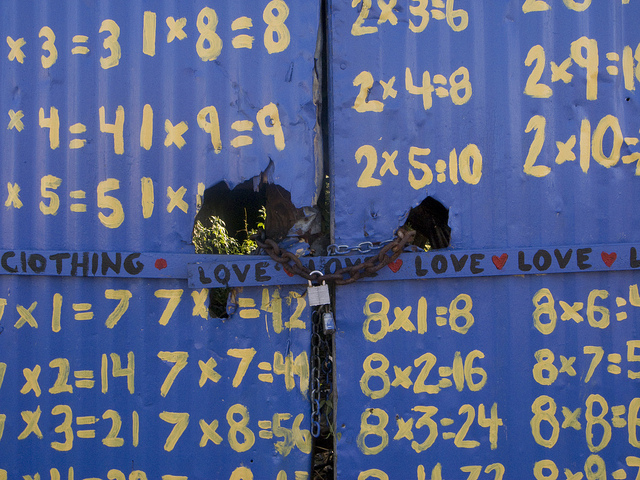
Trouble with Times Tables

[feature photo above by dsb nola via flickr.]

Food for thought:

Imagine that you wanted your children to learn the names of all their cousins, aunts and uncles. But you never actually let them meet or play with them. You just showed them pictures of them, and told them to memorize their names.

Each day you’d have them recite the names, over and over again. You’d say, “OK, this is a picture of your great-aunt Beatrice. Her husband was your great-uncle Earnie. They had three children, your uncles Harpo, Zeppo, and Gummo. Harpo married your aunt Leonie … yadda, yadda, yadda.

— Brian Foley
Times Tables – The Worst Way to Teach Multiplication

On the other hand, if you want your children to develop relationships with the numbers, to learn the math facts naturally, then be sure to tell lots of math stories. And when you are ready to focus on multiplication, be sure to study the patterns and relationships within the times tables.