Math rebels believe in Truth. We refuse to accept something just because the teacher or textbook says it. We want to see the connections between math concepts and to understand why things work.
Math rebels care about Justice. We resist society’s push for speed and conformity. We reject the cultural narrative that math has only One Right Answer.
Math rebels celebrate Creative Reasoning. We delight in finding new ways to look at math topics. We want to think deeply about ideas, and we are confident in our ability to figure things out.
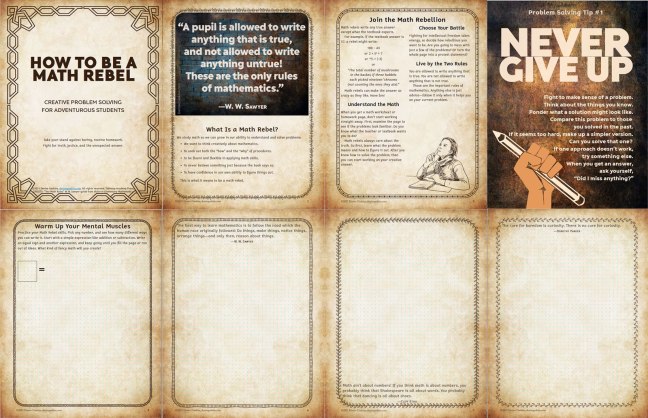
Launch your family’s math rebellion today with my free printable PDF booklet, “How To Be a Math Rebel,” available only on the Make 100 Math Rebels Kickstarter page.
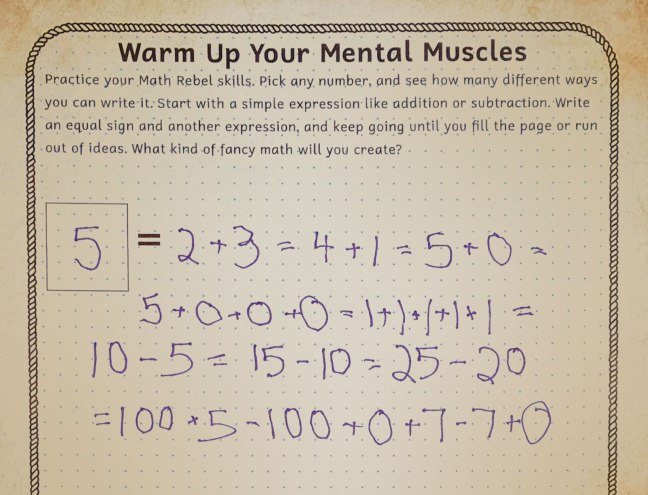
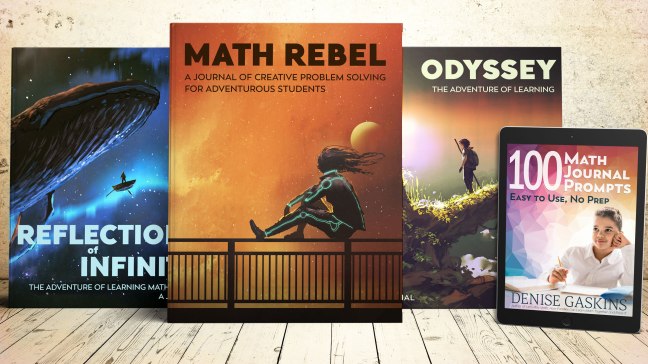
Journaling is a fantastic way to learn and remember any topic — including math. That’s why I created my dot grid journals for kids and adults.
But I just discovered that my printer hates journals and blank books. They refuse to publish them any more.
How frustrating!
So from now on, you can only get my math journals from Amazon. The largest-river-in-the-world store doesn’t mind dot grid pages (so far).
Silver Lining: Because the books aren’t available to regular bookstores, I don’t have to allow for the traditional bookstore discount. Which means I can cut the prices. By a LOT — the new prices are 30% off the original cost of the books!
This afternoon, I’ve been working on the printable pdf math activity booklets I’ll be sending out as stretch goals to the backers of my Math You Can Play Kickstarter campaign.
Some of the booklets include dot grid pages for student journaling.
I love dot grid pages for writing because I can start a line anywhere on the page, and the dots help me keep things in line. (They’re also great for doodling.)
As students wrestle their thoughts into shape and create explanations, they do the same sort of work that mathematicians do every day. It’s difficult for children (or anyone) to pin down a thought and put it into words. But it’s great practice for life.
Journaling is a great practice for adult learners, too — and don’t we all want to be lifelong learners?
So I thought I’d share the journaling pages with you all, in case you’d like to get your children writing about math. There are three styles, ranging from plain to ornate parchment. Enjoy!
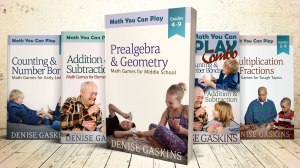
UPDATE: The Kickstarter deals have ended, but my playful math books are still available through your favorite online store or by special order at your local bookshop. (Except for the Prealgebra & Geometry Games book, scheduled for publication in early 2021. Sign up for my email list to get the latest news.)
This fall, my homeschool co-op math class will play with math journaling.
But my earlier dot-grid notebooks were designed for adults. Too thick, too many pages. And the half-cm dot grid made lines too narrow for young writers.
So I created a new series of paperback dot-grid journals for my elementary and middle school students.
I’m sure we’ll use several of these activities in my homeschool co-op math class this fall.
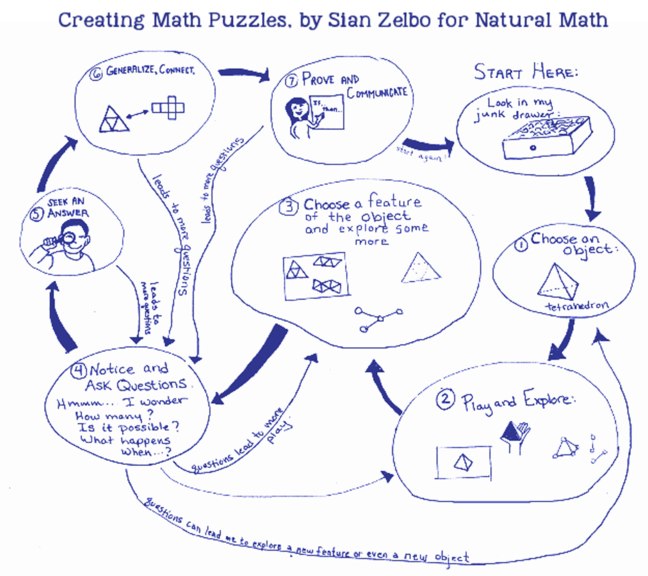
Noticing and Wondering
Learning math requires more than mastering number facts and memorizing rules. At its heart, math is a way of thinking.
So more than anything else, we need to teach our kids to think mathematically — to make sense of math problems and persevere in figuring them out.
Help your children learn to see with mathematical eyes, noticing and wondering about math problems.
Whenever your children need to learn a new idea in math, or whenever they get stuck on a tough homework problem, that’s a good time to step back and make sense of the math.
Kids can write their noticings and wonderings in the math journal. Or you can act as the scribe, writing down (without comment) everything child says.
For more tips on teaching students to brainstorm about math, check out these online resources from The Math Forum:
Problem-solving is a habit of mind that you and your children can learn and grow in. Help your kids practice slowing down and taking the time to fully understand a problem situation.
Puzzles Are Math Experiments
Almost anything your child notices or wonders can lead to a math experiment.
For example, one day my daughter played an online math game…
A math journal can be like a science lab book. Not the pre-digested, fill-in-the-blank lab books that some curricula provide. But the real lab books that scientists write to keep track of their data, and what they’ve tried so far, and what went wrong, and what finally worked.
Here are a few open-ended math experiments you might try:
Explore Shapes
Pick out a 3×3 set of dots. How many different shapes can you make by connecting those dots? Which shapes have symmetry? Which ones do you like the best?
What if you make shapes on isometric grid paper? How many different ways can you connect those dots?
Limit your investigation to a specific type of shape. How many different triangles can you make on a 3×3 set of dots? How many different quadrilaterals? What if you used a bigger set of dots?
Explore Angles
On your grid paper, let one dot “hold hands” with two others. How many different angles can you make? Can you figure out their degree without measuring?
Are there any angles you can’t make on your dot grid? If your paper extended forever, would there be any angles you couldn’t make?
Does it make a difference whether you try the angle experiments on square or isometric grid paper?
Explore Squares
How many different squares can you draw on your grid paper? (Don’t forget the squares that sit on a slant!) How can you be sure that they are perfectly square?
Number the rows and columns of dots. Can you find a pattern in the corner positions for your squares? If someone drew a secret square, what’s the minimum information you would need to duplicate it?
Does it make a difference whether you try the square experiments on square or isometric grid paper?
I’d love to hear your favorite math explorations or journaling tips!

Please share in the comments section below.
* * *
P.S.: Do you have a blog? If you’d like to feature a math journal review and giveaway, I’ll provide the prize. Send a message through my contact form or leave a comment below, and we’ll work out the details.
This blog is reader-supported.
If you’d like to help fund the blog on an on-going basis, then please head to my Patreon page.
If you liked this post, and want to show your one-time appreciation, the place to do that is PayPal: paypal.me/DeniseGaskinsMath. If you go that route, please include your email address in the notes section, so I can say thank you.
The more years we spent homeschooling, the more I appreciated Charlotte Mason’s work and tried to incorporate her ideas into our laid-back, eclectic, not-quite-unschooling program.
We never fit the typical Charlotte Mason mold. Mosquitos and natural laziness limited our nature walks, and our version of narration was much too informal.
But those are just techniques, methods.
What really interests me in Mason’s writing is the philosophy behind the methods. Two points resonated: That we must respect our children as persons in their own right. And that we must provide a generous, wide-ranging feast to their minds.
Striving to live out those principles had a profound influence on our day-to-day homeschooling.
I love my new paperback math journal series. The books are sturdy, inexpensive, and fit nicely in my purse.
But as with any paperback book, these have one problem. How do I use them without cracking the spine?
When we exercise, we need to warm up our bodies with a bit of stretching to prevent injury. In the same way, we need to warm up a new book to protect it. The process is called “breaking it in.”
It only takes a few minutes to break in a paperback book:
Step by Step
Never force the book but help it limber up gradually, and it will serve you well.
Because my journals are working books, I take the breaking-in process a bit further than shown in the video:
(1) Set the book on its back and follow the process above. Press down each cover, but not completely flat — let it bend at the fold line, about 1 cm from the actual spine. Then press a couple pages at a time, alternating front and back, down flat on each cover.
(2) Flip through the pages of the book forward and backward to limber them up.
(3) Repeat the steps of the video. This time, gently lean the main part of the book away from the part you are pressing down. Aim for a 130–140 degree angle.
(4) Flip through the pages again. For paperbacks, you can even roll the whole book back and forth a bit — gently curving the cover and pages almost as if you’re trying to fold the book in half — to encourage flexibility.
(5) Optional: Repeat the breaking-in process one more time. This time, fold each section back as close to 180 degrees as it will go.
And you’re done!
The pages will still curve in at the fold line, where they connect to the spine of the book. You want that because it makes the book strong. But now they’ll also open up to provide a nice, wide area for writing or math doodling.
Doodling gives our minds a chance to relax, wander, and come back to our work refreshed. And though it goes against intuition, doodling can help us remember more of what we learn.
Math doodles let us experiment with geometric shapes and symmetries. We can feel our way into math ideas gradually, through informal play. Through doodles, our students will explore a wide range of mathematical structures and relationships.
Our own school experiences can make it hard for us to teach. What we never learned in school was the concept of playing around with math, allowing ideas to “percolate,” so to speak, before mastery occurs, and that process may take time.
—Julie Brennan
I like to doodle on dotty grid paper, like the pages in my math journals, but there’s No Purchase Necessary! You can design your own printable dot page at Incompetech’s PDF generator.
Patterns in Shape and Angle
To make a faceted mathematical gemstone, start with any shape you like. Then build other shapes around it. What do you notice? Does your pattern grow outward from its center? Or flow around the corner of your page? How is each layer similar, and how is it different?
Arbitrary constraints can lead to mathematically interesting doodles. For instance, create a design out of 45-45-90 triangles by coloring exactly half of every grid square. How many variations can you find?
Symmetry Challenge
Play a symmetry puzzle game. Draw a line of symmetry and fill in part of the design. Then trade with a partner to finish each other’s doodles.
Make more complex symmetry puzzles with additional reflection lines.
Math Doodle Links
Who can talk about mathematical doodling without mentioning Vi Hart? If you’ve never seen her “Doodling in Math Class” video series, you’re in for a treat!
Or experiment with the more flexible rules in John’s “Knot Fun” lesson.
And my latest obsession: the “ultimate” tutorial series on Celtic Knotwork, which explores the link between knots and their underlying graphs.
Finally, check out my Math Doodling board at Pinterest.
My favorite knot doodle so far.Inspirations: A Recreational Mathematics JournalReflections: A Math Teacher’s JournalExplorations: A Math Student’s JournalContemplations: A Homeschooler’s Journal
In addition to all the funny Google searches, I get plenty of normal inquiries about math topics. People come here looking for help with fractions, wordproblems, and mathclubactivities — no surprise, those — but I would never have predicted the popularity of the search topic “writing in math class.”
Last year, I compiled a variety of math journal resources, but I’ve found many more since then, especially for older (high school and college) students. So if you’re looking for new ways to get your math students writing…
Do you ever take your kids’ math tests? It helps me remember what it is like to be a student. I push myself to work quickly, trying to finish in about 1/3 the allotted time, to mimic the pressure students feel. And whenever I do this, I find myself prone to the same stupid mistakes that students make.
Even teachers are human.
In this case, it was a multi-step word problem, a barrage of information to stumble through. In the middle of it all sat this statement:
…and there were 3/4 as many dragons as gryphons…
My eyes saw the words, but my mind heard it this way:
…and 3/4 of them were dragons…
What do you think — did I get the answer right? Of course not! Every little word in a math problem is important, and misreading even the smallest word can lead a student astray. My mental glitch encompassed several words, and my final tally of mythological creatures was correspondingly screwy.
But here is the more important question: Can you explain the difference between these two statements?
Math journal entries can be as simple as class notes, or they can be research projects that take hours of experimentation and pondering. Students may use the journal to store their thoughts as they work several days to solve a challenge problem of the week, or they might jot down quick reflections about what they learned in today’s math class.