The (Mathematical) Trouble with Pizza

Photo by George Parrilla via flickr.

Kitten complained that some math programs keep repeating the same kind of problems over and over, with bigger numbers: “They don’t get any harder, they just get longer. It’s boring!”
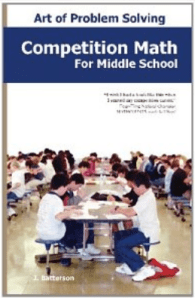
So we pulled out the Counting lessons in Competition Math for Middle School. [Highly recommended book!] Kitten doesn’t like to compete, but she enjoys learning new ideas, and Batterson’s book gives her plenty of those, well organized and clearly explained.

Today’s topic was the Fundamental Counting Principle. It was review, easy-peasy. The problems were too simple, until…

Pizzas at Mario’s come in three sizes, and you have your choice of 10 toppings to add to the pizza. You may order a pizza with any number of toppings (up to 10), including zero. How many choices of pizza are there at Mario’s?

[The book said 9 toppings, but I was skimming/paraphrasing aloud and misread.]

  • Can you figure out the answer?
Continue reading The (Mathematical) Trouble with Pizza

2011 Mathematics Game

[Photo from Wikipedia.]

Two of the most popular New Year’s Resolutions are to spend more time with family and friends, and to get more exercise. The 2011 Mathematics Game is a chance to do both at once.

So grab a partner, slip into your workout clothes, and pump up those mental muscles!

Here are the rules:

Use the digits in the year 2011 to write mathematical expressions for the counting numbers 1 through 100.

  • All four digits must be used in each expression. You may not use any other numbers except 2, 0, 1, and 1.
  • You may use the arithmetic operations +, -, x, ÷, sqrt (square root), ^ (raise to a power), and ! (factorial). You may also use parentheses, brackets, or other grouping symbols.
  • You may use a decimal point to create numbers such as .1, .02, etc.
  • Multi-digit numbers such as 20 or 102 may be used, but preference is given to solutions that avoid them.

Bonus Rules
You may use the overhead-bar (vinculum), dots, or brackets to mark a repeating decimal.

You may use multifactorials:

  • (n!)! = a factorial of a factorial, which is not the same as a multifactorial
  • n!! = a double factorial = the product of all integers from 1 to n that have the same parity (odd or even) as n
  • n!!! = a triple factorial = the product of all integers from 1 to n that are equal to n mod 3

[Note to teachers: The bonus rules are not part of the Math Forum guidelines. They make a significant difference in the number of possible solutions, however, and they should not be too difficult for high school students or advanced middle schoolers.]

Continue reading 2011 Mathematics Game

Rate Puzzle: How Fast Does She Read?


[Photo by Arwen Abendstern.]

If a girl and a half
can read a book and a half
in a day and a half,
then how many books can one girl read in the month of June?

Kitten reads voraciously, but she decided to skip our library’s summer reading program this year. The Border’s Double-Dog Dare Program was a lot less hassle and had a better prize: a free book! Of course, it didn’t take her all summer to finish 10 books.

How fast does Kitten read?

Continue reading Rate Puzzle: How Fast Does She Read?

Hobbit Math: Elementary Problem Solving 5th Grade

[Photo by OliBac. Visit OliBac’s photostream for more.]

The elementary grades 1-4 laid the foundations, the basics of arithmetic: addition, subtraction, multiplication, division, and fractions. In grade 5, students are expected to master most aspects of fraction math and begin working with the rest of the Math Monsters: decimals, ratios, and percents (all of which are specialized fractions).

Word problems grow ever more complex as well, and learning to explain (justify) multi-step solutions becomes a first step toward writing proofs.

This installment of my elementary problem solving series is based on the Singapore Primary Mathematics, Level 5A. For your reading pleasure, I have translated the problems into the world of J.R.R. Tolkien’s classic, The Hobbit.

UPDATE: Problems have been genericized to avoid copyright issues.

Continue reading Hobbit Math: Elementary Problem Solving 5th Grade

The Cookie Factory Guide to Long Division

[Photo by scubadive67.]

Help! My son was doing fine in math until he started long division, but now he’s completely lost! I always got confused with all those steps myself. How can I explain it to him?

Long division. It’s one of the scariest of the Math Monsters, those tough topics of upper-elementary and middle school mathematics. Of all the topics that come up on homeschool math forums, perhaps only one (“How can I get my child to learn the math facts?”) causes parents more anxiety.

Most of the “helpful advice” I’ve seen focuses on mnemonics (“Dad/Mother/Sister/Brother” to remember the steps: Divide, Multiply, Subtract, Bring down) or drafting (turn your notebook paper sideways and use the lines to keep your columns straight).

I worry that parents are too focused on their child mastering the algorithm, learning to follow the procedure, rather than on truly understanding what is happening in long division.

An algorithm is simply a step-by-step recipe for doing a mathematical calculation. But WHY does the algorithm work? If our students could understand the reason for the steps, they wouldn’t have to work so hard on memory tricks.

Continue reading The Cookie Factory Guide to Long Division

Review: Math Mammoth

When Maria of Homeschool Math Blog asked if I would review her Math Mammoth curriculum, I jumped at the chance. I’ve always enjoyed her blog posts, and I liked the worksheets I had seen on her website. (Maria gives away more than 300 pages absolutely free!)

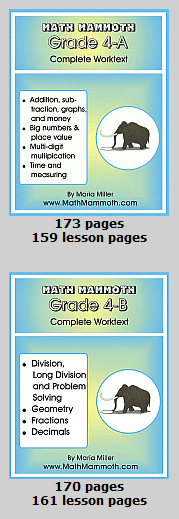
She sent me her then-new 4th grade worktexts, and Kitten and I dug in.
Well, that was longer ago than I care to admit. But of course, it takes quite a bit of daily use before one can be absolutely sure of one’s opinion about a homeschool program — or at least, it does for me. Too many times a homeschool resource will look great in the catalog, and we’ll start it with high hopes only to bog down in the day-to-day grind and abandon it after a few weeks or months. So I wanted to give Math Mammoth a thorough workout before I wrote this review.

And all excuses aside, I really am a pro at crastinating

My aim is to help parents and teachers teach math so our children and students can really understand what is going on. I’ve strived to explain the concepts so that both the teacher and the student can “get it” by reading the explanations in the books.

— Maria Miller
author of Math Mammoth worktexts
and Homeschool Math Blog

Continue reading Review: Math Mammoth

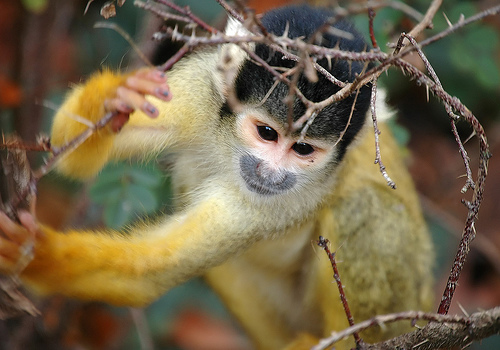
Prime Numbers Are like Monkeys

[Photo by mape_s.]

I’m afraid that Math Club may have fallen victim to the economy, which is worse in our town than in the nation in general. Homeschooling families have tight budgets even in the best of times, and now they seem to be cutting back all non-essentials. I assumed that last semester’s students would return, but I should have asked for an RSVP.

Still, Kitten and I had a fun time together. We played four rounds of Tens Concentration, since I had spread out cards on the tables in the library meeting room before we realized that no one was coming. Had to pick up the cards one way or another, so we figured we might as well enjoy them! She won the first two rounds, which put her in a good mood for our lesson.

I had written “Prime numbers are like monkeys!” on the whiteboard, and Kitten asked me what that meant. That was all the encouragement I needed to launch into my planned lesson, despite the frustrating dearth of students. The idea is taken from Danica McKellar’s book Math Doesn’t Suck.

Continue reading Prime Numbers Are like Monkeys