Memorizing the Math Facts

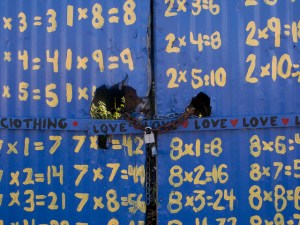
Central City Times Tables[Photo by dsb nola via flickr. (CC BY 2.0)]

The most effective and powerful way I’ve found to commit math facts to memory is to try to understand why they’re true in as many ways as possible. It’s a very slow process, but the fact becomes permanently lodged, and I usually learn a lot of surrounding information as well that helps me use it more effectively.

Actually, a close friend of mine describes this same experience: he couldn’t learn his times tables in elementary school and used to think he was dumb. Meanwhile, he was forced to rely on actually thinking about number relationships and properties of operations in order to do his schoolwork. (E.g. I can’t remember 9×5, but I know 8×5 is half of 8×10, which is 80, so 8×5 must be 40, and 9×5 is one more 5, so 45. This is how he got through school.) Later, he figured out that all this hard work had actually given him a leg up because he understood numbers better than other folks. He majored in math in college and is now a cancer researcher who deals with a lot of statistics.

Ben Blum-Smith
Comment on Math Mama’s post What must be memorized?

The entire discussion (article and comments) is well worth reading:

You may also enjoy:

Review Game: Once Through the Deck

Math Concepts: basic facts of addition, multiplication.
Players: one.
Equipment: one deck of math cards (poker- or bridge-style playing cards with the face cards and jokers removed).

The best way to practice the math facts is through the give-and-take of conversation, orally quizzing each other and talking about how you might figure the answers out. But occasionally your child may want a simple, solitaire method for review.

Continue reading Review Game: Once Through the Deck

Math Games with Factors, Multiples, and Prime Numbers

Students can explore prime and non-prime numbers with these free favorite classroom games:

For $15-20 you can buy a downloadable file of the beautiful, colorful, mathematical board game Prime Climb. Or pick up the full Prime Climb game box at Amazon.

Or you can try the following game by retired Canadian education professor Jerry Ameis:

Factor Finding Game

FactorFindingGame

Math Concepts: multiples, factors, composite numbers, and primes.
Players: only two.
Equipment: pair of 6-sided dice, 10 squares each of two different colors construction paper, and the game board (click the image to print it, or copy by hand).

On your turn, roll the dice and make a 2-digit number. Use one of your colored squares to mark a position on the game board. You can only mark one square per turn.

  • If your 2-digit number is prime, cover a PRIME square.
  • If any of the numbers showing are factors of your 2-digit number, cover one of them.
  • BUT if there’s no square available that matches your number, you lose your turn.

The first player to get three squares in a row (horizontal, vertical, or diagonal) wins. Or for a harder challenge, try for four in a row.

 
* * *

This game was featured in the Math Teachers At Play (MTaP) math education blog carnival: MTaP #79. Hat tip: Jimmie Lanley.

This blog is reader-supported.

If you’d like to help fund the blog on an on-going basis, then please join me on Patreon for mathy inspiration, tips, and an ever-growing archive of printable activities.

If you liked this post, and want to show your one-time appreciation, the place to do that is PayPal: paypal.me/DeniseGaskinsMath. If you go that route, please include your email address in the notes section, so I can say thank you.

Which I am going to say right now. Thank you!

“Math Games with Factors, Multiples, and Prime Numbers” copyright © 2015 by Denise Gaskins. Image at the top of the post copyright © Jimmie via flickr (CC BY 2.0).

Reblog: A Mathematical Trauma

Feature photo (above) by Jimmie via flickr.

My 8-year-old daughter’s first encounter with improper fractions was a bit more intense than she knew how to handle.

I hope you enjoy this “Throw-back Thursday” blast from the Let’s Play Math! blog archives:


Photo (right) by Old Shoe Woman via Flickr.

Nearing the end of Miquon Blue today, my youngest daughter encountered fractions greater than one. She collapsed on the floor of my bedroom in tears.

The worksheet started innocently enough:

\frac{1}{2} \times 8=\left[ \quad \right]

[Click here to go read the original post.]

Multiplication Models Card Game

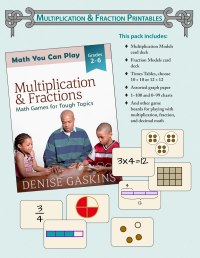
multfrac-300Update: An expanded version of this post is featured in my book Multiplication & Fractions: Math Games for Tough Topics, available now at your favorite online book dealer.

Homeschooling parents know that one of the biggest challenges for any middle-elementary math student is to master the multiplication facts. It can seem like an unending task to memorize so many facts and be able to pull them out of mental storage in any order on demand.

Too often, we are tempted to stress the rote aspect of such memory work, which makes our children lose their focus on what multiplication really means. Before practicing the times table facts, make sure your student gets plenty of practice recognizing and using the common models for multiplication.

To help your children see what multiplication looks like in real life, explore the multitude of Multiplication Models collected at the Natural Math website. Or sign up for their Multiplication Explorers Online Course.

You may want to pick up this poster and use it for ideas as you play the Tell Me a (Math) Story game. Word problems are important for children learning any new topic in math, because they give children a mental “hook” on which to hang the abstract number concepts.

And for extra practice, you can play my free card game…

Click here to continue reading.

Things To Do with a Hundred Chart #29

100chart puzzle

Here’s a new entry for my 20+ Things to Do with a Hundred Chart post:

(29) Blank 100 Grid Number Investigations: Challenge your students to deduce the secret behind each pattern of shaded squares. Then have them make up pattern puzzles of their own.
[Created by Stuart Kay. Free registration required to download pdf printable.]

Share Your Ideas

Can you think of anything else we might do with a hundred chart? Add your ideas in the Comments section below, and I’ll add the best ones to our master list.

What Do You Notice? What Do You Wonder?

Drawing Star

If you want your children to understand and enjoy math, you need to let them play around with beautiful things and encourage them to ask questions.

Here is a simple yet beautiful thing I stumbled across online today, which your children may enjoy:

It reminds me of string art designs, but the app makes it easy to vary the pattern and see what happens.

  • What do your students notice about the patterns?
  • What questions can they ask?

I liked the way the app uses “minutes” as the unit that describes the star you want the program to draw. That makes it easier (for me, at least) to notice and understand the patterns, since minutes are a more familiar and intuitive unit than degrees, let alone radians.

Continue reading What Do You Notice? What Do You Wonder?

PUFM 1.5 Multiplication, Part 2

Poster by Maria Droujkova of NaturalMath.com. In this Homeschooling Math with Profound Understanding (PUFM) Series, we are studying Elementary Mathematics for Teachers and applying its lessons to home education.

Multiplication is taught and explained using three models. Again, it is important for understanding that students see all three models early and often, and learn to use them when solving word problems.

— Thomas H. Parker & Scott J. Baldridge
Elementary Mathematics for Teachers

I hope you are playing the Tell Me a (Math) Story game often, making up word problems for your children and encouraging them to make up some for you. As you play, don’t fall into a rut: Keep the multiplication models from our lesson in mind and use them all. For even greater variety, use the Multiplication Models at NaturalMath.com to create your word problems.

Continue reading PUFM 1.5 Multiplication, Part 2