Quotable: Times Tables Are Not Math

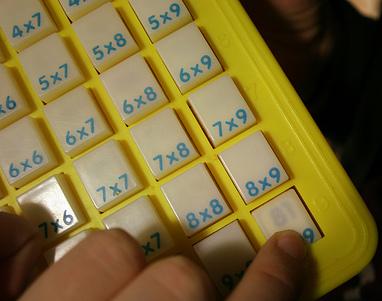
Important note: times tables are not math. Math doesn’t need to be made fun; it already is fun. Memorizing your times tables is a rote activity, it requires a fair bit of repetition for most, and it may need to be made fun. Just saying.

Dan Finkel
A game to end all times tables drills: Damult Dice

It’s a great game! Do click over to Dan’s blog and check it out:

And while we’re on the topic of times tables, Maria posted an article, too:

Game: Target Number (or 24)

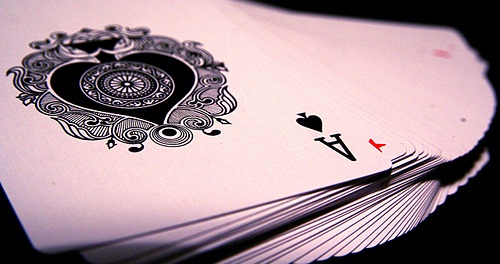
[Photo by stevendepolo via Flickr (CC BY 2.0).]

Math concepts: addition, subtraction, multiplication, division, powers and roots, factorial, mental math, multi-step thinking
Number of players: any number
Equipment: deck of math cards, pencils and scratch paper, timer (optional)

Set Up

All players must agree on a Target Number for the game. Try to choose a number that has several factors, which means there will be a variety of ways to make it. Traditionally, I start my math club students with a target of 24.

Shuffle the deck, and deal four cards face down to each player. (For larger target numbers, such as 48 or 100, deal five or six cards to each player.) The players must leave the cards face down until everyone is ready. Set the remainder of the deck to one side.

Continue reading Game: Target Number (or 24)

Prime Numbers Are like Monkeys

[Photo by mape_s.]

I’m afraid that Math Club may have fallen victim to the economy, which is worse in our town than in the nation in general. Homeschooling families have tight budgets even in the best of times, and now they seem to be cutting back all non-essentials. I assumed that last semester’s students would return, but I should have asked for an RSVP.

Still, Kitten and I had a fun time together. We played four rounds of Tens Concentration, since I had spread out cards on the tables in the library meeting room before we realized that no one was coming. Had to pick up the cards one way or another, so we figured we might as well enjoy them! She won the first two rounds, which put her in a good mood for our lesson.

I had written “Prime numbers are like monkeys!” on the whiteboard, and Kitten asked me what that meant. That was all the encouragement I needed to launch into my planned lesson, despite the frustrating dearth of students. The idea is taken from Danica McKellar’s book Math Doesn’t Suck.

Continue reading Prime Numbers Are like Monkeys

Math Facts: 5 Minutes a Day

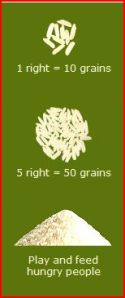
free-rice-image

Y of x reminded me about one of my old favorite websites for math fact practice with a purpose:

5-10 minutes of daily practice will cement the math facts in your student’s mind, while at the same time doing a good deed. For each correct answer, a Free Rice sponsor donates a very small amount of rice to feed hungry people worldwide through the UN World Food Program.

Even very small amounts of rice add up. Since Free Rice started in 2007, its sponsors have bought more than 63 billion grains of rice, just by paying for one right answer click at a time.

You and your students can practice other topics as well:

Continue reading Math Facts: 5 Minutes a Day

Cute Math Facts for Visual Thinkers

numberwalk[Photo by angela7dreams.]

A forum friend posted about her daughter’s adventure in learning the math facts:

“She loves stories and drawing, so I came up with the Math Friends book. She made a little book, and we talked about different numbers that are buddies.”

Continue reading Cute Math Facts for Visual Thinkers

Contig Game: Master Your Math Facts

[Photo by Photo Mojo via Flickr (CC BY 2.0).]

Yahtzee and other board games provide a modicum of math fact practice. But for intensive, thought-provoking math drill, I can’t think of any game that would beat Contig.

Math concepts: addition, subtraction, multiplication, division, order of operations, mental math
Number of players: 2 – 4
Equipment: Contig game board, three 6-sided dice, pencil and scratch paper for keeping score, and bingo chips or wide-tip markers to mark game squares

Set Up

Place the game board and dice between players, and give each player a marker or pile of chips. (Markers do not need to be different colors.) Write the players’ names at the top of the scratch paper to make a score sheet.

Continue reading Contig Game: Master Your Math Facts

30+ Things to Do with a Hundred Chart

[Photo by geishaboy500 via Flickr (CC BY 2.0).]

Are you looking for creative ways to help your children study math? Even without a workbook or teacher’s manual, your kids can learn a lot about numbers. Just spend an afternoon playing around with a hundred chart (also called a hundred board or hundred grid).

My free 50-page PDF Hundred Charts Galore! printables file features 1–100 charts, 0–99 charts, bottom’s-up versions, multiple-chart pages, blank charts, game boards, and more. Everything you need to play the activities below and those in my new 70+ Things to Do with a Hundred Chart book.

Download Free “Hundred Charts Galore!” Printables

Shop for “70+ Things To Do with a Hundred Chart” Book

And now, let’s play…

Continue reading 30+ Things to Do with a Hundred Chart

What’s Wrong with “Repeated Addition”?

[Photo by Alejandra Mavroski.]

Myrtle called it The article that launched a thousand posts…, and counting comments on this and several other blogs, that may not be too much of an exaggeration. Yet the discussion feels incomplete — I have not been able to put into words all that I want to say. Thus, at the risk of once again revealing my mathematical ignorance, I am going to try another response to Keith Devlin’s multiplication articles.

Let me state up front that I speak as a teacher, not as a mathematician. I am not qualified, nor do I intend, to argue about the implications of Peano’s Axioms. My experience lies primarily in teaching K-10, from elementary arithmetic through basic algebra and geometry. I remember only snippets of my college math classes, back in the days when we worried more about nuclear winter than global warming.

I will start with a few things we can all agree on…

Continue reading What’s Wrong with “Repeated Addition”?

Answers: Euclid’s Geometric Algebra

Remember the Math Adventurer’s Rule: Figure it out for yourself! Whenever I give a problem in an Alexandria Jones story, I will try to post the answer soon afterward. But don’t peek! If I tell you the answer, you miss out on the fun of solving the puzzle. So if you haven’t worked these problems yet, go back to the original post. Figure them out for yourself — and then check the answers just to prove that you got them right.

Euclid’s Geometric Algebra

Continue reading Answers: Euclid’s Geometric Algebra