Playful Math Snacks: Why Pi?

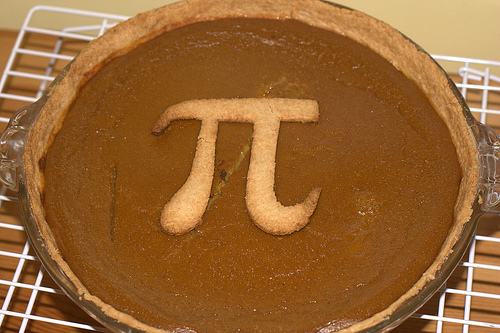
Photo by KaCey97078 (CC BY 2.0) via Flickr.
Photo by KaCey97078 (CC BY 2.0) via Flickr .

Teachers and other math nerds are preparing to celebrate an epic Pi Day on 3/14/15. Unfortunately, the activities I see on teacher blogs and Pinterest don’t include much actual math. They stress the pi/pie wordplay or memorizing the digits.

With a bit of digging, however, I found a couple of projects that let you sink your metaphorical teeth into real mathematical meat. So I put those in the March “Let’s Play Math” newsletter, which went out this morning to everyone who signed up for Tabletop Academy Press math updates.

If you’re not on the mailing list, you can still join in the fun:

A Preview

Math Snack: Why Pi?

In math, symmetry is beautiful, and the most completely symmetric object in the (Euclidean) mathematical plane is the circle. No matter how you turn it, expand it, or shrink it, the circle remains essentially the same. Every circle you can imagine is the exact image of every other circle there is.

This is not true of other shapes. A rectangle may be short or tall. An ellipse may be fat or slim. A triangle may be squat, or stand up right, or lean off at a drunken angle. But circles are all the same, except for magnification. A circle three inches across is a perfect, point-for-point copy of a circle three miles across, or three millimeters…
Pi Day Roundup

WhyPi

[Feature photo above by Nicolo’ Canali De Rossi.]

Math holiday alert: March 14th is Pi Day. But why limit ourselves to a single day? Playing with math should be a year-round adventure! Here are some ideas to help you celebrate…

Pi Day Posts on Let’s Play Math! Blog

DragonOfPi

Continue reading Pi Day Roundup

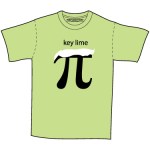
Key Lime Pi

This may be my favoritest ever Pi Day T-shirt, designed by the admin over at 10-Minute Math. I admit it’s not very mathy, but I’ve always enjoyed word play, and I love key lime.

The design won a Reflection T-shirt Company contest and is now available to pre-order for only $8.99 (plus shipping). [Company seems to have gone out of business? Can’t find their website…]

Unfortunately, it won’t be available in time for this Friday’s class.

Math History Tidbits: Agnesi, Euler, and China

Alexandria JonesI’ve fallen behind on my project of transcribing my Alexandria Jones stories. Finally, here are a few more tidbits from math history, along with links to relevant Internet sites and a few math puzzles for your students to try.

I hope you find them interesting.

Continue reading Math History Tidbits: Agnesi, Euler, and China

Math History on the Internet

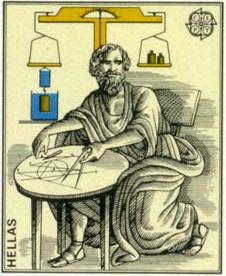
[Image from the MacTutor Archive.]

The story of mathematics is the story of interesting people. What a shame it is that our children see only the dry remains of these people’s passion. By learning math history, our students will see how men and women wrestled with concepts, made mistakes, argued with each other, and gradually developed the knowledge we today take for granted.

In a previous article, I recommended books that you may find at your local library or be able to order through inter-library loan. Now, let me introduce you to the wealth of math history resources on the Internet.

Continue reading Math History on the Internet

Happy Pi Day II

[Feature photo above by pauladamsmith.]

Now there is an ancient Greek letter,
And I think no other is better.
It isn’t too tall,
It might look very small,
But its digits, they go on forever.

— Scott
Mrs. Mitchell’s Virtual School

Time to Celebrate

Are your students doing anything special for \pi Day? After two months with no significant break, we are going stir crazy. We need a day off — and what better way could we spend it than to play math all afternoon?
If you need ideas, here are some great \pi pages:

Continue reading Happy Pi Day II

Egyptian Geometry and Other Challenges

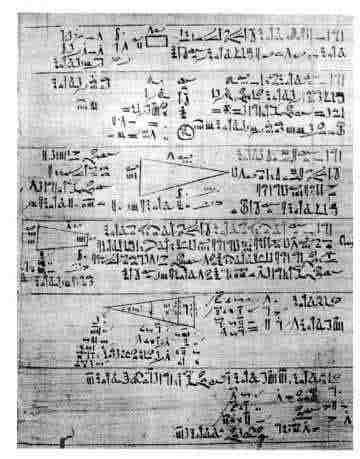
Rhind papyrus

Would you like to study “the knowledge of all existing things and all obscure secrets”? That is how Scribe Ahmose (also translated Ahmes) described his mathematical papyrus. Ahmose’s masterpiece is now called the Rhind Papyrus, after Alexander Henry Rhind, a Scotsman who was one of the first archaeologists to make meticulous records of his excavations (rather than simply hunting for treasures). Rhind purchased the papyrus from an antiquities dealer in Luxor, Egypt, in 1858.

Ahmose’s writing included a huge table of fractions as well as story problems, geometry, algebra, and accounting. Can you solve any of Scribe Ahmose’s problems?

Continue reading Egyptian Geometry and Other Challenges