I want to tell you a story. Everyone likes a story, right? But at the heart of my story lies a confession that I am afraid will shock many readers.
People assume that because I teach math, blog about math, give advice about math on internet forums, and present workshops about teaching math — because I do all this, I must be good at math.
How can we help children learn to think mathematically? Live by these four principles.
PTALSMP 1: Ask questions.
Ask why. Ask how. Ask whether your answer is right. Ask whether it makes sense. Ask what assumptions you have made, and whether an alternate set of assumptions might be warranted. Ask what if. Ask what if not.
PTALSMP 2: Play.
See what happens if you carry out the computation you have in mind, even if you are not sure it’s the right one. See what happens if you do it the other way around. Try to think like someone else would think. Tweak and see what happens.
PTALSMP 3: Argue.
Say why you think you are right. Say why you might be wrong. Try to understand how someone else sees things, and say why you think their perspective may be valid. Do not accept what others say is so, but listen carefully to it so that you can decide whether it is.
PTALSMP 4: Connect.
Ask how this thing is like other things. Try your ideas out on a new problem. Ask whether and how these ideas apply to other situations. Look for similarities and differences. Seek out the boundaries and limitations of your techniques.
— Christopher Danielson
And a Puzzle
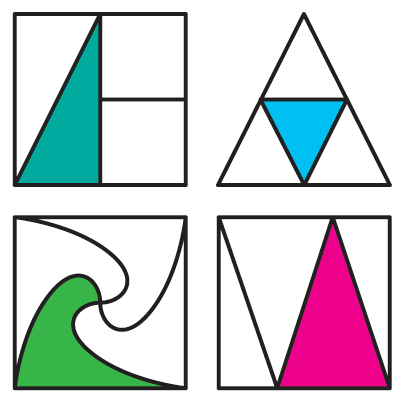
Practice applying Professor Triangleman’s Standards to the puzzle below. Which one doesn’t belong? Can you say why someone else might pick a different one?
Be clear on what you don’t know — and comfortable enough to admit it.
Seriously, those are wonderful videos. If you haven’t seen them before, go check them out. Be sure to come back, though, because I’ve just heard some great news.
Natural Problem-Solving Skills
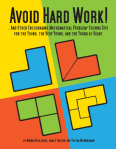
Tanton has joined up with the NaturalMath.com team of Maria Droujkova, Yelena McManaman, and Ever Salazar to put together a book for parents, teachers, math circle leaders, and anyone else who works with children ages 3–10.
It’s called Avoid Hard Work, and it takes a playful look at ten powerful problem-solving techniques.
Join the Crowdfunding Campaign
For more details about Avoid Hard Work, including a 7-page pdf sample with tips and puzzles to enjoy, check out the crowdfunding page at Natural Math:
Note to Readers: Please help me improve this list! Add your suggestions or additions in the comment section below…
What does it mean to think like a mathematician? From the very beginning of my education, I can do these things to some degree. And I am always learning to do them better.
(1) I can make sense of problems, and I never give up.
I always think about what a math problem means. I consider how the numbers are related, and I imagine what the answer might look like.
I remember similar problems I’ve done before. Or I make up similar problems with smaller numbers or simpler shapes, to see how they work.
I often use a drawing or sketch to help me think about a problem. Sometimes I even build a physical model of the situation.
I like to compare my approach to the problem with other people and hear how they did it differently.
There are two ways to do great mathematics. The first is to be smarter than everybody else. The second way is to be stupider than everybody else — but persistent.
How in the world can 1/5 be the same as 1/10? Or 1/80 be the same as one whole thing? Such nonsense!
No, not nonsense. This is real-world common sense from a couple of boys faced with a problem just inside the edge of their ability — a problem that stretches them, but that they successfully solve, with a bit of gentle help on vocabulary.
Here’s the problem:
How can you divide eight sausages evenly among five people?
Think for a moment about how you (or your child) might solve this puzzle, and then watch the video below.
Do you enjoy math? I hope so! If not, browsing this post just may change your mind.
Welcome to the 70th edition of the Math Teachers At Play math education blog carnival — a smorgasbord of 42+ links to bloggers all around the internet who have great ideas for learning, teaching, and playing around with math from preschool to pre-college. Let the mathematical fun begin!
By tradition, we start the carnival with a puzzle in honor of our 70th edition. But if you would like to jump straight to our featured blog posts, click here to see the Table of Contents.
A good problem should be more than a mere exercise; it should be challenging and not too easily solved by the student, and it should require some “dreaming” time.
Welcome to the Math Teachers At Play blog carnival — which is not just for math teachers! If you like to learn new things and play around with ideas, you are sure to find something of interest.
By tradition, we start the carnival with a couple of puzzles in honor of our 66th edition.
Let the mathematical fun begin!
Puzzle 1
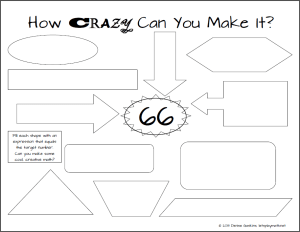
Our first puzzle is based on one of my favorite playsheets from the Miquon Math workbook series. Fill each shape with an expression that equals the target number. Can you make some cool, creative math?
Click the image to download the pdf playsheet set: one page has the target number 66, and a second page is blank so you can set your own target number.
 People assume that because I teach math, blog about math, give advice about math on internet forums, and present workshops about teaching math — because I do all this, I must be good at math.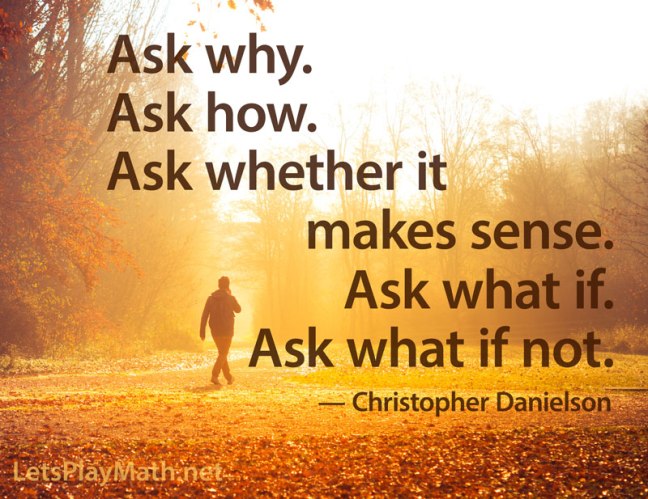

 Tanton has joined up with the NaturalMath.com team of Maria Droujkova, Yelena McManaman, and Ever Salazar to put together a book for parents, teachers, math circle leaders, and anyone else who works with children ages 3–10.





 Denise Gaskins' Let's Play Math