Nrich recently updated their amazing website. I love exploring their backlog of puzzles and games — what a mother lode of resources for math club or a homeschool co-op class!
Math Teachers at Play #52
[Photo by bumeister1 via flickr.]
Welcome to the Math Teachers At Play blog carnival — which is not just for math teachers! We have games, lessons, and learning activities from preschool math to calculus. If you like to learn new things and play around with mathematical ideas, you are sure to find something of interest.
Scattered between all the math blog links, I’ve included highlights from the Common Core Standards for Mathematical Practice, which describe the types of expertise that teachers at all levels — whether in traditional, experimental, or home schools — should seek to develop in their math students.
Let the mathematical fun begin…
TRY THESE PUZZLES
By tradition, we start the carnival with a couple of puzzles in honor of our 52nd edition. Since there are 52 playing cards in a standard deck, I chose two card puzzles from the Maths Is Fun Card Puzzles page:
- A blind-folded man is handed a deck of 52 cards and told that exactly 10 of these cards are facing up. How can he divide the cards into two piles (which may be of different sizes) with each pile having the same number of cards facing up?
- What is the smallest number of cards you must take from a 52-card deck to be guaranteed at least one four-of-a-kind?
The answers are at Maths Is Fun, but don’t look there. Having someone give you the answer is no fun at all!
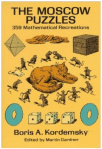
Sample The Moscow Puzzles
Dover Publications is offering a free sample chapter from The Moscow Puzzles.
Cat and Mice
Purrer has decided to take a nap. He dreams he is encircle by 13 mice: 12 gray and 1 white. He hears his owner saying: “Purrer, you are to eat each thirteenth mouse, keeping the same direction. The last mouse you eat must be the white one.”
More Free Math from Dover Publications
How Crazy Can You Make It?
And here is yet more fun from Education Unboxed. This type of page was always one of my my favorites in Miquon Math.
Update:
Handmade “How Crazy…?” worksheets are wonderful, but if you want something a tad more polished, I created a printable. The first page has a sample number, and the second is blank so that you can fill in any target:
Add an extra degree of freedom: students can fill in the blanks with equivalent and non-equivalent expressions. Draw lines anchoring the ones that are equivalent to the target number, but leave the non-answers floating in space.
Or don’t draw lines. Let the kids create a worksheet for you to solve. After they finish their expressions, can you figure out which ones connect to the target number?
Skit: Knights and Knaves Logic Puzzles
photo by puuikibeach via flickr
Our homeschool co-op held an end-of-semester assembly. Each class was supposed to demonstrate something they had learned. I planned to set up a static display showing some of our projects, like the fractal pop-up card and the game of Nim, but the students voted to do a skit based on the logic puzzles of Raymond Smullyan.
We had a small class (only four students), but you can easily divide up the lines make room for more players. We created signs from half-sheets of poster board with each native’s line on front and whether she was a knight or knave on the flip side. In the course of a skit, there isn’t enough time to really think through the puzzles, so the audience had to vote based on first impressions — which gave us a fair showing of all opinions on each puzzle.
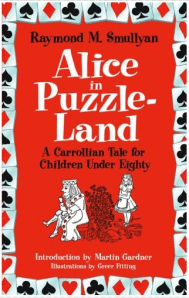
Raymond Smullyan Excerpts at Dover Publications
To celebrate their re-release of his classic puzzle books, the Dover Math and Science Newsletter featured an interview with Raymond Smullyan, as well as several extended excerpts from his books. (For my math club students: Professor Smullyan invented the Knights and Knaves puzzles.) Enjoy!
Math Teachers at Play #46: Living Books for Math
Welcome to the Math Teachers At Play blog carnival — which is not just for math teachers! Here is a smorgasbord of ideas for learning, teaching, and playing around with math from preschool to pre-college. Some articles were submitted by their authors, others were drawn from the immense backlog in my blog reader. If you like to learn new things, you are sure to find something of interest.
Living Books for Math
A child’s intercourse must always be with good books, the best that we can find… We must put into their hands the sources which we must needs use for ourselves, the best books of the best writers.
…
For the mind is capable of dealing with only one kind of food; it lives, grows and is nourished upon ideas only; mere information is to it as a meal of sawdust to the body.
Princess Kitten and I took a longer than usual holiday break from homeschooling, but now I’m in plan-for-the-new-semester mode. I hope to include more living math in our schedule, so I decided to illustrate this edition of the MTaP carnival with a few of my favorite living math books. I’d love to hear more living book suggestions in the comments!
If you click on a book cover, the links take you to Amazon.com, where you can read reviews and other details (and where I earn a small affiliate commission if you actually buy the book), but all of these books should be available through your public library or via inter-library loan.
Let the mathematical fun begin…
Continue reading Math Teachers at Play #46: Living Books for Math
2012 Mathematics Game
photo by Creativity103 via flickr
For our homeschool, January is the time to assess our progress and make a few New Semester’s Resolutions. This year, we resolve to challenge ourselves to more math puzzles. Would you like to join us? Pump up your mental muscles with the 2012 Mathematics Game!
Rules of the Game
Use the digits in the year 2012 to write mathematical expressions for the counting numbers 1 through 100.
- You must use all four digits. You may not use any other numbers.
- You may use +, -, x, ÷, sqrt (square root), ^ (raise to a power), ! (factorial), and parentheses, brackets, or other grouping symbols.
- You may use a decimal point to create numbers such as .2, .01, etc.
- You may create multi-digit numbers such as 10 or 202, but we prefer solutions that avoid them.
Bonus Rules
You may use the overhead-bar (vinculum), dots, or brackets to mark a repeating decimal.You may use multifactorials:
- n!! = a double factorial = the product of all integers from 1 to n that have the same parity (odd or even) as n.
- n!!! = a triple factorial = the product of all integers from 1 to n that are equal to n mod 3
[Note to teachers: Math Forum modified their rules to allow double factorials, but as far as I know, they do not allow repeating decimals or triple factorials.]
Giveaway: Hexa-Trex Puzzle Book
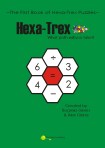
Bogusia Gierus, host of this month’s Math Teachers at Play blog carnival, is offering to give away her First Book of Hexa-Trex Puzzles for just the cost of shipping. How generous!
My math club had fun with several of these puzzles a few years ago, and the “Easy” ones (like the sample shown here) were just right for my 4th-5th grade students. One girl enjoyed them enough that she took home extra copies to share with her father.
It’s a thin book, just the right size for a stocking-stuffer. To see the full range of difficulty levels, look over the puzzles on Bogusia’s Daily Hexa-Trex page. To get your own copy of the book, read the giveaway instructions on Bogusia’s blog.
Object of the Puzzle
The object of the puzzle is to find the equation pathway that leads through ALL the tiles.
Forming Equations
- Two or three (or four or five etc.) digit numbers are made up of the individual tiles in the particular order as the equation is read. For example 5 x 5 = 2 5 is correct, but read backwards 5 2 = 5 x 5 is incorrect.
- The equation must be continuous (no jumping over tiles or empty spaces).
- Each tile can be used ONLY ONCE.
- Order of operations is followed. Multiplication and division comes before addition and subtraction.
- The tile “-” can be used as both a subtraction operation or a negative sign in front of a digit, making it a negative number.
Math Carnival Update, and an Algebra Puzzle
Oops! I misread my calendar last week. The Math Teachers at Play blog carnival will be this Friday at Maths Insider. That means you still have today and tomorrow to send in your blog post submissions using the handy submission form. See you at the carnival!
In the meantime, let me share with you this monster algebra puzzle from the Well-Trained Mind forum. Simplify:
How would you explain this problem to a beginning algebra student who has just learned the exponent rules? Or to his non-mathy mom?
And Don’t Miss…
These other mathy blog carnivals: