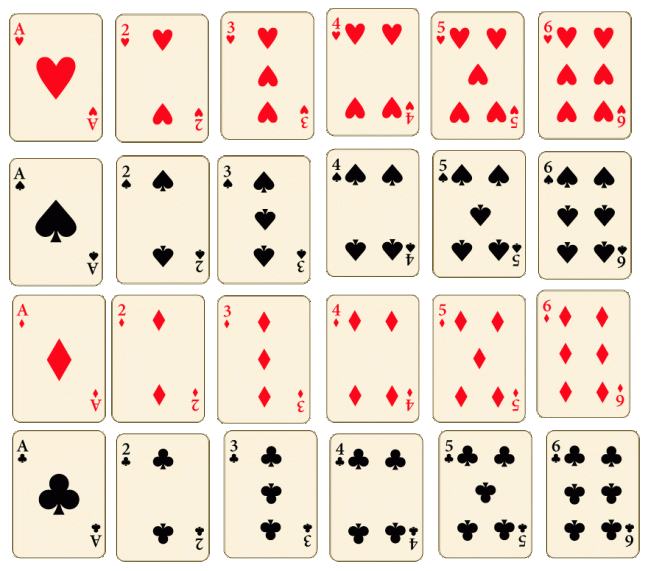
Math Concepts: addition to thirty-one, thinking ahead. Players: best for two. Equipment: one deck of math cards.
How to Play
Lay out the ace to six of each suit in a row, face-up and not overlapping, one suit above another. You will have one column of four aces, a column of four twos, and so on—six columns in all.
The first player flips a card upside down and says its number value. Then the second player turns down a card, adds it to the first player’s number, and says the sum.
Players alternate, each time turning down one card, mentally adding its value to the running total, and saying the new sum out loud. The player who exactly reaches thirty-one, or who forces the next player to go over that sum, wins the game.
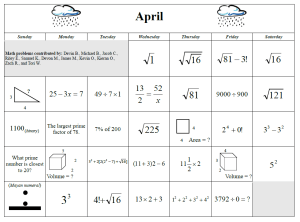
Six years ago, my homeschool co-op classes had fun creating this April calendar to hand out at our end-of-semester party. Looking at my regular calendar today, I noticed that April this year starts on Wednesday, just like it did back then. I wonder when’s the next time that will happen?
A math calendar is not as easy to read as a traditional calendar — it is more like a puzzle. The expression in each square simplifies to that day’s date, so your family can treat each day like a mini-review quiz: “Do you remember how to calculate this?”
The calendar my students made is appropriate for middle school and beyond, but you can make a math calendar with puzzles for any age or skill level. Better yet, encourage the kids to make puzzles of their own.
Did you know that playing games is one of the Top 10 Ways To Improve Your Brain Fitness? So slip into your workout clothes and pump up those mental muscles with the Annual Mathematics Year Game Extravaganza!
For many years mathematicians, scientists, engineers and others interested in math have played “year games” via e-mail. We don’t always know whether it’s possible to write all the numbers from 1 to 100 using only the digits in the current year, but it’s fun to see how many you can find.
Use the digits in the year 2015 to write mathematical expressions for the counting numbers 1 through 100. The goal is adjustable: Young children can start with looking for 1-10, middle grades with 1-25.
You must use all four digits. You may not use any other numbers.
Solutions that keep the year digits in 2-0-1-5 order are preferred, but not required.
You may use a decimal point to create numbers such as .2, .02, etc., but you cannot write 0.02 because we only have one zero in this year’s number.
You may create multi-digit numbers such as 10 or 201 or .01, but we prefer solutions that avoid them.
My Special Variations on the Rules
You MAY use the overhead-bar (vinculum), dots, or brackets to mark a repeating decimal. But students and teachers beware: you can’t submit answers with repeating decimals to Math Forum.
You MAY NOT use a double factorial, n!! = the product of all integers from 1 to n that have the same parity (odd or even) as n. Math Forum allows these, but I’ve decided I prefer my arithmetic straight.
Have you ever heard of Math Storytelling Day? On September 25, people around the world celebrate mathematics by telling stories together. The stories can be real — like my story below — or fictional like the tale of Wizard Mathys from Fantasia and his crystal ball communication system.
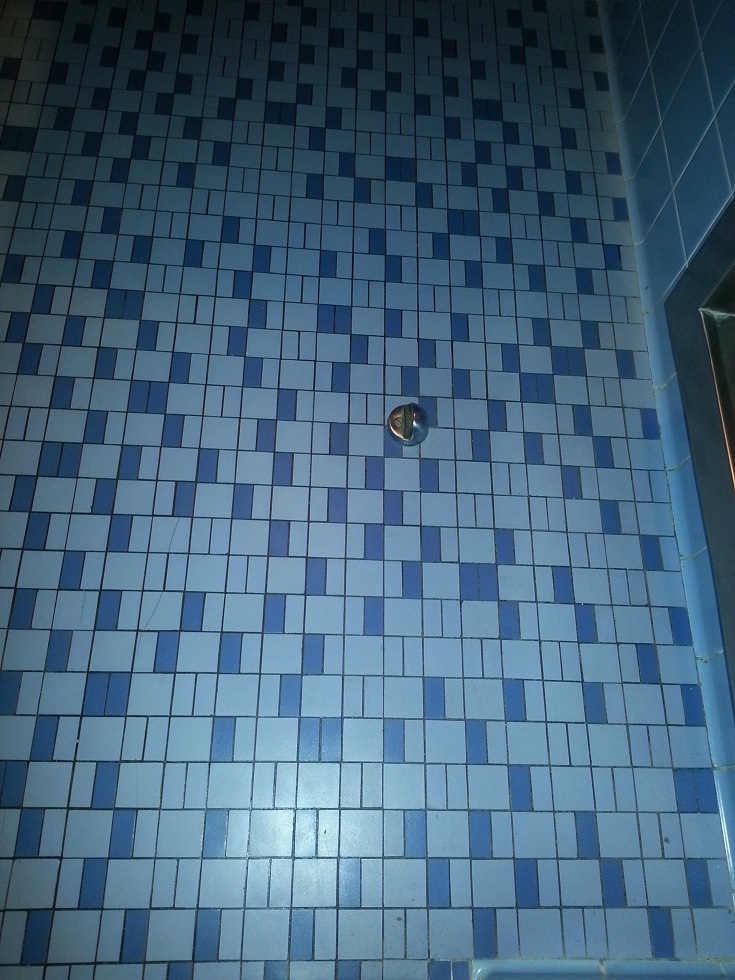
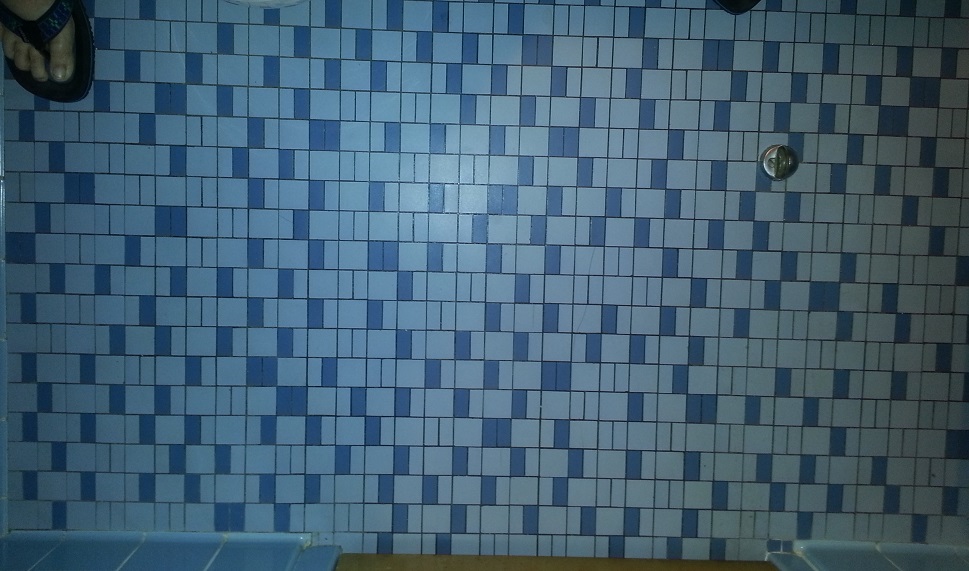
My story begins with an unexpected adventure in pain. Appendicitis sidewhacked my life last week, but that’s not the story. It’s just the setting. During my recovery, I spent a lot of time in the smaller room of my hospital suite. I noticed this semi-random pattern in the floor tile, which made me wonder:
Did they choose the pattern to keep their customers from getting bored while they were … occupied?
Is the randomness real? Or can I find a line of symmetry or a set of tiles that repeat?
If I take pictures from enough different angles, could I transfer the whole floor to graph paper for further study?
And if the nurse finds me doing this, will she send me to a different ward of the hospital? Do hospitals have psychiatric wards, or is that only in the movies?
What is the biggest chunk of squares I could “break out” from this pattern that would create the illusion of a regular, repeating tessellation?
I gave up on the graph paper idea (for now) and printed the pictures to play with. By my definition, “broken” pattern chunks need to be contiguous along the sides of the tiles, like pentominoes. Also, the edge of the chunk must be a clean break along the mortar lines. The piece can zigzag all over the place, but it isn’t allowed to come back and touch itself anywhere, even at a corner. No holes allowed.
I’m counting the plain squares as the unit and each of the smaller rectangles as a half square. So far, the biggest chunk of repeating tiles I’ve managed to break out is 283 squares.
What Math Stories Will You Tell?
Have you and your children created any mathematical stories this year? I’d love to hear them! Please share your links in the comments section below.
* * *
Are you looking for more creative ways to play math with your kids? Check out all my books, printable activities, and cool mathy merch at Denise Gaskins’ Playful Math Store. Or join my email newsletter.
This blog is reader-supported. If you’d like to help fund the blog on an ongoing basis, then please join me on Patreon (or choose the paid level on Substack) for mathy inspiration, tips, and an ever-growing archive of printable activities.
My free time lately has gone to local events and to book editing. I hope to put up a series of blog posts sometime soon, based on the Homeschool Math FAQs chapter I’m adding to the paperback version of Let’s Play Math. [And of course, I’ll update the ebook whenever I finally publish the paperback, so those of you who already bought a copy should be able to get the new version without paying extra.]
But in the meantime, as I was browsing my blog archives for an interesting “Throw-Back Thursday” post, I stumbled across this old geometry puzzle from Dave Marain over at MathNotations blog:
Is it possible that AB is a chord but NOT a diameter? That is, could circle ABC have a center that is NOT point O?
Jake shows Jack a piece of wood he cut out in the machine shop: a circular arc bounded by a chord. Jake claimed that the arc was not a semicircle. In fact, he claimed it was shorter than a semicircle, i.e., segment AB was not a diameter and arc ACB was less than 180 degrees.
Jack knew this was impossible and argued: “Don’t you see, Jake, that O must be the center of the circle and that OA, OB and OC are radii.”
Jake wasn’t buying this, since he had measured everything precisely. He argued that just because they could be radii didn’t prove they had to be.
Which boy do you agree with?
Pick one side of the debate, and try to find at least three different ways to prove your point.
If you have a student in geometry or higher math, print out the original post (but not the comments — it’s no fun when someone gives you the answer!) and see what he or she can do with it.
Dave offers many other puzzles to challenge your math students. While you are at his blog, do take some time to browse past articles.
Last week, Kitten and I reached her textbook’s chapter on graphing linear equations, and a minor mistake with negative numbers threw her into an “I can’t do it!” funk. It’s not easy teaching a perfectionist kid.
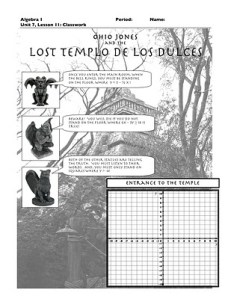
Usually her mood improves if we switch to a slightly more advanced topic, and luckily I had saved these worksheets on my desktop, waiting for just such an opportunity. Today’s lesson:
Some fun(ish) worksheets
“For tomorrow, students will be graphing systems of inequalities, so I decided to create a little Ohio Jones adventure (Indiana’s lesser known brother)…”
I offered to give her a hint, but she wanted to try it totally on her own. It took her about 40 minutes to work through the first few rooms of the Lost Templo de los Dulces and explain her solutions to me. I’m sure she’ll speed up with experience.
So far, she’s enjoying it much more than the textbook lesson. It’s fascinating to me how the mere hint of fantasy adventure can change graphing equations from boring to cool. Thanks, Dan!
Have you made a New Year’s resolution to spend more time with your family this year, and to get more exercise? Problem-solvers of all ages can pump up their (mental) muscles with the Annual Mathematics Year Game Extravaganza!
For many years mathematicians, scientists, engineers and others interested in mathematics have played “year games” via e-mail and in newsgroups. We don’t always know whether it is possible to write expressions for all the numbers from 1 to 100 using only the digits in the current year, but it is fun to try to see how many you can find.
Use the digits in the year 2014 to write mathematical expressions for the counting numbers 1 through 100. The goal is adjustable by age: Young children can start with looking for 1-10, or 1-25.
You must use all four digits. You may not use any other numbers.
Solutions that keep the year digits in 2-0-1-4 order are preferred, but not required.
You may use a decimal point to create numbers such as .2, .02, etc., but you cannot write 0.02 because we only have one zero in this year’s number.
You may use the overhead-bar (vinculum), dots, or brackets to mark a repeating decimal.
You may create multi-digit numbers such as 10 or 201 or .01, but we prefer solutions that avoid them.
You may use a double factorial, but we prefer solutions that avoid them. n!! = the product of all integers from 1 to n that have the same parity (odd or even) as n.
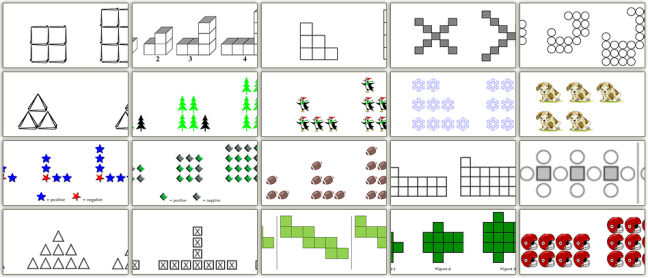
In addition to the 115 puzzle patterns (as of this writing), the site features a Gallery page of patterns submitted by students. And under the “Teachers” tab, Fawn shares a form to guide students in thinking their way through to the algebraic formula for a pattern.
How can you use these patterns to develop algebraic thinking with younger students? Mike Lawler and sons demonstrate Pattern #1 in the YouTube video below.
(30) Can you mark ten squares Sudoku-style, so that no two squares share the same row or column? Add up the numbers to get your score. Then try to find a different set of ten Sudoku-style squares. What do you notice? What do you wonder?
[Suggested by David Radcliffe.]
Share Your Ideas
Can you think of anything else we might do with a hundred chart? Add your ideas in the Comments section below, and I’ll add the best ones to our master list.