Homeschool Memories: Bill Gates Proportions II

Woman on a shopping spree to buy books

Once upon a time, when my kids and I were young…

Later the same year, not too long after our discussion of the Bill Gates proportions, I stumbled on some more data. I discovered that the median American family’s net worth was $93,100 in 2004, most of that being home equity.

This gave me another chance to play around with proportions. And since I was preparing a workshop for our regional homeschooling conference, I wrote a sample problem:

The median American family has a net worth of about $100 thousand. Bill Gates has a net worth of $56 billion. If Average Jane Homeschooler spends $100 in the vendor hall, what would be the equivalent expense for Gates?

In the last post, I explained that a proportion sets two ratios equal to each other, like equivalent fractions. Each ratio must compare similar thing to similar thing in the same order.

In this case, we are interested in the ratio “Expense compared to Net Worth.”

Continue reading Homeschool Memories: Bill Gates Proportions II

Homeschool Memories: Putting Bill Gates in Proportion

Money Bag, dollar banknotes and stacked coins on wooden table

Once upon a time…

We were getting ready for the annual homeschool co-op speech contest, and a friend emailed me for help.

“Can you help us figure out how to figure out this problem?

    “This is related to C’s speech. I think we have all the information we need, but I’m not sure:

      “The average household income in the United States is $60,000/year. And a man’s annual income is $56 billion.

        “Is there a way to figure out what this man’s value of a million dollars would be, compared to the person who earns $60,000/year? In other words, I would like to say—$1,000,000 to us is like 10 cents to Bill Gates.”

        We found out later that her son’s numbers weren’t exactly right. He hadn’t understood the difference between income and net worth, so he made Gates sound richer than reality.

        But the basic math principles never change, and it’s fun to play with big numbers.

        Continue reading Homeschool Memories: Putting Bill Gates in Proportion

        Reblog: Putting Bill Gates in Proportion

        [Feature photo above by Baluart.net.]

        Seven years ago, one of my math club students was preparing for a speech contest. His mother emailed me to check some figures, which led to a couple of blog posts on solving proportion problems.

        I hope you enjoy this “Throw-back Thursday” blast from the Let’s Play Math! blog archives:


        Putting Bill Gates in Proportion

        A friend gave me permission to turn our email discussion into an article…

        Can you help us figure out how to figure out this problem? I think we have all the information we need, but I’m not sure:

        The average household income in the United States is $60,000/year. And a man’s annual income is $56 billion. Is there a way to figure out what this man’s value of $1mil is, compared to the person who earns $60,000/year? In other words, I would like to say — $1,000,000 to us is like 10 cents to Bill Gates.

        Let the Reader Beware

        When I looked up Bill Gates at Wikipedia, I found out that $56 billion is his net worth, not his income. His salary is $966,667. Even assuming he has significant investment income, as he surely does, that is still a difference of several orders of magnitude.

        But I didn’t research the details before answering my email — and besides, it is a lot more fun to play with the really big numbers. Therefore, the following discussion will assume my friend’s data are accurate…

        [Click here to go read Putting Bill Gates in Proportion.]


        Bill Gates Proportions II

        Another look at the Bill Gates proportion… Even though I couldn’t find any data on his real income, I did discover that the median American family’s net worth was $93,100 in 2004 (most of that is home equity) and that the figure has gone up a bit since then. This gives me another chance to play around with proportions.

        So I wrote a sample problem for my Advanced Math Monsters workshop at the APACHE homeschool conference:

        The median American family has a net worth of about $100 thousand. Bill Gates has a net worth of $56 billion. If Average Jane Homeschooler spends $100 in the vendor hall, what would be the equivalent expense for Gates?

        Continue reading Reblog: Putting Bill Gates in Proportion

        Cool Fibonacci Conversion Trick

        photo by Muffet via flickr

        Maria explains how to use the Fibonacci Numbers to convert distance measurements between miles and kilometers:

        P.S.: Congratulations to Maria for her Math Mammoth program being featured in the latest edition of Cathy Duffy’s 100 Top Picks for Homeschool Curriculum! And Home School Buyer’s Co-op has a sale on Cathy Duffy’s book through the end of July.

        PUFM 1.5 Multiplication, Part 1

        Photo by Song_sing via flickr. In this Homeschooling Math with Profound Understanding (PUFM) Series, we are studying Elementary Mathematics for Teachers and applying its lessons to home education.

        My apologies to those of you who dislike conflict. This week’s topic inevitably draws us into a simmering Internet controversy.

        Thinking my way through such disputes helps me to grow as a teacher, to re-think on a deeper level concepts that I thought I understood. This is why I loved Liping Ma’s book when I first read it, and it’s why I thoroughly enjoyed Terezina Nunes and Peter Bryant’s book Children Doing Mathematics.

        repeatedaddition

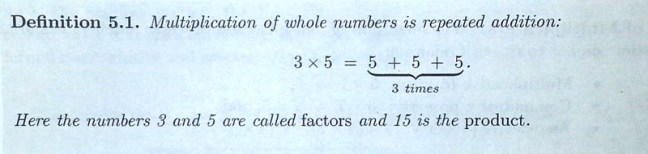
        Multiplication of whole numbers is defined as repeated addition…

        — Thomas H. Parker & Scott J. Baldridge
        Elementary Mathematics for Teachers

        Multiplication simply is not repeated addition, and telling young pupils it is inevitably leads to problems when they subsequently learn that it is not… Adding numbers tells you how many things (or parts of things) you have when you combine collections. Multiplication is useful if you want to know the result of scaling some quantity.

        — Keith Devlin
        It Ain’t No Repeated Addition

        Continue reading PUFM 1.5 Multiplication, Part 1

        Radiation Sanity Chart

        With news reports of radiation from Japan being found from California to Massachusetts — and now even in milk — math teachers need to help our students put it all in perspective.

        xkcd to the rescue!

        Pajamas Media offers a brief history of radiation, plus an analysis of our exposure in Banana Equivalent Doses:

        And the EPA offers a FAQ:

        [T]he levels being seen now are 25 times below the level that would be of concern even for infants, pregnant women or breastfeeding women, who are the most sensitive to radiation… At this time, there is no need to take extra precautions… Iodine-131 disappears relatively quickly in the environment.

        — Centers for Disease Control and Prevention (CDC)
        pages 4-5 of EPA FAQ

        [Hat tip: Why Homeschool.]

        Probability Issue: Hints and Answers

        Remember the Math Adventurer’s Rule: Figure it out for yourself! Whenever I give a problem in an Alexandria Jones story, I will try to post the answer soon afterward. But don’t peek! If I tell you the answer, you miss out on the fun of solving the puzzle. So if you haven’t worked these problems yet, go back to the original posts. If you’re stuck, read the hints. Then go back and try again. Figure them out for yourself — and then check the answers just to prove that you got them right.

        This post offers hints and answers to puzzles from these blog posts:

        Continue reading Probability Issue: Hints and Answers

        Rate Puzzle: How Fast Does She Read?


        [Photo by Arwen Abendstern.]

        If a girl and a half
        can read a book and a half
        in a day and a half,
        then how many books can one girl read in the month of June?

        Kitten reads voraciously, but she decided to skip our library’s summer reading program this year. The Border’s Double-Dog Dare Program was a lot less hassle and had a better prize: a free book! Of course, it didn’t take her all summer to finish 10 books.

        How fast does Kitten read?

        Continue reading Rate Puzzle: How Fast Does She Read?

        Hobbit Math: Elementary Problem Solving 5th Grade

        [Photo by OliBac. Visit OliBac’s photostream for more.]

        The elementary grades 1-4 laid the foundations, the basics of arithmetic: addition, subtraction, multiplication, division, and fractions. In grade 5, students are expected to master most aspects of fraction math and begin working with the rest of the Math Monsters: decimals, ratios, and percents (all of which are specialized fractions).

        Word problems grow ever more complex as well, and learning to explain (justify) multi-step solutions becomes a first step toward writing proofs.

        This installment of my elementary problem solving series is based on the Singapore Primary Mathematics, Level 5A. For your reading pleasure, I have translated the problems into the world of J.R.R. Tolkien’s classic, The Hobbit.

        UPDATE: Problems have been genericized to avoid copyright issues.

        Continue reading Hobbit Math: Elementary Problem Solving 5th Grade

        Can You Read the Flu Map?

        swine-flu-map-with-circles
        [Map as of early afternoon on May 4th, found at the NY Times.]

        Compare the dark circles (confirmed cases) for Mexico, New York and Nova Scotia in the top part, or Mexico and the U.S. in the lower part of the map. It’s easy to see which has more cases of the flu — but how many more? Which would you guess is the closest estimate:

        Mexico : New York : Nova Scotia

        • = 7:3:2 or 20:5:3 or 16:2:1?

        U.S. : Mexico

        • = 1:2 or 2:5 or 3:7?

        Continue reading Can You Read the Flu Map?